



TLDR
- Stock futures in the U.S. advanced Monday following the Dow’s third consecutive weekly loss.
- Nasdaq 100 futures climbed approximately 0.7%, S&P 500 futures increased about 0.5%, and Dow futures rose roughly 0.4%.
- Market participants are focused on Thursday’s scheduled talks between President Donald Trump and Chinese President Xi Jinping.
- Crude prices declined even as Middle East geopolitical risks persisted, and the 10-year Treasury yield held near the 5% level.
- Last week, the Federal Reserve implemented a 25 basis point rate hike, maintaining attention on monetary policy direction.
Equity futures in the United States advanced Monday morning as market participants shifted focus toward diplomatic discussions between Washington and Beijing, geopolitical developments in the Middle East, and the trajectory of monetary policy.
Futures tied to the Nasdaq 100 climbed approximately 0.7%, while S&P 500 futures increased around 0.5%. Futures linked to the Dow Jones Industrial Average added roughly 0.4%.
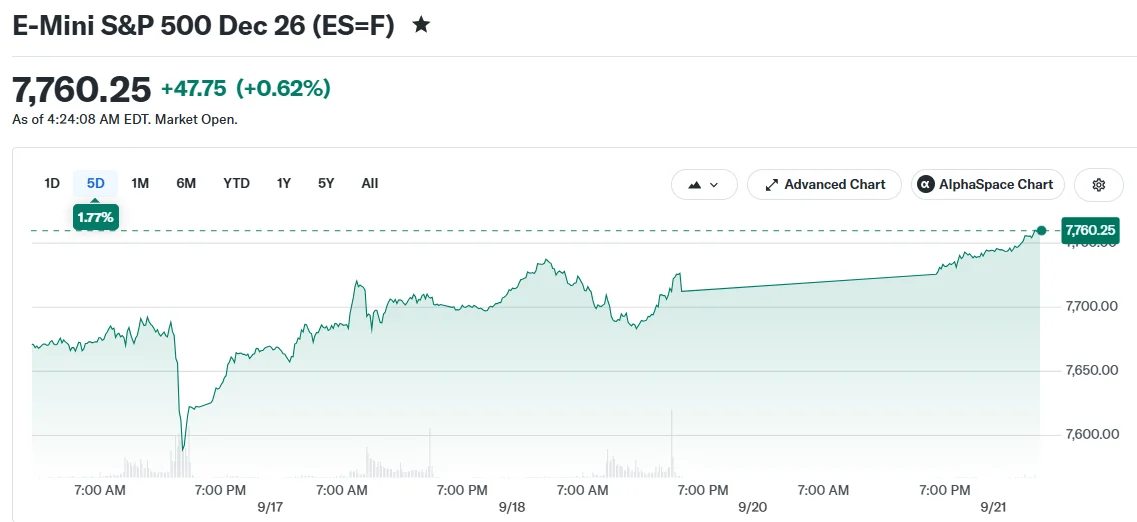
The upward movement came after a challenging period for the Dow Jones Industrial Average, which declined approximately 1.7% and notched its third straight weekly loss.
The S&P 500 edged down roughly 0.1% during the previous week, while the Nasdaq Composite managed to post a gain of about 0.7%.
U.S.-China Summit Takes Center Stage
Investors are closely monitoring Thursday’s anticipated dialogue between U.S. President Donald Trump and Chinese President Xi Jinping scheduled to take place in Washington.

China’s Foreign Ministry has verified that President Xi will conduct an official visit to the United States between September 23 and September 25.
Discussions are anticipated to cover trade relations, tariff structures, artificial intelligence cooperation, critical mineral resources, and additional economic matters. According to Reuters, prolonging the existing trade ceasefire stands as a probable central agenda item.
Treasury Secretary Scott Bessent held preliminary discussions with Chinese Vice Premier He Lifeng in New York ahead of the main summit.
The two economic leaders exchanged views on trade matters and explored the possibility of establishing an AI safety notification framework between the two nations.
Asian equity markets also registered gains Monday.
MSCI’s Asia-Pacific index excluding Japan advanced roughly 0.9%, with technology stocks in South Korea and Taiwan providing significant upward momentum.
Crude Prices Decline Despite Regional Tensions
Market observers are tracking Middle Eastern developments following weekend claims by Yemen’s Iran-aligned Houthi forces of missile and drone strikes targeting Riyadh.
Saudi Arabian and neighboring Gulf stock markets fell Sunday in response to the reported attacks.
Despite heightened geopolitical uncertainties, crude oil prices trended downward Monday.
Brent crude dropped approximately 2%, continuing recent weakness as markets evaluated reports indicating improved oil flow volumes from Gulf sources and potential restoration of Saudi production facilities.
The decline in energy prices offered some support to equity markets given that elevated fuel costs have been fueling inflation worries.
The Federal Reserve’s policy stance continues to be closely connected to inflation trends and energy price movements.
Central Bank Policy and Treasury Yields Stay in Spotlight
The Federal Reserve increased its key interest rate by 25 basis points during the previous week, bringing the target range to 3.75% to 4.00%.
This marked the central bank’s first rate hike since July 2023.
Treasury yields have remained elevated in the aftermath of the policy adjustment.
The 10-year Treasury yield has been hovering around the 5% mark, while market pricing reflects the potential for additional Fed tightening measures before year-end.
Technology stocks have demonstrated relative resilience compared to broader market indices, with semiconductor shares rebounding from earlier weekly weakness.
Monday’s futures gains extended this trend, with technology-heavy Nasdaq futures outpacing Dow futures during pre-market trading.
Investors will continue monitoring Middle Eastern geopolitical situations, remarks from Federal Reserve policymakers, and Thursday’s high-stakes Trump-Xi summit as the trading week unfolds.
Get 3 Free Stock Ebooks
Discover top-performing stocks in AI, Crypto, and Technology with expert analysis.
- Top 10 AI Stocks - Leading AI companies
- Top 10 Crypto Stocks - Blockchain leaders
- Top 10 Tech Stocks - Tech giants



