



TLDR
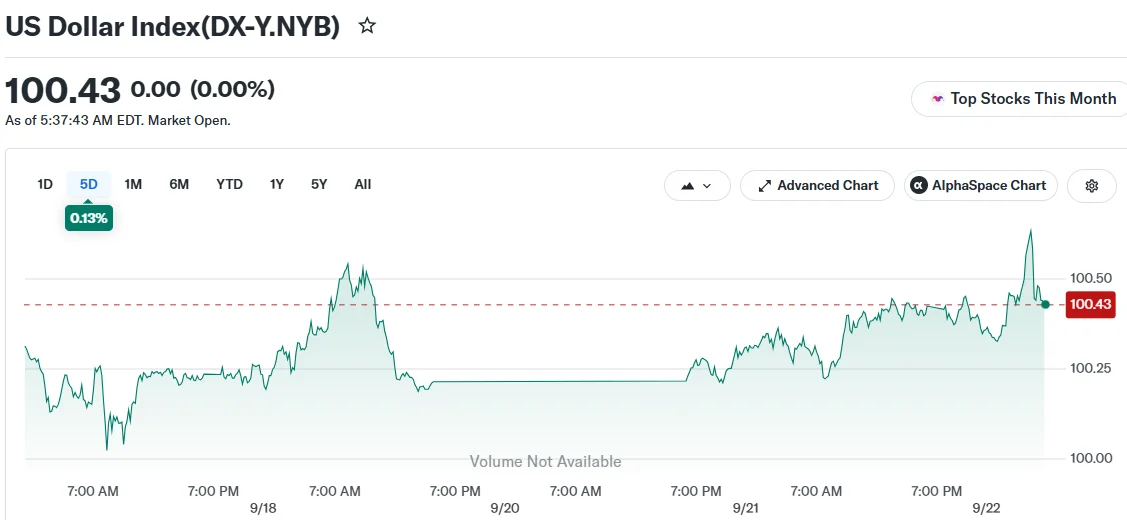
- The greenback temporarily reached a seven-week peak at 100.667 on the Dollar Index before moderating
- Crude oil markets experienced volatility following Iran’s proposal to reopen the Strait of Hormuz in one week
- Japan’s currency extended losses to a third consecutive session, touching 157.69 against the dollar
- Trading data indicates a 55% probability of an additional Federal Reserve rate increase in October
- Antipodean currencies responded to policy commentary from Australian and New Zealand central bank leaders
The American dollar advanced to its strongest level in seven weeks during Tuesday’s trading session before relinquishing a portion of those gains, as petroleum price volatility and monetary policy expectations fueled activity throughout foreign exchange markets.
The Dollar Index registered a 0.1% increase to reach 100.49, after touching a session high of 100.667. The benchmark had already posted gains exceeding 1% during the previous week following the Federal Reserve’s quarter-percentage-point rate increase and accompanying guidance suggesting additional tightening may be forthcoming.
Current market pricing suggests a 55% likelihood of an additional quarter-point rate adjustment at the Federal Reserve’s October policy meeting, based on CME FedWatch Tool data.
Petroleum market movements played a crucial role in early dollar momentum. Advancing crude prices provided support for the greenback since the United States maintains net exporter status for oil, while the currency simultaneously attracts safe-haven flows during periods of energy market turbulence.
However, the trajectory shifted after Kyodo News in Japan disclosed that Iran had presented a proposal to reopen the Strait of Hormuz within a seven-day timeframe, contingent upon the United States reducing military presence in the region.

President Donald Trump indicated receptiveness to potential face-to-face discussions with Iranian President Masoud Pezeshkian during the ongoing UN General Assembly proceedings this week.
The diplomatic prospects contributed to crude oil and European natural gas futures retreating from their multi-week elevated levels.
Japanese Currency Extends Decline as Intervention Speculation Intensifies
The yen weakened by 0.33% to settle at 157.69 versus the dollar, marking its third consecutive daily decline. This deterioration occurred notwithstanding the Bank of Japan’s 25-basis-point rate elevation to 1.25% implemented last week.
Market liquidity in Tokyo remained constrained due to prolonged public holidays, which market participants noted exacerbated price movements. The Nikkei publication disclosed that the Bank of Japan executed official “rate checks” with currency trading desks, a procedure frequently interpreted as preparation for potential direct market intervention.
Japanese monetary authorities maintain approximately $1 trillion in foreign exchange reserves, providing substantial firepower to support the currency if policymakers determine action is necessary.
The euro declined 0.1% to $1.1456, while sterling traded marginally lower at $1.3364.
Australian Dollar Stable While Kiwi Advances on Inflation Commentary
The Australian currency remained unchanged at $0.7123 following Reserve Bank of Australia Governor Michele Bullock’s appearance at a public forum. Market participants currently assign a 90% probability to a rate increase from the RBA at next week’s meeting.
The New Zealand dollar appreciated to $0.5735 after Reserve Bank of New Zealand Governor Anna Breman indicated that elevated petroleum prices would likely drive inflation projections moderately higher.
The fluctuations across Asia-Pacific currencies underscored the tight connection between monetary policy anticipation and energy price dynamics in current market conditions.
As the UN General Assembly continues and potential diplomatic engagement between Iran and the United States remains possible, foreign exchange traders are monitoring developments that could influence oil markets and subsequently affect the dollar’s trajectory.
Get 3 Free Stock Ebooks
Discover top-performing stocks in AI, Crypto, and Technology with expert analysis.
- Top 10 AI Stocks - Leading AI companies
- Top 10 Crypto Stocks - Blockchain leaders
- Top 10 Tech Stocks - Tech giants



