


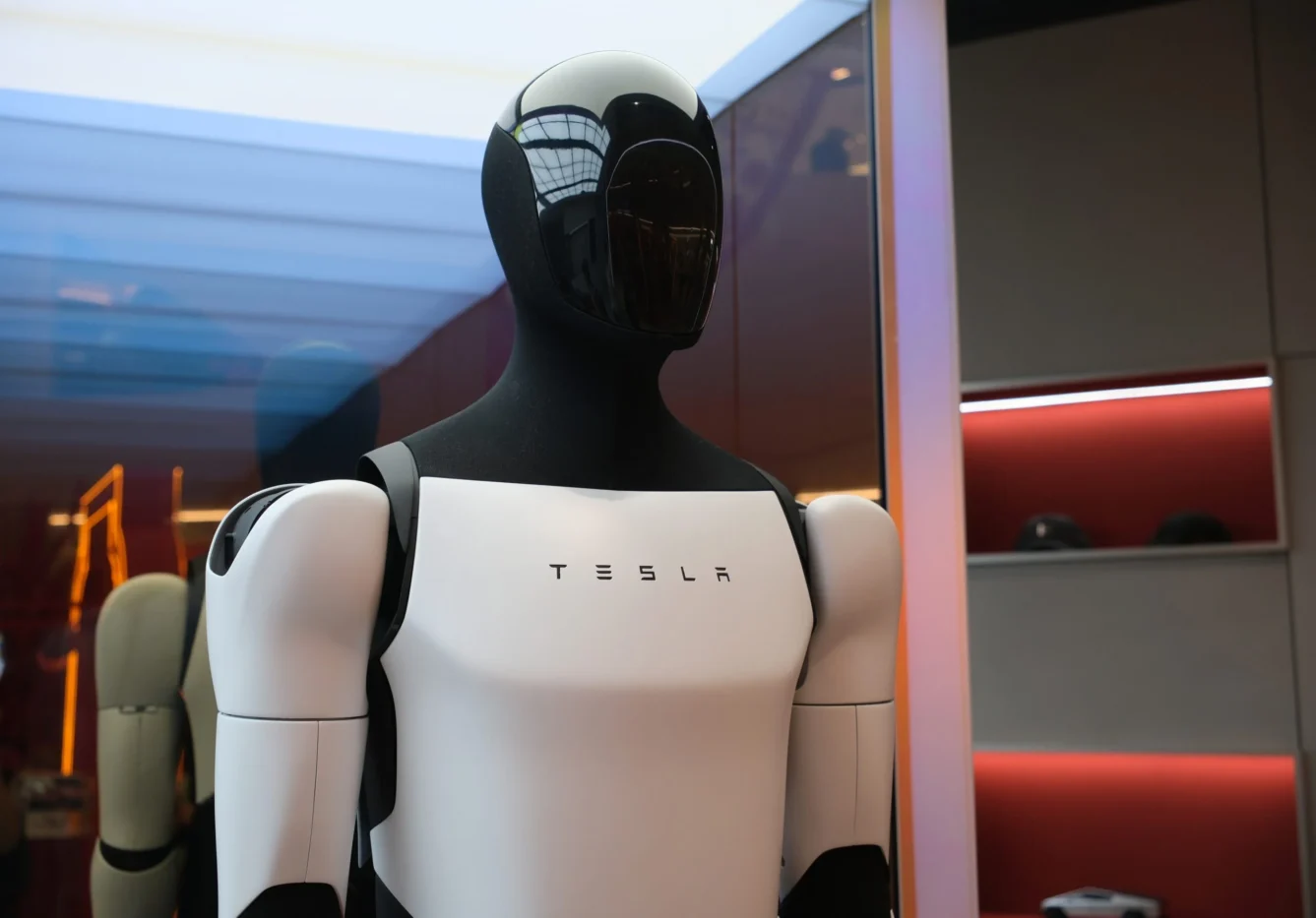
TLDR
- Tesla shares declined approximately 2% following reports of production challenges with Optimus robot hand assembly.
- According to The Information, complex hand manufacturing processes are hindering Tesla’s goal of producing 1,000 robots weekly.
- The company has increased component orders from Chinese suppliers based in Ningbo for the Optimus project.
- Initial commercial Optimus robots will be available through leasing arrangements rather than direct purchases.
- Elon Musk offered praise for Chinese President Xi Jinping ahead of a scheduled Trump-Xi summit.
Tesla (TSLA) shares experienced a roughly 2% decline on Thursday following fresh reports highlighting production challenges with the company’s Optimus humanoid robot. The stock settled around $368.81, representing an approximately $9 decrease for the trading session.
According to reporting from The Information, the robot’s hand mechanisms have emerged as the primary obstacle preventing faster production scaling. While Tesla has achieved a tenfold production increase since Q2, expanding from dozens of units weekly to several hundred, significant hurdles remain.
The electric vehicle manufacturer maintains aggressive production targets. Tesla aims to manufacture 1,000 Optimus robots per week before the year concludes, with long-term projections targeting 20,000 units weekly.
Manufacturing challenges extend beyond just supplier limitations. Automated assembly equipment malfunctions compound the difficulties. The intricate hand assembly procedures demand a degree of mechanical accuracy that’s proving difficult to achieve at industrial scale.

Capabilities of Optimus V3
Tesla’s latest iteration, Optimus V3, currently manufactured at the Fremont facility, features an improved lighter construction and enhanced camera systems compared to previous generations. The robot has undergone training utilizing over 500,000 hours of real-world operational data.
Even with extensive training, the V3 model cannot yet function as a completely autonomous general-purpose robot. Current capabilities remain restricted to designated supervised tasks within Palo Alto testing environments and manufacturing facilities.
Recognizing that this isn’t the ultimate consumer-ready product, Tesla has adopted a conservative deployment strategy. Initial commercial deployments will utilize a leasing structure instead of outright sales.
This leasing approach provides Tesla with flexibility to retrieve robots for mechanical enhancements as necessary. Additionally, it enables continuous collection of operational data from factory environments to progressively improve the artificial intelligence systems.
Musk has indicated that unrestricted commercial sales might commence by the end of 2027. Achieving this timeline hinges on first resolving the current hand manufacturing challenges.
Expansion with Chinese Manufacturing Partners
Tesla has increasingly turned to Chinese manufacturing partners to accelerate Optimus production volumes. This represents a notable departure from the company’s recent efforts to reduce Chinese sourcing for vehicles assembled in the United States.
Tesla personnel conducted site visits to Ningbo, a prominent manufacturing center on China’s eastern coastline, for supplier evaluations. These assessments emphasized production reliability and exclusivity arrangements, based on a regional report citing supply chain insiders.
Component orders for Optimus have been finalized with Ningbo-based suppliers. Concurrently, development proceeds on Tesla’s purpose-built Optimus manufacturing facility at Gigafactory Texas.
The Texas plant is projected to ultimately achieve annual production capacity of 10 million robots. However, the initial large-scale Optimus assembly operations will launch from Fremont, occupying space previously utilized for Model S and Model X production.
China continues playing a vital role in Tesla’s overall business operations. The company achieved unprecedented energy storage deployment figures in Europe, the Middle East, and Africa during the previous quarter, powered by production from Megafactory Shanghai.
Musk characterized the Shanghai facility as “a gem” during a recent interview. He additionally commended China’s manufacturing expertise as “very strong” and “inherent.”
During a conversation with Chinese state broadcaster CCTV, Musk offered direct praise for President Xi Jinping. He described Xi as someone who “seems like a great leader” and attributed visible infrastructure improvements throughout China to his leadership.
These remarks arrive as President Trump prepares for a summit meeting with Xi scheduled for this week. Musk has maintained cordial relations with Trump and accompanied him on a business delegation to Beijing in May.
Trade tensions persist despite warming rhetoric. In July, the FCC expanded its banned device registry to include foreign-manufactured robotic devices, encompassing humanoid robots, mandating elevated domestic component percentages through 2029. China’s Commerce Ministry characterized the decision as detrimental to trade stability.
Get 3 Free Stock Ebooks
Discover top-performing stocks in AI, Crypto, and Technology with expert analysis.
- Top 10 AI Stocks - Leading AI companies
- Top 10 Crypto Stocks - Blockchain leaders
- Top 10 Tech Stocks - Tech giants



