


Key Highlights
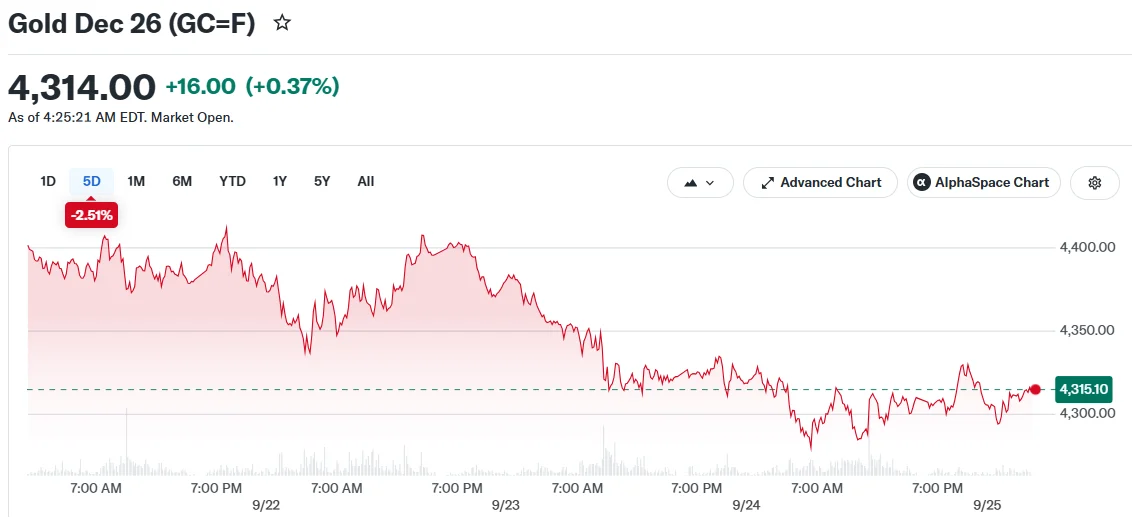
- Gold hovered around $4,271 per ounce, recording a weekly decline exceeding 2%.
- Crude oil prices remained elevated amid ongoing U.S.-Iran tensions over the Strait of Hormuz.
- The 30-year Treasury yield approached 5.5%, marking its highest point in more than twenty years.
- Market participants anticipate potential additional rate increases from the Federal Reserve following last week’s initial hike in three years.
- Silver declined approximately 4% over the week, while platinum and palladium remained relatively stable.
Gold prices drifted downward on Friday, positioning the precious metal for its weakest weekly showing in more than three months. Spot gold was trading in the vicinity of $4,271 per ounce, reflecting a decline of over 2% compared to the prior Friday’s close.
This downward movement coincides with persistently elevated energy costs. Market participants are closely monitoring whether these conditions will compel the Federal Reserve to implement additional interest rate increases.
Crude oil prices stabilized on Friday following significant gains recorded the previous day. These advances occurred as diplomatic tensions between the United States and Iran over the Strait of Hormuz reopening remained unresolved.
Hormuz Strait Tensions Keep Energy Sector Volatile
The Strait of Hormuz represents a critical chokepoint for worldwide petroleum distribution. Sources suggest negotiators are developing a staged agreement framework.
According to the proposed framework, Iran would restore access through the strategic waterway. Simultaneously, the United States would withdraw its blockade on an Iranian maritime facility.

In the absence of a finalized agreement, oil prices are anticipated to maintain elevated levels. This situation continues to exert upward pressure on inflation metrics, a primary focus for monetary authorities.
Elevated energy expenditures can decelerate the rate at which inflationary pressures subside. This dynamic complicates the Federal Reserve’s ability to pivot from its restrictive monetary approach.
The previous week witnessed the Fed implementing its first rate increase in three years. Financial markets are now assessing the likelihood of subsequent tightening measures.
Bond Yields Reach Levels Unseen in Decades
Fixed-income markets experienced substantial selling pressure on Thursday. This movement originated from inflation anxieties linked to the spike in petroleum prices.
Apprehensions regarding expanding public debt levels also contributed to bond market weakness. The 30-year Treasury bond yield climbed to approximately 5.5%.
This represents the most elevated reading for the long-dated Treasury in excess of two decades. Climbing yields generally enhance the relative attractiveness of bonds versus gold.
Since gold generates no income stream, its appeal typically diminishes when fixed-income yields advance. This dynamic has served as a primary headwind for gold valuations in recent trading sessions.
The US Dollar Index also registered modest gains on Friday. The greenback had already posted consecutive gains across five trading sessions.
Dollar strength can elevate gold’s cost for international purchasers transacting in alternative currencies. This represents an additional headwind facing the precious metal.
Notwithstanding the recent retreat, certain market participants view the correction as a short-term phenomenon. One prominent hedge fund manager highlighted enduring structural factors that continue supporting gold valuations.
Research analysts at ANZ indicated that investment appetite for gold has remained resilient. They observed an absence of significant liquidation despite challenging macroeconomic conditions.
This pattern implies investors are maintaining their gold allocations, despite recent price weakness. The metal’s immediate trajectory remains closely tied to developments in energy markets, yield movements, and Federal Reserve policy decisions.
Additional precious metals also experienced declines this week. Silver retreated roughly 4% over the period, trading in the neighborhood of $63.68 per ounce.
Platinum and palladium valuations showed minimal movement on Friday. These metals have circumvented the more pronounced volatility observed in gold and silver markets.
During Friday morning Asian trading hours in Singapore, spot gold was quoted at $4,271.54 per ounce, representing a 0.1% intraday decline. Conversely, gold futures contracts advanced 0.3% to $4,309.72, illustrating divergent signals across different gold market segments entering the weekend session.
Get 3 Free Stock Ebooks
Discover top-performing stocks in AI, Crypto, and Technology with expert analysis.
- Top 10 AI Stocks - Leading AI companies
- Top 10 Crypto Stocks - Blockchain leaders
- Top 10 Tech Stocks - Tech giants



