


Key Takeaways
- Natural gas markets in Europe stabilized near three-week lows following Iran’s indication that the Strait of Hormuz could reopen within a week.
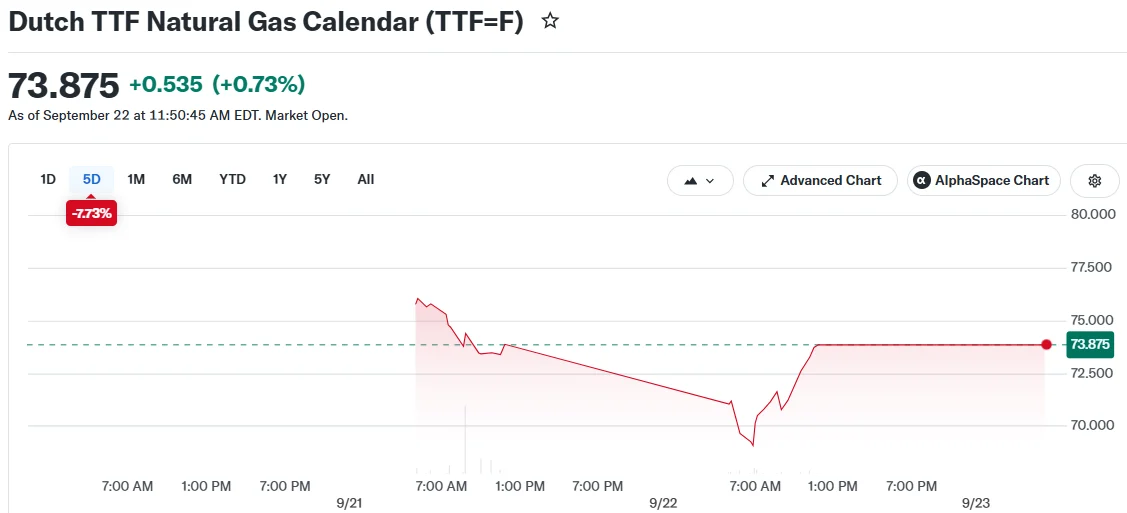
- TTF front-month contracts in the Netherlands hovered around €72.90 per MWh, with UK NBP gas maintaining positions near recent lows.
- Iran’s proposed reopening hinges on the United States reducing military operations and removing blockades from Iranian shipping ports.
- Gas inventories across Europe stand at approximately 70% capacity, creating vulnerability as winter approaches.
- Declining energy prices offer potential inflation relief, though supply uncertainty continues to pose risks.
European gas prices maintained positions near their lowest levels in three weeks on Wednesday, with market participants balancing optimism over potential Strait of Hormuz developments against concerning winter storage figures.
The Netherlands’ TTF benchmark contract for front-month delivery declined approximately 0.6% to settle around €72.90 per megawatt-hour, representing levels not witnessed since early September. Meanwhile, wholesale gas in Britain experienced modest gains while staying near its recent floor.
Middle East Developments Reduce Market Risk Premium
According to statements provided to Reuters, Iranian officials have indicated the Strait of Hormuz could resume normal operations within seven days, conditional upon the United States scaling back its military posture and removing port blockades. Tehran has confirmed that its delegation attending the United Nations General Assembly possesses the necessary authorization to engage in renewed diplomatic channels with Washington.
These diplomatic signals have prompted energy traders to pare back some of the geopolitical risk premium previously embedded in European gas valuations and international oil benchmarks. Brent crude has similarly retreated below the $100 threshold as market sentiment responds to improving outlooks for Middle Eastern energy transit.
Saudi Arabia has contributed to supply optimism by resuming operations along its East-West pipeline infrastructure following an earlier interruption. This strategic route enables crude transportation to Red Sea terminals while circumventing the Hormuz chokepoint, providing an additional avenue for supply continuity.

Nevertheless, any actual reopening of the strait remains contingent upon concrete actions. Iranian authorities have emphasized that meaningful reductions in U.S. military presence would be prerequisite, and past diplomatic initiatives have demonstrated a pattern of inconsistent progress.
Storage Deficits Threaten Winter Supply Security
While declining prices have provided some near-term market relief, European nations continue to face significant exposure as the winter heating period approaches.
Current gas storage facilities across Europe are filled to roughly 70% capacity, substantially below typical seasonal benchmarks. Recent Reuters analysis highlighted that inventories remain historically depleted while European dependence on liquefied natural gas imports has intensified.
This situation creates substantial price vulnerability should winter temperatures drop significantly or Middle Eastern supply disruptions reemerge. The restricted flow through Hormuz has already impacted certain LNG shipments, particularly affecting exports from Qatar, which ranks among the world’s dominant suppliers.
Additional constraints have emerged from Norwegian pipeline maintenance operations in recent periods, amplifying the critical importance of LNG accessibility and adequate storage reserves.
Energy Price Decline May Provide Inflation Cushion
A sustained reduction in natural gas and oil valuations would deliver favorable implications for European inflation trajectories. Energy expenditures cascade through household utility costs, industrial production expenses, and broader consumer price indices.
Such developments could also reshape expectations surrounding European monetary policy if reduced energy costs diminish inflationary pressures. Alternatively, renewed spikes in gas valuations might reinforce central bank arguments for maintaining restrictive policy stances over extended periods.
Currently, market pricing reflects heightened probability of improved Middle Eastern energy logistics. European gas maintains proximity to three-week lows, though depleted storage inventories ensure the market remains acutely sensitive to winter weather patterns and geopolitical evolution.
Get 3 Free Stock Ebooks
Discover top-performing stocks in AI, Crypto, and Technology with expert analysis.
- Top 10 AI Stocks - Leading AI companies
- Top 10 Crypto Stocks - Blockchain leaders
- Top 10 Tech Stocks - Tech giants



