


Key Takeaways
- Gas futures in Europe gained approximately 1.6% Tuesday following Monday’s sharp 7%+ decline
- Monday’s selloff followed reports of President Trump’s willingness to engage in dialogue with Iran’s President Pezeshkian during the UN General Assembly
- Initial optimism about potential U.S.-Iran diplomacy reducing Middle Eastern tensions temporarily lowered supply risk considerations
- Tuesday’s trading saw markets tempering expectations as concrete diplomatic outcomes remain uncertain
- Storage capacity issues in Germany combined with underwhelming tender activity heighten pre-winter apprehensions
European natural gas futures experienced a rebound Tuesday after recording their most significant single-session decline in approximately eight weeks during the prior trading day.
The TTF front-month Dutch contract, serving as Europe’s pricing benchmark, climbed 1.6% to approximately 78.80 euros per megawatt-hour. Britain’s NBP contract mirrored this gain, reaching levels around 195.40 pence per therm.
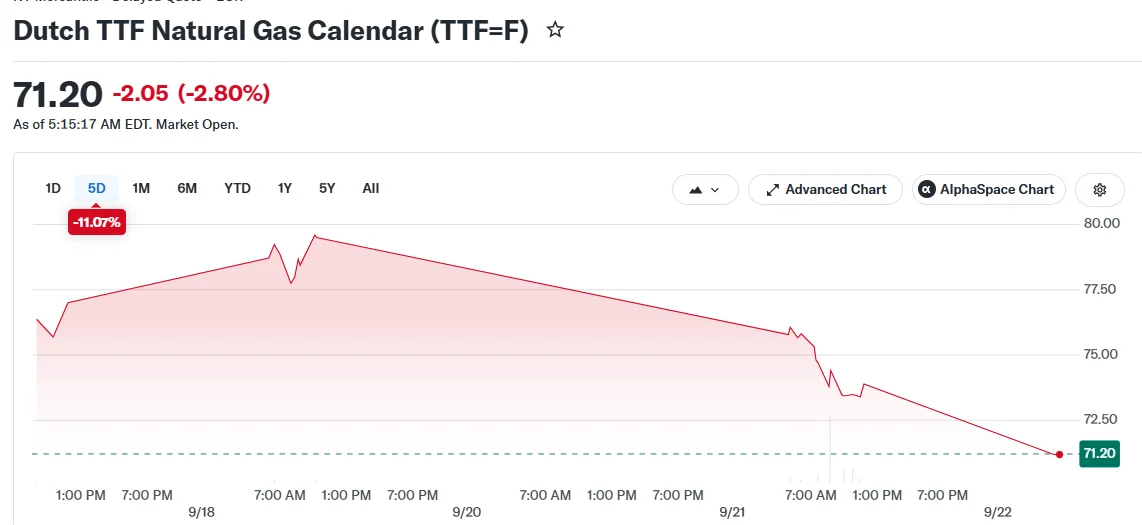
Monday’s session witnessed both contracts tumbling more than 7%. The decline represented the sharpest daily percentage loss seen in nearly eight weeks.
The dramatic price movement followed emerging reports indicating U.S. President Donald Trump expressed receptiveness to potential discussions with Iranian President Masoud Pezeshkian. The Iranian leader is currently in New York attending this week’s UN General Assembly.
These developments generated optimism that renewed diplomatic channels might facilitate resolution of the Middle Eastern conflict that has persisted for seven months. Energy markets immediately responded by reducing risk premiums associated with potential supply disruptions affecting transit through the Strait of Hormuz.

The Strait represents a critical bottleneck for worldwide energy transport. Any perceived threats to maritime passage through this waterway typically elevate energy commodity valuations.
Reality Check Tempers Initial Market Enthusiasm
When Tuesday’s trading commenced, market sentiment had shifted more cautiously. Market participants acknowledged that achieving meaningful diplomatic progress remains highly uncertain, while physical supply constraints affecting the Persian Gulf region continue.
Brent crude contracts similarly declined modestly Tuesday after surrendering 3% during Monday’s session. Industry intelligence indicates energy producers and maritime logistics operators are increasingly utilizing terrestrial pipeline infrastructure and alternative loading facilities along Oman’s coastline to circumvent Gulf transit complications.
These workaround transportation solutions are providing some relief regarding supply availability fears, contributing additional bearish momentum to pricing alongside the diplomatic narrative.
German Storage Situation Compounds Market Anxiety
Recent gas-storage procurement auctions conducted by Germany yielded lower-than-anticipated volume commitments. This development contributed some downward pricing influence.
Nevertheless, Germany’s aggregate storage capacity utilization remains unusually depleted by historical standards. This situation generates significant apprehension regarding energy availability as the winter heating demand period approaches, when consumption traditionally intensifies.
The European Central Bank has additionally raised concerns in recent analysis. Its latest Economic Bulletin highlighted that wholesale gas price increases now translate to consumer-level inflation within one to three months across more than half the eurozone member states. This transmission speed means sustained commodity price elevations could rapidly impact household costs.
Currently, market participants are adopting a cautious stance. Attention remains focused on developments from New York, where any substantive updates regarding U.S.-Iran diplomatic engagement this week could trigger significant price volatility in either direction.
Germany’s constrained storage situation continues representing a substantial vulnerability as Europe approaches the cold-weather season.
Get 3 Free Stock Ebooks
Discover top-performing stocks in AI, Crypto, and Technology with expert analysis.
- Top 10 AI Stocks - Leading AI companies
- Top 10 Crypto Stocks - Blockchain leaders
- Top 10 Tech Stocks - Tech giants



