



Key Highlights
- Continental equity indices climbed approximately 1% on Monday as declining energy costs provided relief for inflation concerns and business profitability.
- The pan-European STOXX 600 recorded its most significant single-day increase in over eight weeks.
- Germany’s benchmark DAX advanced despite Chancellor Friedrich Merz’s party experiencing its poorest regional electoral performance since 1949.
- Tech sector shares drove market momentum, with notable gains from ASML and Soitec.
- Market participants await guidance from ECB policymakers regarding whether the latest rate adjustment signals an extended monetary tightening phase.
European stocks posted substantial gains on Monday as declining energy prices enabled market participants to overlook German political upheaval and mounting interest rate apprehensions.
The benchmark STOXX 600 climbed approximately 1%, recording its most robust daily performance in over eight weeks.
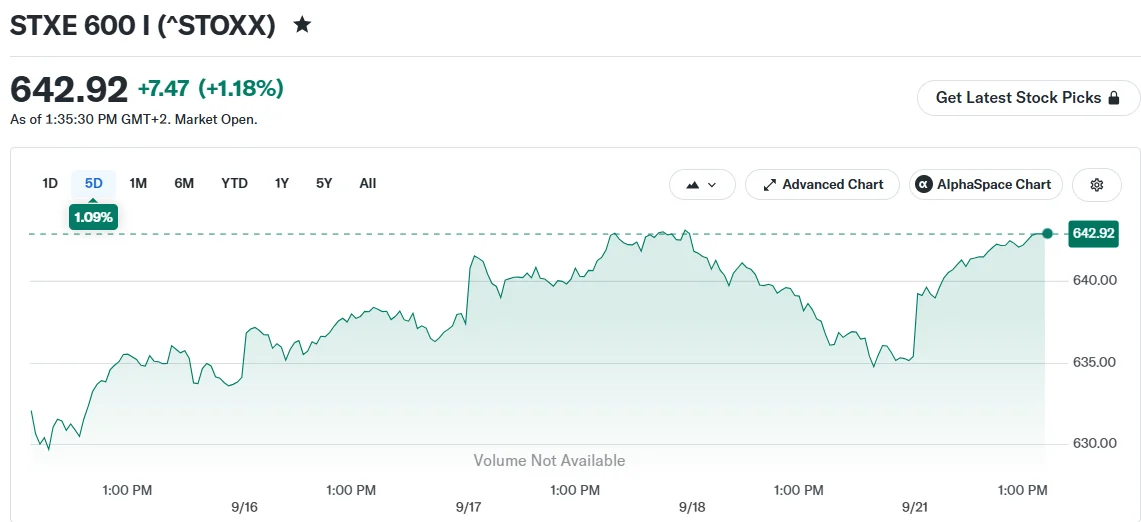
The CAC 40 in France, Italy’s FTSE MIB, and Spain’s IBEX 35 similarly advanced roughly 1%.
The FTSE 100 in London registered gains approaching 1%, though weakness in energy-related equities capped some advancement.
Energy Price Decline Provides Market Support
The primary catalyst for equity gains stemmed from continued weakness in petroleum prices.

Oil extended its losing streak to four consecutive sessions as market participants monitored potential diplomatic developments in Middle Eastern tensions.
President Donald Trump indicated potential openness to discussions with Iranian President Masoud Pezeshkian during this week’s United Nations General Assembly proceedings.
Decreasing petroleum costs can alleviate inflationary pressures while enhancing profitability for energy-dependent corporations.
This dynamic enabled European equity markets to rebound following Friday’s downturn.
The STOXX 600 had declined 0.33% during the previous week, extending its losing streak to three consecutive weeks.
Friday’s market weakness stemmed from anxiety surrounding European petroleum supplies after Saudi Aramco suspended certain allocations following infrastructure attacks on its East-West pipeline system.
DAX Advances Despite German Electoral Setback
Germany’s DAX benchmark climbed approximately 1% notwithstanding a challenging electoral outcome for Chancellor Friedrich Merz over the weekend.
Merz’s conservative political faction registered its most disappointing regional election result since 1949.
The outcome sparked uncertainty regarding governing coalition stability and capacity to implement economic reform initiatives.
Deutsche Bank research analysts noted the immediate market impact reflected less about national policy shifts than erosion of Germany’s political mainstream.
Technology sector equities helped counterbalance these political concerns.
Soitec surged over 7%, while ASML advanced approximately 4% following strength in Asian technology equities.
Novo Nordisk moved contrary to the broader market trend, declining more than 5% after presenting its extended growth outlook.
Central Bank Policy Trajectory Under Scrutiny
Market participants continue monitoring statements from European Central Bank representatives.
ECB President Christine Lagarde and Executive Board member Piero Cipollone have speaking engagements scheduled for later Monday.
Investors seek clarity on whether the ECB’s recent rate elevation to 2.50% represented an isolated response to inflation and energy challenges or signals the beginning of sustained restrictive monetary policy.
Eurozone inflation metrics continue exceeding target levels, maintaining pressure on monetary authorities.
Fixed-income markets have already adjusted to the latest policy action, and investors remain vigilant for any signals that elevated borrowing costs may persist.
Individual equity performance exhibited considerable variation.
Elixirr International experienced sharp declines following reports of decelerated organic growth.
Ayvens decreased despite elevating its 2029 return-on-tangible-equity projection.
Currently, declining petroleum prices combined with technology sector momentum continue supporting European equity markets, even as investors monitor German political developments and anticipate the ECB’s subsequent policy decisions.
Get 3 Free Stock Ebooks
Discover top-performing stocks in AI, Crypto, and Technology with expert analysis.
- Top 10 AI Stocks - Leading AI companies
- Top 10 Crypto Stocks - Blockchain leaders
- Top 10 Tech Stocks - Tech giants



