



Key Takeaways
- The Dow Jones Industrial Average dropped 0.2% on Friday, marking its third consecutive weekly decline.
- The S&P 500 climbed 0.2%, with the Nasdaq advancing 0.4% for the session.
- The benchmark 10-year Treasury yield finished the week hovering just under the 5% threshold.
- Federal Reserve policymakers implemented a 25-basis-point rate increase earlier in the week.
- Crude oil retreated below the $100 mark as chip stocks bounced back from midweek weakness.
American equities closed Friday’s session on a mixed note as market participants digested elevated borrowing costs, bond yields flirting with 5%, and ongoing inflation concerns.
The Dow Jones Industrial Average declined approximately 0.2%, settling at 51,682.64.
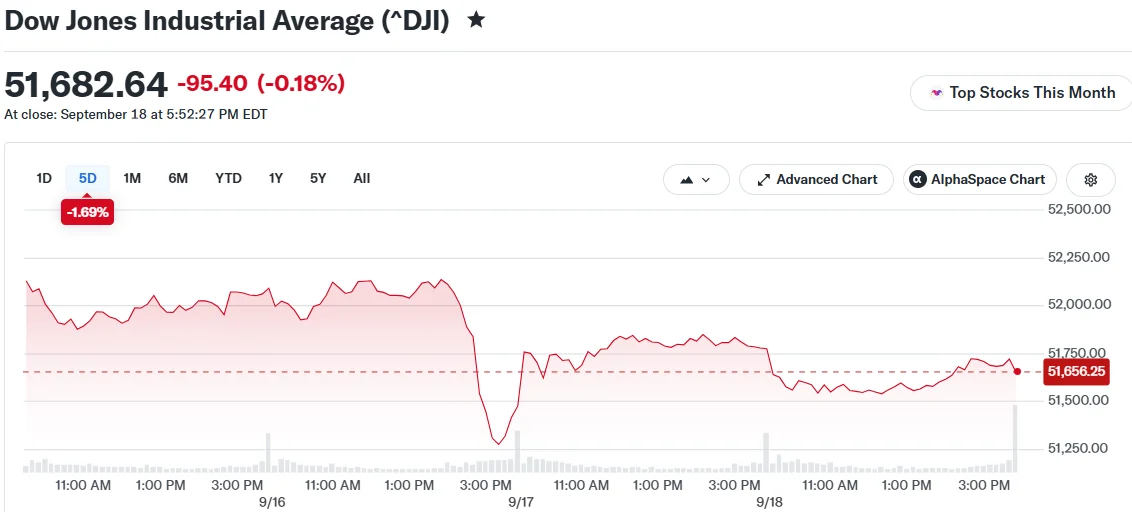
This downturn marked the blue-chip index’s third consecutive weekly loss. The week also represented the Dow’s most challenging performance since March.
The S&P 500 advanced 0.2% during Friday’s trading to settle at 7,650.50, though it registered a modest weekly decline.
The Nasdaq Composite climbed approximately 0.4%, securing a positive result for the week.

Bond Yields Climb Following Central Bank Decision
Yield movements in the bond market continued to weigh heavily on equity valuations.
The benchmark 10-year Treasury yield concluded the week at 4.995%, positioning itself just beneath the psychologically significant 5% mark.
The 2-year Treasury yield settled at 4.741%. This marked its highest closing level at 3 p.m. since July 1, 2024, based on Dow Jones Market Data.
The yield surge came after the Federal Reserve’s Wednesday announcement to lift its benchmark lending rate by 25 basis points.
This marked the central bank’s first rate elevation in three years.
Market participants are now weighing the likelihood of additional monetary tightening. According to CME FedWatch data, traders are pricing in a 47.1% chance of another quarter-point hike and a 42.4% probability of cumulative half-point increases extending through December.
Market focus remains squarely on inflationary pressures following recent energy cost spikes that have strained both household and corporate budgets.
JPMorgan Chase CEO Jamie Dimon commented to Yahoo Finance this week that uncertainty persists regarding whether inflation has been effectively contained.
Crude Retreats as Technology Sector Rebounds
Oil prices offered some market relief on Friday, sliding back beneath the $100-per-barrel threshold after previously breaching that level.
Energy trading continues to react sensitively to supply disruptions connected to the Iranian conflict and maritime traffic through the Strait of Hormuz.
Technology equities demonstrated stronger performance compared to broader market segments.
Semiconductor stocks regained ground after experiencing losses earlier in the week. The PHLX Semiconductor Index concluded the week with slight gains.
Chip manufacturers had faced selling pressure following statements from Anthropic and OpenAI advocating for a decelerated pace of artificial intelligence advancement due to safety considerations.
Morgan Stanley Wealth Management portfolio manager Daniel Skelly noted that crude oil pricing, elevated bond yields, and upcoming U.S. midterm elections could sustain near-term market turbulence.
Investors will now monitor Treasury yield movements, energy prices, and Federal Reserve policy expectations ahead of October’s central bank meeting following the Dow’s third straight weekly setback.
Get 3 Free Stock Ebooks
Discover top-performing stocks in AI, Crypto, and Technology with expert analysis.
- Top 10 AI Stocks - Leading AI companies
- Top 10 Crypto Stocks - Blockchain leaders
- Top 10 Tech Stocks - Tech giants



