



Key Takeaways
- U.S. military strikes on Iranian targets near the Strait of Hormuz sent Bitcoin tumbling beneath the $73,000 threshold
- Crypto markets experienced roughly $1 billion in liquidations within a 24-hour period, with long positions accounting for 93%
- Major altcoins suffered losses: Ethereum breached $2,000, while Solana, XRP, and Dogecoin declined 3–4%
- Equity futures retreated, with Nasdaq 100 contracts sliding 0.8%
- Snowflake stock exploded more than 30% in extended trading following impressive quarterly results and major AWS partnership
Geopolitical tensions erupted into financial market turmoil Thursday as U.S. military operations against Iranian positions sparked widespread selling across digital assets and equity futures, eliminating close to $1 billion in leveraged crypto holdings.
Digital Currency Bloodbath Led by Bitcoin
During Asian market hours, Bitcoin plummeted to an intraday low of $72,912, marking its first descent under $73,000 in several months. The leading cryptocurrency was changing hands at $72,978, representing a 24-hour decline of 3.4% and a seven-day drop of 6.3%.
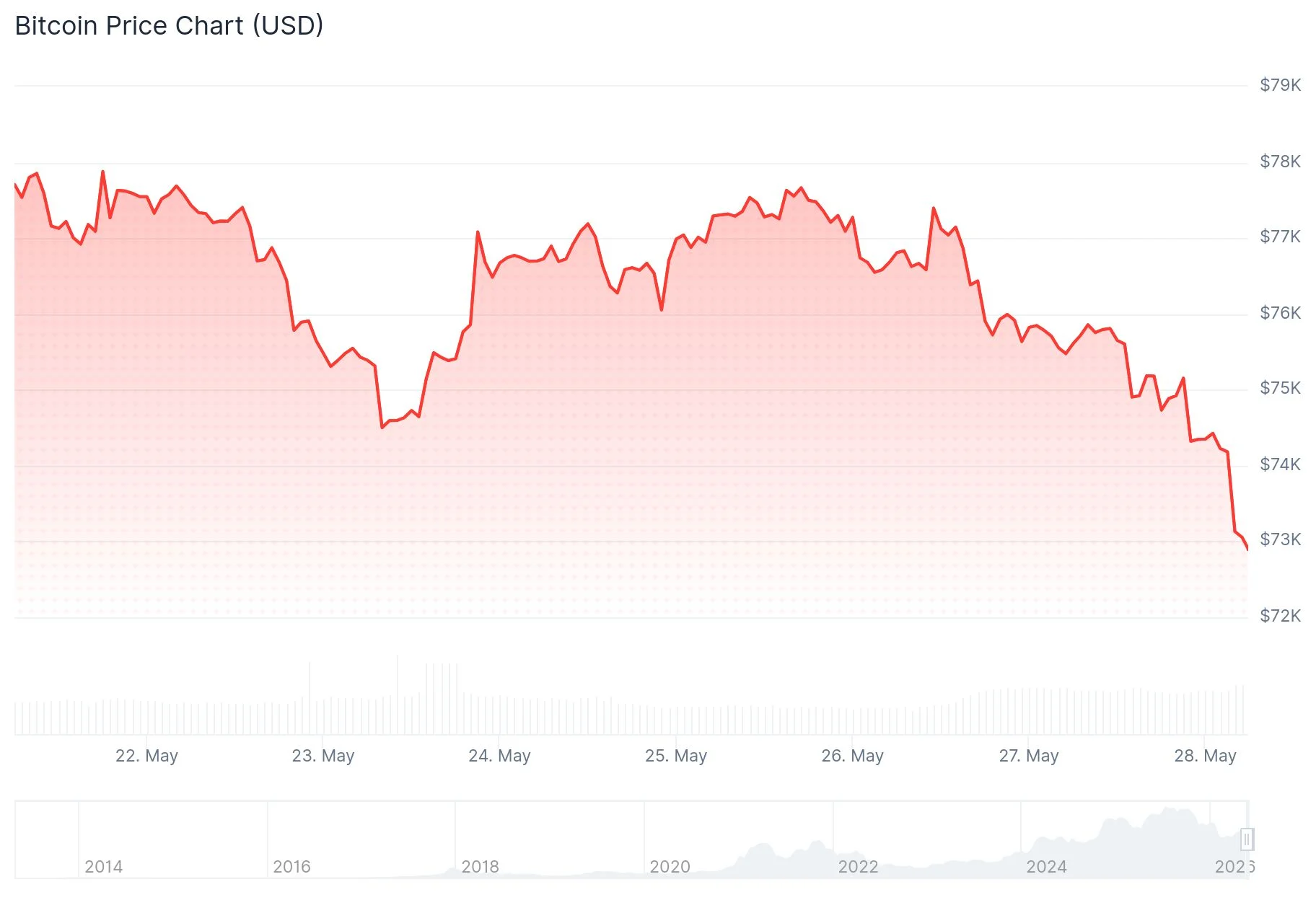
Ethereum suffered a steeper 4.2% loss, falling to $1,976 and breaking through the psychologically important $2,000 level. Other major tokens weren’t spared: Solana declined 3.5%, XRP retreated 3.6%, and Dogecoin shed 3.2%.
Among prominent cryptocurrencies, Hyperliquid stood as the sole survivor with a positive weekly performance. Despite sliding 4.5% during Thursday’s session, it maintained a 2.4% gain over the seven-day period. Tron similarly preserved modest weekly gains despite participating in the broader market downturn.
The market carnage precipitated a cascade of forced liquidations. According to CoinGlass tracking data, total liquidations reached $958.8 million spanning 167,706 individual traders within 24 hours. Long positions bore the brunt with $897 million liquidated, while short positions accounted for merely $61 million.


Bitcoin dominated liquidation volumes at $386 million. Ethereum claimed second place with $246 million. The single largest forced closure was a $15.34 million Bitcoin trade on Hyperliquid.
The overwhelming 93% concentration in long liquidations reveals traders were heavily positioned for upward movement precisely when the market reversed course dramatically.
Catalyst Behind the Market Collapse
U.S. Central Command executed precision airstrikes targeting an Iranian military installation situated near the strategically vital Strait of Hormuz. American forces simultaneously neutralized four Iranian assault drones launched toward a commercial vessel, characterizing the response as defensive measures.
The U.S. Treasury Department rolled out fresh sanctions targeting Iran’s Persian Gulf Strait Authority, alleging systematic extortion of vessels transiting the waterway. Iranian forces reportedly retaliated against the American military installation from which the strikes originated.
Kuwait confirmed it addressed missile and drone threats within its airspace, with military officials acknowledging explosions from activated air defense systems.
During a cabinet session, President Trump emphasized open access to the crucial shipping lane. “The strait’s going to be open to everybody,” he declared.
Equity futures contracted uniformly. Dow contracts declined 0.2%, S&P 500 futures shed 0.4%, and Nasdaq 100 futures retreated 0.8%. Crude oil prices advanced as the military actions heightened anxieties about commercial shipping disruptions through the strait.
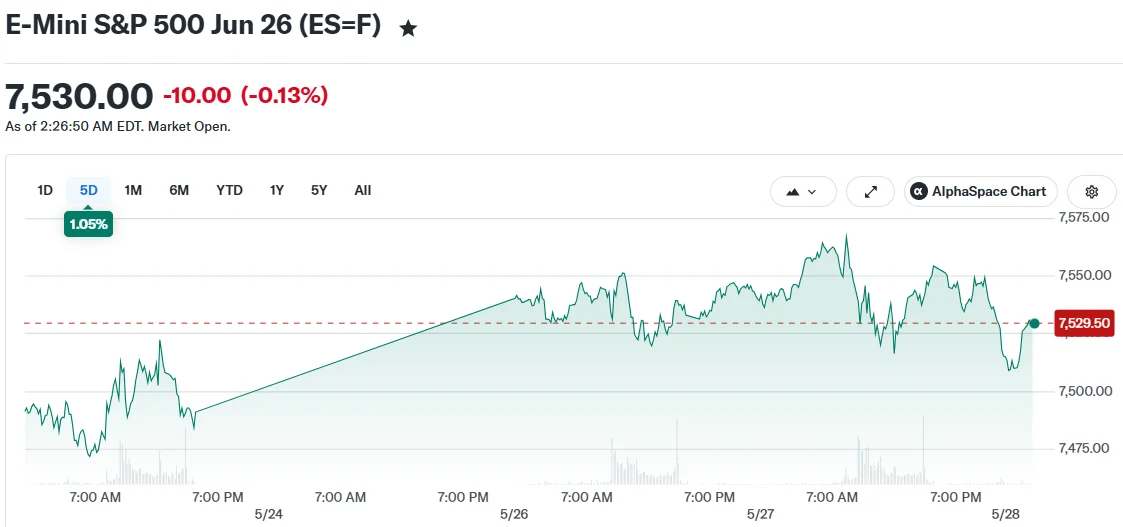
The MSCI All Country World Index surrendered 0.4% from its recent record peak, while Asian equity markets tumbled 1.7%.
Corporate Results Provide Market Bright Spots
Amid the geopolitical chaos, positive corporate developments emerged. Following regular trading, Snowflake unveiled robust quarterly performance and disclosed a $6 billion strategic agreement with Amazon Web Services. Shares rocketed over 30% in after-hours activity.
Salesforce exceeded analyst projections, though conservative forward guidance sparked concerns about artificial intelligence’s influence on enterprise software expenditures. Marvell and HP similarly delivered quarterly reports.
Market participants will focus Thursday on the Federal Reserve’s preferred inflation gauge, the Personal Consumption Expenditures index, seeking clues about potential price pressures.
Get 3 Free Stock Ebooks
Discover top-performing stocks in AI, Crypto, and Technology with expert analysis.
- Top 10 AI Stocks - Leading AI companies
- Top 10 Crypto Stocks - Blockchain leaders
- Top 10 Tech Stocks - Tech giants



