



Quick Summary
- Stock index futures for the Dow, S&P 500, and Nasdaq showed minimal movement Wednesday as investors awaited the PCE inflation data.
- The 30-year Treasury yield surged past 5.6% while the 10-year approached 5.3%, marking multidecade peaks.
- Market-implied probability of a Federal Reserve rate increase in October dropped to approximately 49% from 71% earlier this week.
- Federal Reserve Bank of New York President John Williams indicated policymakers face “no need for urgency” regarding further rate adjustments.
- Crude oil prices remained stable in the mid-$90s as the Iranian conflict entered its seventh month.
U.S. equity futures displayed minimal volatility Wednesday morning as market participants adopted a wait-and-see posture before a critical inflation reading.
Dow Jones Industrial Average futures climbed approximately 0.4%. Futures tied to the S&P 500 advanced roughly 0.2%. Nasdaq-100 contracts hovered near unchanged territory, posting gains of about 0.2%.
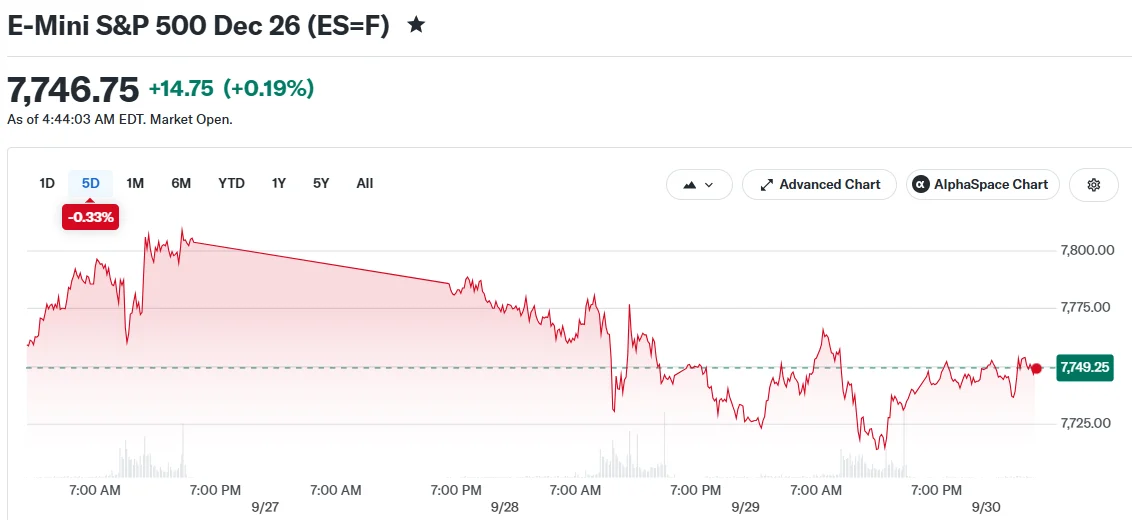
The subdued trading atmosphere followed Tuesday’s challenging session, when equities retreated as government bond yields surged to levels unseen in many years.
Treasury Yields Climb to Levels Not Seen in Decades
The yield on the 30-year Treasury bond pushed above 5.6% during Tuesday’s session, representing the highest point since June 2002.
Meanwhile, the benchmark 10-year yield advanced as well, touching a fresh high dating back to 2007 near the 5.3% threshold.

The rising yield environment weighed heavily on equity valuations. The Dow declined by more than 100 points. The S&P 500 retreated 0.2%, while the Nasdaq shed 0.1%.
Crude oil markets experienced downward pressure that same session. On Wednesday, oil futures found stability in the mid-$90-per-barrel territory.
The ongoing Iranian conflict has extended into its seventh month, maintaining elevated uncertainty across energy markets.
Interactive Brokers senior economist Jose Torres observed that equities are “trying to hang in there.” He noted that increasingly restrictive financial conditions are “emboldening the bears and lifting interest in downside hedges.”
Probability of October Rate Increase Falls Dramatically
Market participants had previously assigned high probability to another rate increase at the Federal Reserve’s October policy meeting. Those expectations have shifted significantly lower.
According to the CME Group’s FedWatch tool, the implied probability of a 25-basis-point increase next month stood at 49%, representing a steep decline from the 71% probability registered just one day prior.
New York Federal Reserve President John Williams contributed to this recalibration with remarks made Tuesday evening, stating there exists “no need for urgency” to implement additional rate increases in October.
Williams emphasized that policymakers have sufficient “time to gather more information” before reaching a decision.
Market attention now centers squarely on the Personal Consumption Expenditures price index, scheduled for release Wednesday. This metric represents the Federal Reserve’s preferred inflation measure.
Consensus forecasts from economists anticipate the core measure, which strips out volatile food and energy components, to remain unchanged at 3.3% on a year-over-year basis. A separate consensus from Dow Jones-surveyed economists projects the headline monthly increase at 0.3%, which would place the annual rate around 3.7%.
Corporate earnings also command investor attention. Micron is scheduled to release quarterly results after market close, providing insights into memory chip demand and artificial intelligence semiconductor trends.
Conagra Brands will report financial results before the opening bell.
International equity markets delivered mixed performances overnight. Japan’s Nikkei 225 index advanced 1.94%. South Korea’s Kospi index declined 0.48%.
Across Europe, the pan-regional Stoxx 600 index climbed 0.74% during morning trading hours. Britain’s FTSE 100 and Italy’s FTSE MIB both posted identical gains of 0.76%.
Wednesday represents the final trading session of both September and the third quarter. Performance across these periods has been uneven.
For September, the S&P 500 and Dow are tracking toward monthly declines. The Nasdaq has managed to post gains exceeding 1%. Examining the full quarter, both the S&P 500 and Nasdaq have advanced approximately 2%, while the Dow has retreated nearly 2%.
Get 3 Free Stock Ebooks
Discover top-performing stocks in AI, Crypto, and Technology with expert analysis.
- Top 10 AI Stocks - Leading AI companies
- Top 10 Crypto Stocks - Blockchain leaders
- Top 10 Tech Stocks - Tech giants



