



Key Highlights
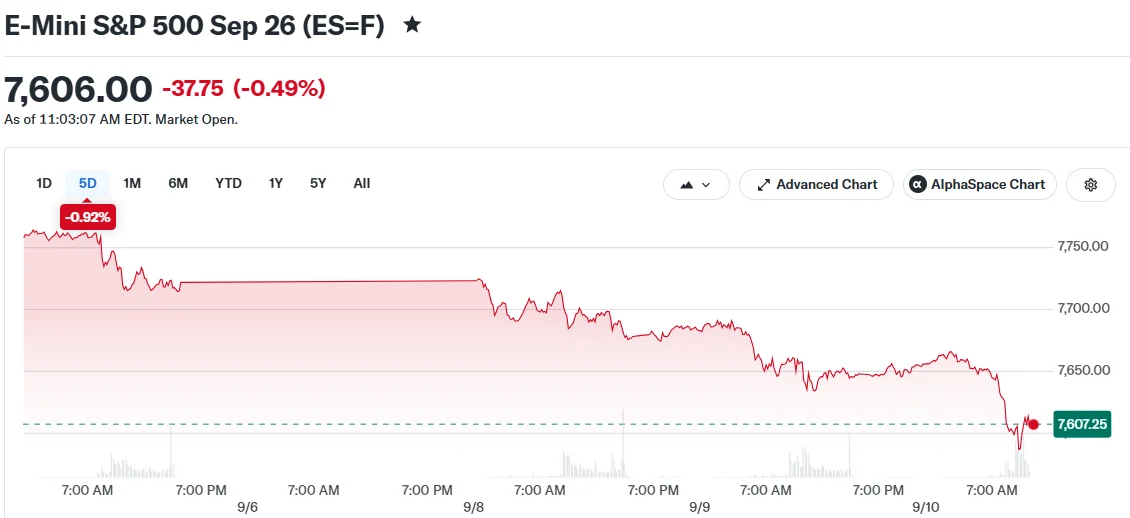
- Major US indexes extended their decline for a fourth consecutive trading day on Thursday
- Crude oil surged past the $100 mark following Iranian military action against US naval vessels in Middle Eastern waters
- The benchmark 10-year Treasury yield surged beyond 4.9%, marking its highest level in three years
- Wholesale inflation climbed 5.4% annually, while consumer price data awaits release on Friday
- President Trump suggested a $5,000 payment plan for American adults contingent on Republican congressional control
US stocks continued their downward trajectory during Thursday’s morning session, extending losses across all three primary indexes for the fourth consecutive day.
The Dow Jones Industrial Average declined 0.4%, while the S&P 500 shed 0.5%, and the Nasdaq Composite experienced a more substantial drop of 0.8% to 1%.
Energy Prices and Bond Yields Fuel Market Weakness
Energy markets have emerged as the primary catalyst behind this week’s selloff. Brent crude surged past $105 per barrel while West Texas Intermediate breached the $100 threshold after Iranian forces launched an attack on US Navy vessels operating in the Strait of Hormuz.
The escalating tensions have sparked fears of a more extensive energy crisis. Elevated oil prices typically fuel inflationary pressures, potentially forcing the Federal Reserve’s hand toward additional interest rate increases.
Thursday saw the 10-year Treasury yield break through 4.9%, establishing a fresh three-year peak. This followed Wednesday’s upward movement after the Treasury Department announced plans to purchase as much as $6 billion in longer-maturity securities.

Elevated yields increase the cost of capital and typically pressure equity valuations, with technology shares bearing the brunt of the impact.
Wholesale Price Data Meets Market Expectations
Thursday morning brought new wholesale inflation figures. The Producer Price Index registered a 5.4% annual increase, with the core measure rising 4.6%.
These numbers aligned closely with market projections. Friday will bring consumer inflation figures, providing additional insight into the trajectory of price pressures.
The European Central Bank implemented a 25 basis-point rate increase on Thursday. Market participants now broadly anticipate the Federal Reserve will implement a comparable adjustment.
President Trump indicated Wednesday that energy prices might remain elevated until after the midterm elections, now just two months away.
Additional Market Developments
Trump additionally proposed distributing $5,000 payments to every American adult should Republicans maintain congressional control. The funding mechanism for such a program remains unclear, as it would necessitate congressional authorization.
Oracle is scheduled to release quarterly results following Thursday’s market close. Investors will scrutinize the report for insights into AI-related capital expenditure and demand patterns.
Nasdaq futures had already shifted into negative territory during premarket hours before the opening bell, following the wholesale inflation data release.
All three major indexes have now recorded losses across four straight trading sessions, with no obvious near-term catalyst emerging to halt the decline.
Market participants are focused on Friday’s consumer inflation report, although analysts suggest that one data release is unlikely to alter the Fed’s trajectory while oil prices and yields continue their upward climb.
Get 3 Free Stock Ebooks
Discover top-performing stocks in AI, Crypto, and Technology with expert analysis.
- Top 10 AI Stocks - Leading AI companies
- Top 10 Crypto Stocks - Blockchain leaders
- Top 10 Tech Stocks - Tech giants



