


Key Highlights
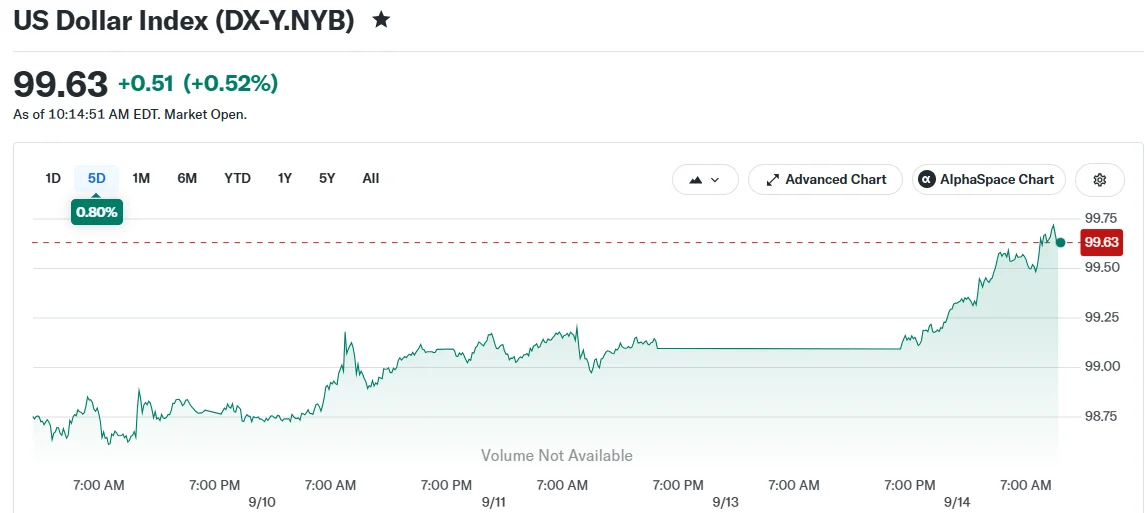
- The Dollar Index advanced 0.55% to reach 99.55, approaching its highest level in two weeks on Monday
- Trading data shows an 86% probability that the Federal Reserve will implement a 25 basis point rate increase this week
- The euro declined 0.5% to $1.1500 following the European Central Bank’s decision to raise rates to 2.50% last week
- Brent crude oil surged 3% to approximately $112 per barrel after attacks targeted Saudi Arabian pipeline facilities
- Bank of America analysts forecast lateral dollar movement through the end of the year despite current rate hike speculation
The US dollar strengthened on Monday as market participants positioned for what appears to be an almost inevitable Federal Reserve interest rate increase later this week, propelled by persistent inflation readings and a sudden spike in crude oil prices.
The Dollar Index, a benchmark measuring the greenback’s performance against a basket of six major global currencies, gained 0.55% to settle at 99.55. This upward movement reversed two consecutive weeks of minor declines.
Current market pricing indicates an 86% likelihood of a 25 basis point rate increase at the Federal Reserve’s upcoming September 15-16 policy meeting, based on CME FedWatch data.
Persistent Inflation Strengthens Case for Monetary Tightening
Last Friday’s consumer price index data maintained pressure on Federal Reserve policymakers. Headline inflation remained steady at 3.4%, while core month-over-month CPI edged higher to 0.3%.
The inflation print briefly drove the 10-year Treasury yield above the 5% threshold. Derivatives market participants are also incorporating substantial odds for an additional rate increase in December.

The euro weakened 0.5% to $1.1500, reaching its lowest point in nearly two weeks. Market participants are balancing eurozone stagflation concerns against dollar strength, particularly after the European Central Bank increased rates to 2.50% during last week’s policy meeting.
The Japanese yen retreated modestly on Monday, with the dollar appreciating 0.65% against the Japanese currency to approximately 154.55. Nevertheless, the yen maintains a 4% advance for September, remaining close to the seven-month peaks reached last week.
The Bank of Japan is broadly anticipated to increase its policy rate by 25 basis points this Friday, lifting it to 1.25%. Expectations for accelerated monetary tightening, combined with Tokyo’s unprecedented $96.4 billion currency market intervention, have driven speculators to establish net long positions on the yen for the first time since February.
Energy Market Volatility Intensifies Currency Fluctuations
Brent crude surged approximately 3% on Monday to approach $112 per barrel. Recent attacks on Saudi Arabian pipeline infrastructure and Houthi military advances in the Red Sea region have constrained Persian Gulf supply channels.
The current week presents an exceptionally active schedule for central bank observers. The Federal Reserve convenes Wednesday, the Bank of England holds its meeting Thursday, and the Bank of Japan gathers Friday.
Notwithstanding Monday’s dollar appreciation, Bank of America analysts perceive constrained potential for further gains. The financial institution anticipates the dollar will experience range-bound trading through year-end, with the exception of movements versus the yen.
BofA observed that dollar market sentiment has remained subdued since Fed Chair Warsh’s July press conference, during which markets interpreted a lack of definitive strategy for addressing inflation levels above the central bank’s target.
The dollar has additionally struggled to gain momentum despite climbing energy prices, which historically provide support for the currency. Conflicting statements from Federal Reserve officials, including more accommodative remarks from Williams and Waller, have contributed to market uncertainty.
With market pricing now reflecting more than three rate increases for the Fed, Bank of America maintains that the threshold for the Federal Reserve to exceed market expectations remains elevated.
The financial institution released its analysis on September 8, 2026, in a research report entitled “G10 FX back-to-school: dollar unloaded.”
Get 3 Free Stock Ebooks
Discover top-performing stocks in AI, Crypto, and Technology with expert analysis.
- Top 10 AI Stocks - Leading AI companies
- Top 10 Crypto Stocks - Blockchain leaders
- Top 10 Tech Stocks - Tech giants



