


Key Takeaways
- UBS predicts gold will reach $5,000 per ounce by early 2027
- The precious metal rallied 2.3% on Friday following disappointing US employment data showing a loss of 23,000 jobs in July
- Weekly gains exceeded 7%, marking the strongest performance since late January
- ETF flows and Chinese investor activity have been significant catalysts for the recent price movement
- China’s central bank has maintained a 21-month buying streak of gold reserves
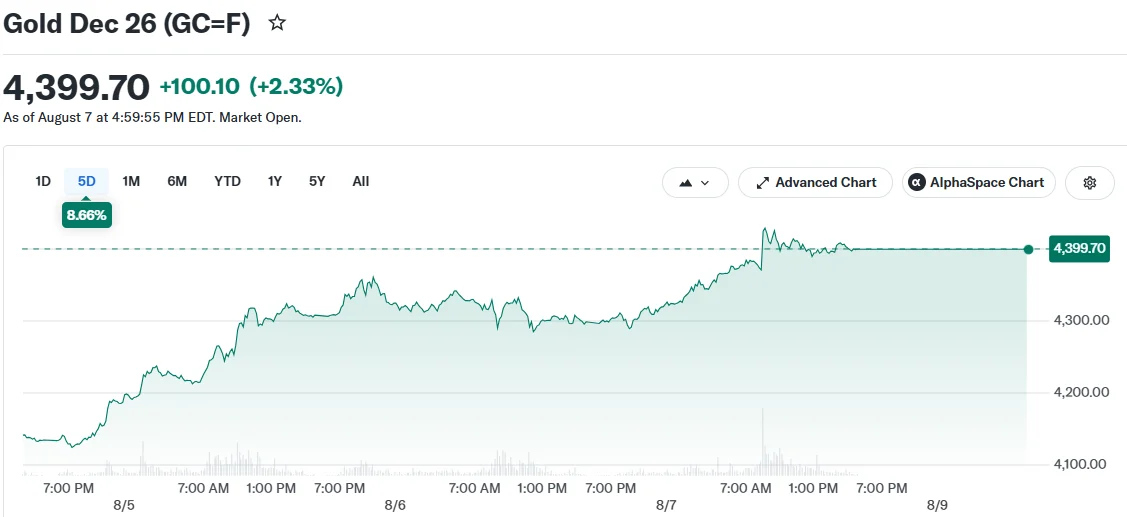
The price of gold experienced a sharp rally on Friday as disappointing US employment figures dampened market expectations for additional Federal Reserve interest rate increases. The metal advanced 2.3% to settle at $4,340.70 per ounce, marking its strongest close since mid-June.
According to the Bureau of Labor Statistics, the US economy shed 23,000 jobs during July. This figure significantly undershot analyst projections, which had anticipated a gain of 85,000 positions.
The employment report also included downward revisions to previous months’ data. June’s job creation was revised downward to 20,000 from the initially reported 57,000, while May’s numbers were adjusted to 63,000 from the original estimate of 129,000.
Market participants swiftly adjusted their expectations following the release. According to CME Group’s FedWatch tool, the likelihood of a September interest rate increase declined to 42% from 57% prior to the report’s publication.
Major Bank Projects $5,000 Milestone
Ulrike Hoffmann-Burchardi, chief investment officer at UBS, stated in a research note that gold’s current upward momentum has fundamental backing. The investment bank’s analysts project prices will climb to $5,000 per ounce during the first six months of 2027.

According to UBS, inflation is anticipated to decline gradually, enabling the Federal Reserve to maintain current interest rates through this year before implementing cuts in 2027. Declining rate expectations would diminish real yields, weaken the dollar, and stimulate investment appetite for gold.
The financial institution suggested that price pullbacks approaching $4,000 per ounce might present strategic entry points for long-term investors.
Potential headwinds identified include rising crude oil prices or markets anticipating a more hawkish Federal Reserve trajectory. Both developments could enhance the appeal of fixed-income securities and create downward pressure on gold valuations.
Central Bank Purchases and Asian Demand Drive Market
Official sector purchasing has provided consistent underlying support for gold markets. The People’s Bank of China has expanded its gold holdings for 21 straight months.
During July, the PBOC acquired 20 tons of gold, representing its largest monthly addition since October 2023, based on World Gold Council data.
Retail investors in China and capital flowing into exchange-traded funds have contributed substantially to recent price appreciation.
Silver experienced similar momentum on Friday, advancing 3.1% to $63.33 per ounce. This represented silver’s highest settlement value since late June.
Over the full week, gold climbed 7.2%, delivering its strongest weekly showing since the week concluding January 23. Silver jumped 10% for its most impressive weekly gain since late February.
Year-to-date, gold prices remain essentially unchanged, following a remarkable surge of more than 65% throughout 2025.
Attention now turns to next week’s US Consumer Price Index inflation data. Market participants are also monitoring petroleum prices closely, as diplomatic efforts between the US and Iran remain unresolved following hostilities that commenced in late February.
The SPDR Gold Shares ETF and comparable gold-focused investment vehicles experienced sustained inflows coinciding with the price rally.
Get 3 Free Stock Ebooks
Discover top-performing stocks in AI, Crypto, and Technology with expert analysis.
- Top 10 AI Stocks - Leading AI companies
- Top 10 Crypto Stocks - Blockchain leaders
- Top 10 Tech Stocks - Tech giants



