



Key Highlights
- Equity futures retreated Tuesday morning with Nasdaq 100 contracts dropping more than 1% amid heightened Middle East tensions
- Trump’s warnings regarding Oman and the Strait of Hormuz sparked a sharp rally in crude oil markets
- Brent crude futures surged to $91 per barrel while WTI climbed toward $85, marking two-week highs
- Long-dated Treasury yields advanced, with the 30-year rate reaching 5.33%, approaching levels not seen since 2006
- Technology sector weakness dominated pre-market activity, particularly among semiconductor and storage device manufacturers
Equity futures signaled a weak opening for U.S. markets Tuesday as escalating geopolitical tensions in the Middle East drove energy prices higher while government bond yields continued their upward trajectory.
Contracts tied to the Nasdaq 100 declined approximately 1.1%. Futures for the S&P 500 retreated between 0.4% and 0.6%. Dow Jones Industrial Average futures showed modest weakness, down roughly 22 to 58 points, trading near unchanged levels.
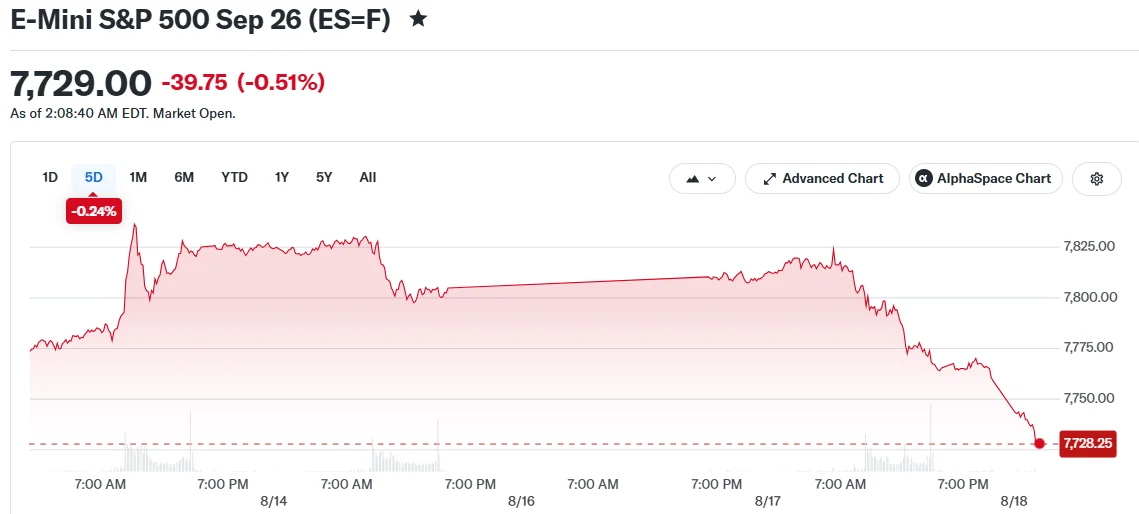
The pre-market decline extended Monday’s selloff, which saw all three primary indices finish lower after President Trump issued threats of potential military strikes against Oman should it impede U.S. operations surrounding the Strait of Hormuz.
Energy Markets Rally While Treasury Yields Climb
The president indicated intentions to intensify economic pressure on Iran and suggested bombing Oman remained an option if the nation obstructed access to the strategic waterway. The remarks triggered significant gains in crude oil markets during early Tuesday trading.
Brent crude futures advanced to $91 per barrel. West Texas Intermediate futures reached approximately $85 per barrel, registering gains of roughly 1% for the session. Both benchmarks touched their strongest levels in over two weeks.

Additional pressure emerged from news that America’s Strategic Petroleum Reserve had declined to its lowest point since 1982, further tightening supply concerns.
Government debt markets also saw yields rise. The benchmark 10-year Treasury yield touched 4.72%. The 30-year yield climbed to a range of 5.31% to 5.33%, approaching its highest level in approximately 19 years.
According to Deutsche Bank macro strategist Henry Allen, market participants grew increasingly pessimistic about prospects for reopening the Strait of Hormuz in the near term, applying downward pressure on longer-duration sovereign debt instruments.
Technology Sector Faces Headwinds
Semiconductor and data storage companies, which had provided some support during Monday’s session, emerged as the most significant underperformers in Tuesday’s pre-market trading.
Sandisk, Coherent, Western Digital, and Seagate ranked among the weakest performers within the S&P 500 during pre-market hours.
Market participants had accumulated positions in chip-related equities throughout recent weeks, though those advances faced challenges from climbing yields and heightened geopolitical uncertainty.
In positive developments, Home Depot shares gained approximately 1% in pre-market trading following the retailer’s report of stronger-than-expected second quarter sales performance. Management noted consumers gravitated toward smaller-scale home improvement projects during summer months, contributing to favorable results.
Toll Brothers and Klarna are scheduled to release quarterly results later Tuesday.
Bond yields have advanced across global markets, propelled by a confluence of factors including elevated energy prices, increased borrowing related to artificial intelligence infrastructure investments, and ongoing concerns regarding sovereign debt burdens.
Financial markets remain unsettled as diplomatic negotiations between the United States and Iran show minimal progress, maintaining pressure across equity, commodity, and fixed income markets heading into Tuesday’s regular trading session.
Get 3 Free Stock Ebooks
Discover top-performing stocks in AI, Crypto, and Technology with expert analysis.
- Top 10 AI Stocks - Leading AI companies
- Top 10 Crypto Stocks - Blockchain leaders
- Top 10 Tech Stocks - Tech giants



