


Key Highlights
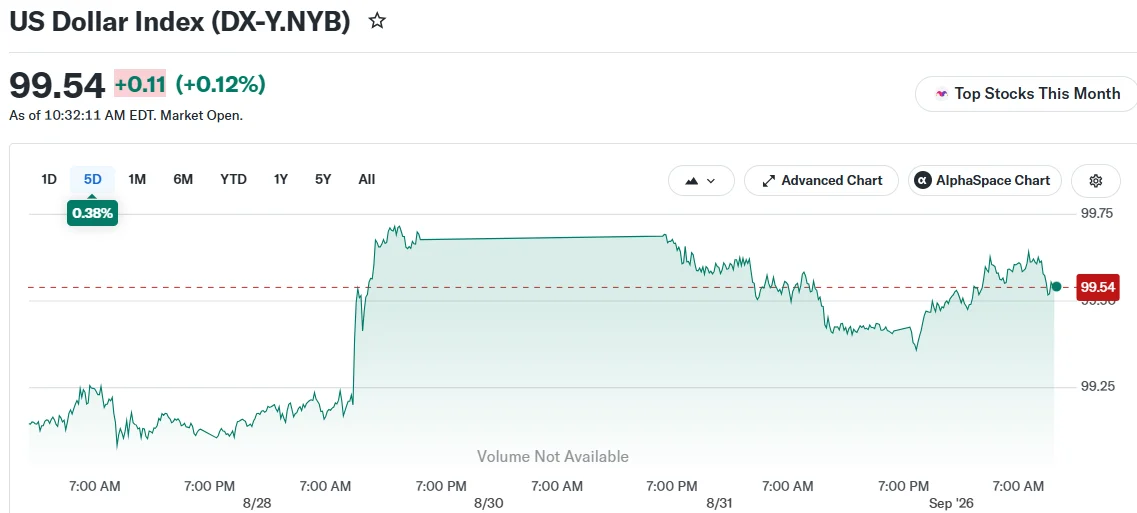
- The Dollar Spot Index climbed 0.2% to reach 99.61, maintaining levels near a two-week peak
- July’s job openings remained steady at 7.3 million, indicating continued labor market strength
- Traders now assign a 74% probability to a Fed rate increase on September 17
- The euro declined 0.20% to $1.1592 following Eurozone core inflation cooling to 2.4%
- The Japanese yen ticked higher but remained near 159.85, hovering close to the key 160 threshold
The U.S. dollar maintained its position near a two-week peak on Tuesday following the release of employment data that reinforced market expectations for a Federal Reserve interest rate increase.
The Dollar Spot Index advanced 0.2% to settle at 99.61, extending the momentum from the previous week when Fed Chair Kevin Warsh adopted a more aggressive stance during his Jackson Hole symposium address.
Employment Report Bolsters Greenback
According to the July JOLTS release, U.S. job openings remained essentially unchanged at 7.3 million positions. The vacancy rate stayed constant at 4.4%, though hiring activity decreased to 5.1 million from the prior month’s 5.3 million.
Voluntary separations also held firm at 3.1 million, suggesting workers maintain sufficient confidence to change employment. This indicates the labor market hasn’t experienced the softening many analysts anticipated.
During the Jackson Hole conference, Warsh emphasized the Fed’s continued commitment to achieving its 2% inflation objective. With core PCE inflation currently at 3.3%, the central bank clearly has additional tightening to consider.

Financial markets now assess a 74% likelihood of a 25 basis point rate increase at the Federal Reserve’s September 17 policy meeting. This represents a substantial jump from the mere 34% probability priced in before Warsh’s remarks.
The benchmark 10-year Treasury yield climbed 3 basis points to 4.80%, marking its highest level since January 2025. Increasing yields support the dollar by expanding the interest rate differential with foreign currencies.
European and Japanese Currencies Face Headwinds
The euro slipped 0.20% to trade at $1.1592. Eurozone headline inflation accelerated to 3.3% year-over-year in August, rising from July’s 2.9%. However, core CPI, which excludes volatile energy and food components, moderated to 2.4% from 2.5%.
This divergence creates a challenging scenario for the European Central Bank as it approaches its September policy decision. The declining core inflation figure may restrict the ECB’s ability to follow the Fed’s tightening trajectory.
The Japanese yen gained 0.10% to 159.85 against the dollar, remaining just beneath the 160 threshold that has historically prompted official currency market intervention.
During the G20 gathering in Asheville, U.S. Treasury Secretary Scott Bessent urged Bank of Japan Governor Kazuo Ueda to implement interest rate increases. He indicated possessing “information that the market doesn’t have” regarding Japanese currency stabilization measures.
Market Attention Shifts to Incoming Economic Reports
Derivative markets now reflect nearly 88% odds of a Bank of Japan rate hike during its September 17-18 policy gathering. The 10-year Japanese government bond yield jumped 5 basis points to 3.00%, reaching its highest point in three decades.
Crude oil prices stabilized around $91.10 per barrel, influenced by recent U.S.-Iran military tensions, introducing additional uncertainty to global financial markets.
The ADP private sector employment report is scheduled for release Wednesday, with the comprehensive August Nonfarm Payrolls data arriving Friday. U.S. August CPI figures, expected next week, will represent the final significant inflation reading before the Fed’s policy determination.
An inflation print exceeding expectations could drive September rate hike probabilities even higher and provide additional momentum to the dollar’s recent advance.
Get 3 Free Stock Ebooks
Discover top-performing stocks in AI, Crypto, and Technology with expert analysis.
- Top 10 AI Stocks - Leading AI companies
- Top 10 Crypto Stocks - Blockchain leaders
- Top 10 Tech Stocks - Tech giants



