



Key Takeaways
- The 10-year Treasury yield surged past 5.041%, marking its highest level in 16 years
- Fed rate hike probability stands at over 92% for a 25 basis point increase this week
- Persistent inflation well above the Federal Reserve’s 2% target continues to fuel rate expectations
- Elevated oil prices show strong correlation with Treasury yields, creating additional upward momentum
- S&P 500 futures dropped 0.3% following the yield surge
On Tuesday, the 10-year Treasury yield surged past a critical 5% milestone, reaching heights not witnessed since 2007 as investors prepare for an anticipated Federal Reserve interest rate increase.
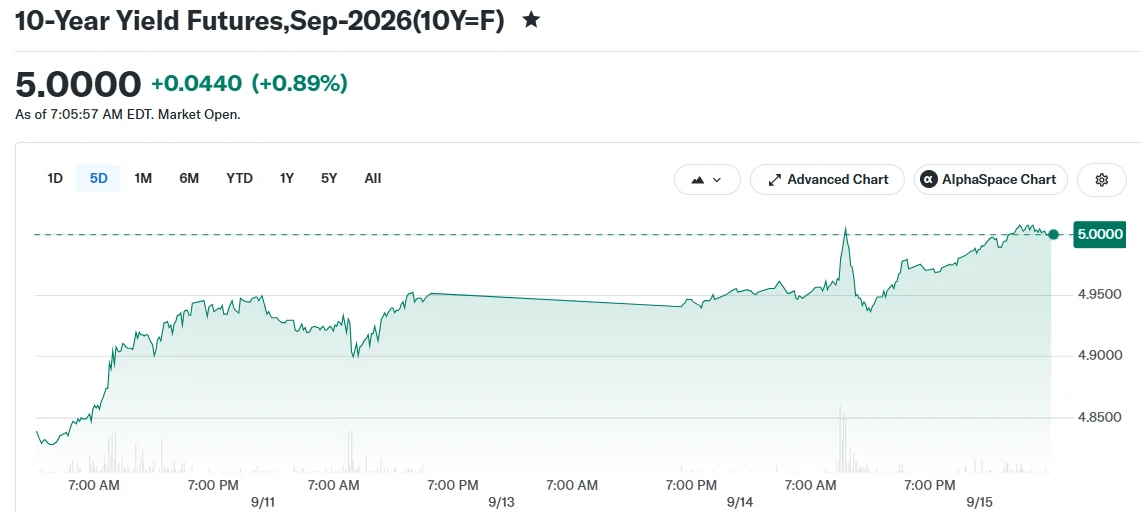
During intraday trading, the yield peaked at 5.041% before moderating to approximately 5.014% in the morning session. Meanwhile, the 30-year Treasury bond yield advanced to 5.381%, and the 2-year note climbed to 4.663%.
Market participants are currently assigning a greater than 92% probability to a 25 basis point rate increase by the Federal Reserve during its two-day policy session that commenced Tuesday, based on data from the CME FedWatch tool.
The primary catalyst remains stubborn inflation. Data from August revealed price levels continuing to exceed the Federal Reserve’s 2% yearly target by a significant margin, providing justification for continued monetary tightening.
Questions surrounding America’s fiscal stability are contributing as well. An expanding federal deficit combined with mounting debt obligations have prompted certain investors to seek higher returns as compensation for purchasing U.S. government bonds.

Rising Crude Prices Intensify Pressure
An additional complicating factor is the strengthening relationship between crude oil valuations and Treasury yields. According to BMO Capital Markets, the one-month rolling correlation between West Texas Intermediate crude and the 10-year yield has climbed to 0.96.
Steve Sosnick, chief strategist at Interactive Brokers, noted that the connection between oil markets and inflation forecasts is exceptionally strong at present. He emphasized that sustained elevated oil prices will maintain pressure on interest rates.
Jonathan Liang, serving as Standard Chartered’s CIO of fixed income and FX, indicated that the correlation between inflation expectations and Treasury yields will likely remain robust as long as inflation persists above the Fed’s established target.
Equity Markets Under Pressure
The 5% threshold on the 10-year yield represents a significant psychological benchmark for financial markets. With bonds now offering more attractive risk-adjusted returns, investors may redirect capital away from equities.
This dynamic manifested immediately. Following the yield spike, S&P 500 futures declined 0.3% during early Tuesday trading.
Equity markets were already experiencing stress prior to this week. Elevated yields increase corporate borrowing costs and diminish the relative attractiveness of stocks when fixed-income securities provide competitive returns.
Bond yields and prices maintain an inverse relationship. As yields climb, the value of existing bonds decreases, compelling investors to seek higher returns on newly issued debt.
The Federal Reserve’s policy meeting concludes Wednesday, with a rate announcement anticipated. Market observers will scrutinize any guidance regarding potential future rate adjustments beyond the current session.
The 10-year yield reaching these elevated levels represents the highest point for this benchmark rate in more than 16 years, creating ripple effects throughout both fixed-income and equity markets.
Get 3 Free Stock Ebooks
Discover top-performing stocks in AI, Crypto, and Technology with expert analysis.
- Top 10 AI Stocks - Leading AI companies
- Top 10 Crypto Stocks - Blockchain leaders
- Top 10 Tech Stocks - Tech giants



