



Quick Summary
- Equity futures for major indices declined during Wednesday’s premarket session
- Brent crude surged past $95 following escalating tensions after Trump’s warning to Iran
- Treasury yields continued climbing with the 10-year reaching 4.79% and 30-year touching 5.27%
- Trade friction between Washington and Ottawa persists without resolution in sight
- Market participants await quarterly results from Broadcom and Snowflake later Wednesday
Equity index futures pointed lower Wednesday morning as surging crude prices and climbing Treasury yields created headwinds for markets entering the final trading days before September.
Futures tied to the Dow Jones Industrial Average declined approximately 0.2%, while S&P 500 contracts retreated 0.3%. Nasdaq-100 futures bore the brunt of selling pressure, sliding 0.6%. The weakness followed Tuesday’s session that saw the Nasdaq lose 1%.
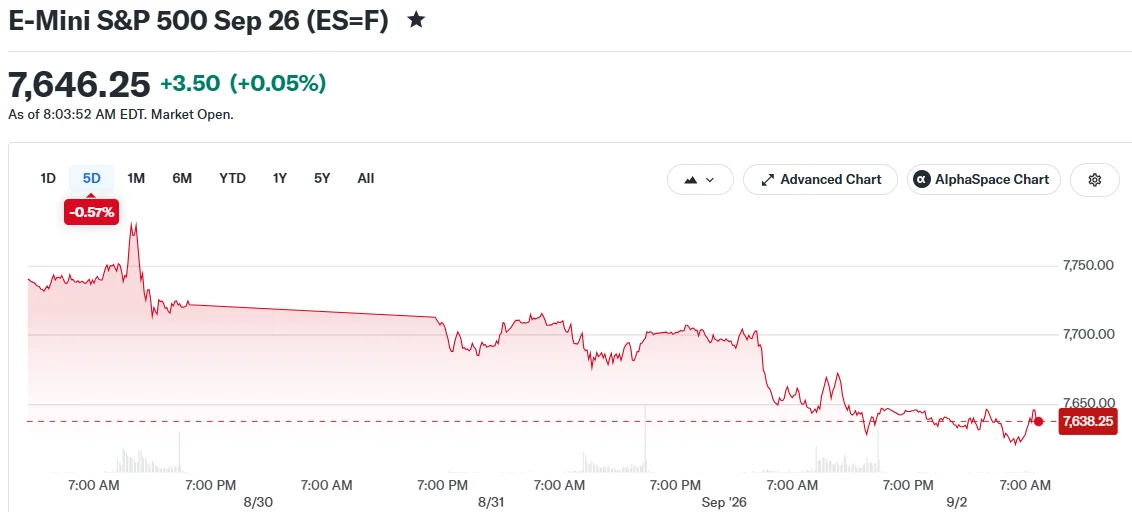
Middle East Conflict Drives Energy Prices and Yields Upward
Brent crude pushed beyond $95 a barrel after President Trump warned of intensified military action against Iran in response to Tuesday’s American airstrikes. The escalating rhetoric lifted energy markets and compounded existing inflation concerns among market participants.
Elevated oil prices contribute to inflation expectations, which subsequently pressure Treasury yields higher. Tuesday saw the benchmark 10-year Treasury yield climb to 4.79%, while the 30-year bond reached 5.27%.
Climbing yields present challenges for equity markets by increasing capital costs for corporations and households. They simultaneously enhance the relative appeal of fixed-income securities versus stocks.

“Stocks and bond prices can go down together during environments where rates are rising at a fast pace,” said Michael Landsberg, CIO at Landsberg Bennett Private Wealth Management.
Landsberg noted that while bonds typically serve as a hedge against equity volatility, this inverse relationship deteriorates during periods of rapid rate increases.
Positive quarterly results from Dell released after Tuesday’s market close failed to boost investor confidence. The bond market’s movements dominated attention and overshadowed corporate earnings.
Trade Dispute with Canada Remains Unresolved
Cross-border trade friction with Canada remained a focal point. Canadian Prime Minister Mark Carney indicated negotiations could restart once Washington ceases “throwing shade” and demonstrates genuine commitment to discussions.
Treasury Secretary Scott Bessent countered by denying the existence of a trade war between the nations. The ongoing verbal sparring contributed to broader market uncertainty.
Wednesday’s economic calendar features ADP’s private employment report, offering investors an early glimpse into Friday’s comprehensive monthly jobs data.
Recent labor market indicators suggest stagnant job openings, and upcoming employment figures could influence market expectations regarding Federal Reserve monetary policy direction.
After Wednesday’s closing bell, market participants will scrutinize quarterly earnings from Broadcom and Snowflake. Both technology companies face heightened attention given the recent pressure on tech equities from ascending yields.
The technology-heavy Nasdaq has experienced the steepest declines among major benchmarks this week. Technology sector valuations prove especially vulnerable to rate increases due to their reliance on discounted future earnings projections.
Early Wednesday trading showed E-Mini Dow futures hovering near $52,937, while E-Mini Nasdaq-100 futures traded around $29,068.
The remainder of the week promises significant market-moving events with employment data releases and critical earnings announcements approaching.
Get 3 Free Stock Ebooks
Discover top-performing stocks in AI, Crypto, and Technology with expert analysis.
- Top 10 AI Stocks - Leading AI companies
- Top 10 Crypto Stocks - Blockchain leaders
- Top 10 Tech Stocks - Tech giants



