



TLDR
- Major index futures posted gains Friday morning ahead of the September employment report release.
- Forecasts call for 85,000 to 89,500 new positions added last month, a decline from August’s figures.
- Markets assign a 74% probability that the Federal Reserve will maintain current rates at its October 28 policy meeting.
- Energy markets saw declines, with Brent crude sliding to approximately $99 per barrel.
- The ongoing Middle East war, entering its eighth month, continues exerting upward pressure on consumer prices.
U.S. stock futures advanced Friday morning as market participants positioned themselves ahead of employment data that may influence the Federal Reserve’s upcoming monetary policy decision.
S&P 500 contracts increased 0.4%. Nasdaq 100 futures climbed nearly 0.6%. Dow Jones Industrial Average futures advanced approximately 209 points, or roughly 0.4%.
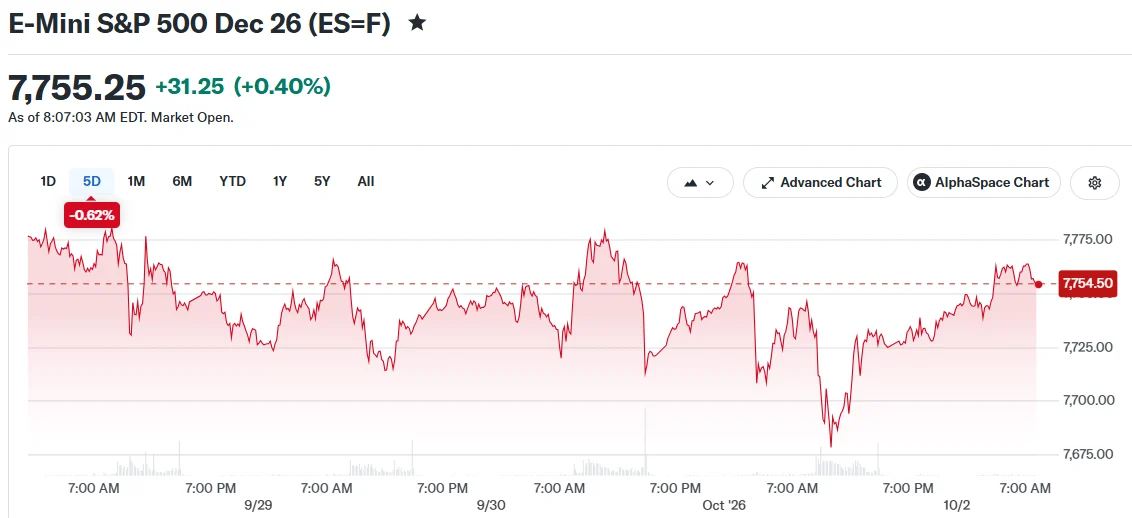
The gains followed a challenging period for equities. Both the S&P 500 and Dow Jones Industrial Average had broken three-session losing streaks earlier this week. The Nasdaq composite extended its winning run to two consecutive days.
Employment Data’s Impact on Rate Expectations
The September employment situation report was scheduled for an 8:30 a.m. Eastern time release. Analyst consensus projected the economy generated between 85,000 and 89,500 new positions during the month.
Such a result would represent a decline from August’s figure of 127,000 jobs created. The previous month’s report had exceeded market expectations.

Employment statistics carry significant weight because they directly influence Federal Reserve policy deliberations. The central bank’s next scheduled policy meeting occurs on October 28, when officials will determine the course of borrowing costs.
According to the CME Fedwatch tool, market participants were assigning a 74% likelihood that policymakers would maintain rates at current levels during that gathering.
A macro strategist at Deutsche Bank noted the heightened importance of this particular jobs release. He referenced the economy’s continued strength as a key support factor for U.S. equity markets in recent months.
The majority of market participants still anticipate at least one quarter-percentage-point increase in borrowing costs before year-end, with December viewed as the most probable timing.
Energy Markets and Price Pressures
Oil prices experienced significant declines Friday. Brent crude, the international pricing benchmark, fell to approximately $99 per barrel.
The retreat occurred as market focus shifted toward employment statistics and their implications for monetary policy trajectory.
Rising consumer prices remain a primary concern for Federal Reserve officials. Multiple policymakers have indicated in recent statements that the central bank can afford to assess additional economic data before adjusting policy.
These officials have also acknowledged that price increases continue exceeding the Fed’s preferred pace.
A substantial portion of inflationary pressure has been linked to the Middle East military conflict. The confrontation has now extended into its eighth month.
President Trump has indicated he is weighing renewed military operations against Iran following the midterm elections. He has also expressed a desire to see the situation resolved around that timeframe.
On Thursday, the United States reportedly deployed an additional aircraft carrier along with approximately 10,000 sailors and Marines to the Persian Gulf region. Bloomberg first published the report.
Treasury yields remained largely unchanged Friday morning as investors awaited the employment figures.
The labor market report, coupled with continuing Middle East developments, will probably determine the direction of equity and energy markets throughout the remainder of the month.
Get 3 Free Stock Ebooks
Discover top-performing stocks in AI, Crypto, and Technology with expert analysis.
- Top 10 AI Stocks - Leading AI companies
- Top 10 Crypto Stocks - Blockchain leaders
- Top 10 Tech Stocks - Tech giants



