



Key Takeaways
- Major indices posted gains on Wednesday, with the S&P 500 advancing 0.3% and Nasdaq climbing 0.7% following July’s inflation report.
- The Consumer Price Index registered a 3.4% year-over-year increase in July, down marginally from June’s 3.5% reading.
- Market participants increasingly favored a September rate hold by the Federal Reserve after reviewing the inflation figures.
- Rising geopolitical concerns in the Middle East drove Brent crude toward $90 per barrel, maintaining pressure on inflation metrics.
- Technology and artificial intelligence equities outperformed, though software sector stocks underperformed relative to the broader rally.
Wall Street equities advanced midweek following the release of July’s inflation metrics, which aligned precisely with analyst projections and provided market participants with sufficient reassurance to drive buying activity.
The S&P 500 index registered a 0.3% increase, while the Nasdaq Composite posted a 0.7% advance. The Dow Jones Industrial Average remained essentially unchanged, experiencing a modest decline to approximately 53,758.
The July inflation data revealed consumer prices moderating to an annualized rate of 3.4%, compared with the prior month’s 3.5% figure. Month-over-month, the index increased by 0.1%.
David Rosenberg of Rosenberg Research characterized the data as “Not too hot, but also not too cold.” He described the report as neutral territory for fixed-income markets, noting the absence of any compelling evidence to push the Fed toward immediate action in September.
Market positioning underwent a notable adjustment following the data release. Previously evenly divided expectations regarding whether the central bank would maintain current rates or implement an increase in September shifted decisively toward anticipating a hold.
Monetary Policy Challenges Persist
With inflation figures remaining stubbornly above the Federal Reserve’s 2% objective, policymakers continue to face significant challenges. While the baseline expectation now tilts toward a September pause, the meeting remains consequential and unpredictable.

Treasury yields retreated following the CPI announcement, with the 2-year note declining to 4.18% and the 10-year benchmark falling to 4.66%, signaling diminished expectations for near-term rate increases.
Technology sector equities and artificial intelligence-focused companies delivered the session’s strongest performance, buoyed by a succession of robust quarterly earnings announcements. Software companies represented a notable exception, failing to match the momentum seen across other technology subsectors.
Geopolitical Risks Support Energy Prices
Brent crude futures approached the $90 per barrel threshold after US forces engaged a Panama-registered vessel attempting to navigate the Gulf of Oman on Tuesday.
Ongoing diplomatic stalemate between the United States and Iran regarding access to the Strait of Hormuz continues to generate anxiety in energy markets, sustaining upward momentum in commodity prices.
This dynamic further complicates the Federal Reserve’s policy calculus, as persistently elevated petroleum prices translate directly into increased consumer expenses across multiple categories.
Among notable earnings releases scheduled this week, Cisco Systems (CSCO), Coherent Corp. (COHR), and Cerebras Systems (CBRS) are set to disclose quarterly financial results.
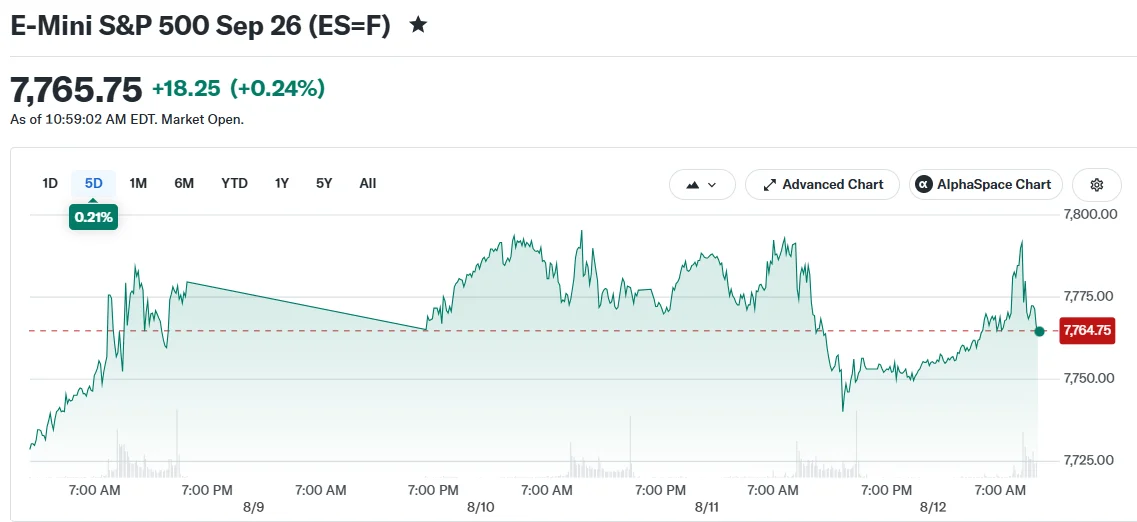
The Nasdaq Composite initiated Wednesday’s session with a 0.9% advance before moderating to a 0.7% gain during afternoon trading hours, while the S&P 500 maintained its position near 7,741.
Get 3 Free Stock Ebooks
Discover top-performing stocks in AI, Crypto, and Technology with expert analysis.
- Top 10 AI Stocks - Leading AI companies
- Top 10 Crypto Stocks - Blockchain leaders
- Top 10 Tech Stocks - Tech giants



