


Key Highlights
- The greenback reached its strongest position in more than seven days on Tuesday
- Traders are assigning a 92.1% probability to a Federal Reserve rate increase on Wednesday
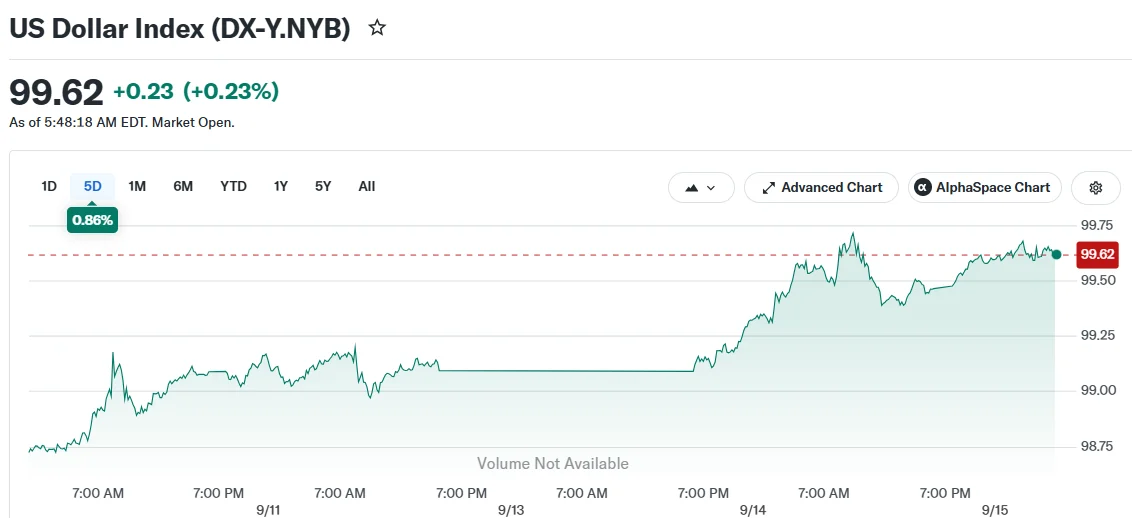
- The Dollar Index advanced approximately 0.24% to trade around 99.60
- Brent crude oil jumped beyond $113 per barrel following Saudi pipeline attacks
- The European currency declined to monthly lows near $1.1539, while Japan’s currency weakened to seven-day lows
The U.S. dollar advanced on Tuesday, reaching its most robust position in over a week as market participants dramatically ramped up expectations for a Federal Reserve monetary policy tightening at the upcoming policy gathering.
The Dollar Index, which tracks the American currency against a basket of six major global currencies, gained approximately 0.24% to hover around the 99.60 mark. The previous session saw the index reach a monthly peak of 99.736.
Financial markets are now viewing a Fed rate increase as virtually guaranteed. According to CME FedWatch data, the likelihood of a 25-basis-point increase bringing rates to the 3.75%-4.00% range stands at 92.1%, a substantial jump from approximately 60% recorded just seven days earlier. Money market instruments are also indicating a 53.4% probability of an additional hike when policymakers convene in October.
Energy Market Surge Boosts Dollar
Crude oil prices provided additional momentum to the greenback’s advance. Brent crude surged beyond $113 per barrel following renewed attacks targeting Saudi Arabian pipeline facilities and Houthi-led strikes across the Red Sea region.
Elevated oil prices are amplifying inflation worries, which consequently drive Treasury yields upward. The benchmark U.S. 10-year Treasury yield broke through the 5% threshold on Tuesday, marking the first occurrence since 2007.

Given that the United States is a net oil exporter, escalating energy costs typically support the dollar. John Velis from BNY noted that monetary policy must maintain control over inflationary expectations, even though it may not be ideally positioned to counteract supply-driven shocks.
Analysts at DBS cautioned against pursuing the dollar’s upward momentum before the Fed announcement, pointing out that two prominent Fed officials had expressed openness to maintaining current rates before entering their communications blackout period.
European and Japanese Currencies Weaken
The euro declined 0.1% during the session to trade around $1.1539, representing its weakest level in approximately 30 days. Market participants are evaluating stagflation threats in the eurozone against dollar strength, despite the European Central Bank’s decision to increase rates by a quarter percentage point to 2.50% in the previous week.
The Japanese yen weakened 0.3% to reach an over seven-day low of 154.82 against the dollar. This represents a retreat from the seven-month peak of 152.89 achieved in the prior week.
The Bank of Japan is anticipated to announce its monetary policy decision on Friday. Market observers are closely monitoring whether the BOJ will indicate an accelerated tightening trajectory following an anticipated rate increase to 1.25%.
The yen has appreciated roughly 4% during this month, propelled by capital repatriation flows and a jump in Japan’s 10-year government bond yield to a three-decade high of 3.025%.
The current week features multiple significant central bank announcements, with the Federal Reserve’s two-day policy meeting commencing Tuesday and the Bank of Japan convening on Friday.
Get 3 Free Stock Ebooks
Discover top-performing stocks in AI, Crypto, and Technology with expert analysis.
- Top 10 AI Stocks - Leading AI companies
- Top 10 Crypto Stocks - Blockchain leaders
- Top 10 Tech Stocks - Tech giants



