


Key Takeaways
- Precious metal prices declined 1.6% to approximately $4,377 amid surging crude oil and rising bond yields
- Federal Reserve Chairman Kevin Warsh’s aggressive Jackson Hole remarks elevated September rate increase probability to 66%
- Brent crude surpassed $91 per barrel following escalating U.S.-Iran geopolitical tensions
- Ten-year Treasury yields reached 4.78%, marking the highest point since early 2025
- Despite current weakness, the yellow metal maintains nearly 10% gains for August driven by Treasury operations and global central bank accumulation
The precious metal experienced a significant downturn on Tuesday, shedding 1.6% to settle around $4,377 per ounce. The decline occurred as crude oil markets rallied and a worldwide selloff in bonds drove yields upward, intensifying speculation about additional Federal Reserve monetary tightening.
Futures contracts for the metal also retreated 1.2% to $4,426. Silver experienced a sharper decline of 2.4% to $64.98 per ounce, while platinum slipped 1.2%.
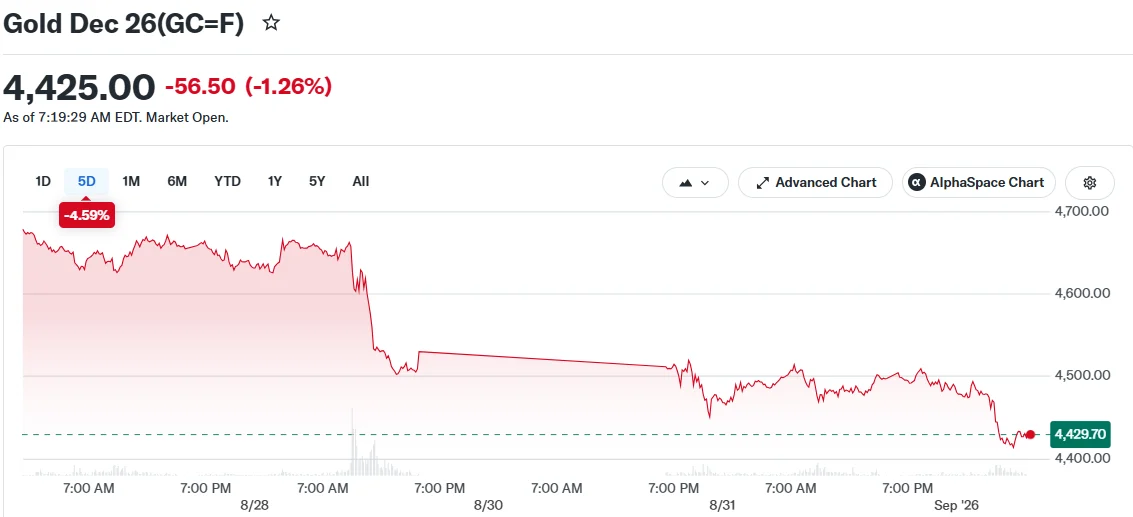
The current pullback positions the precious metal approximately $320 beneath the previous week’s peak near $4,697.
Monetary Tightening Concerns Trigger Market Retreat
Federal Reserve Chairman Kevin Warsh delivered remarks at the Jackson Hole Economic Symposium on Friday, emphasizing unwavering dedication to achieving the central bank’s 2% inflation objective.
Financial markets reacted swiftly. The CME FedWatch tool currently indicates approximately 66% probability of a 25 basis point increase at the upcoming September policy meeting—a notable increase from roughly 40% preceding the chairman’s address.

Elevated interest rates typically create headwinds for the precious metal. Since it generates no income, the asset becomes comparatively less appealing during periods of rising borrowing costs.
Research analysts from ANZ noted that the precious metal now appears exposed to downside risk as market participants recalibrate expectations regarding monetary policy trajectory.
Energy Markets and Fixed Income Amplify Downward Momentum
Intensified conflict between the United States and Iran has propelled oil prices upward. Brent crude advanced beyond $91 per barrel while U.S. crude surpassed $86.
The development heightened apprehension regarding potential energy supply disruptions and compounded inflationary pressures.
The benchmark 10-year U.S. Treasury yield advanced to approximately 4.78%, representing its most elevated position since the beginning of 2025. The worldwide increase in government bond yields has exerted additional downward force on the precious metal.
According to Tony Sycamore, senior market analyst at IG, the convergence of Warsh’s hawkish commentary and emerging tensions surrounding the Strait of Hormuz catalyzed the approximately $300 retreat from the previous week’s apex.
Fundamental Bullish Factors Remain Intact
Notwithstanding the recent setback, gold accumulated nearly 10% appreciation during August. The advance was propelled by an unanticipated initiative from the U.S. Treasury Department, which expanded acquisitions of longer-maturity government securities.
This action depressed financing costs and diminished dollar strength. It simultaneously reignited apprehension regarding U.S. sovereign debt accumulation and potential currency depreciation.
These dynamics contributed to the metal’s remarkable 65% surge throughout 2025. Gold-backed exchange-traded funds experienced robust capital inflows, while systematic purchasing by global central banks provided additional underlying support.
Sycamore indicated his intermediate-term outlook remains unchanged. He identifies the late June trough near $3,942 as foundational support and continues projecting $5,000 as an upside objective.
The precious metal currently trades beneath its 200-day moving average, positioned around $4,526.
Market participants are closely monitoring this week’s employment statistics, including Friday’s nonfarm payrolls report, seeking indications about whether the Federal Reserve will proceed with a rate increase in September.
Get 3 Free Stock Ebooks
Discover top-performing stocks in AI, Crypto, and Technology with expert analysis.
- Top 10 AI Stocks - Leading AI companies
- Top 10 Crypto Stocks - Blockchain leaders
- Top 10 Tech Stocks - Tech giants



