



Key Highlights
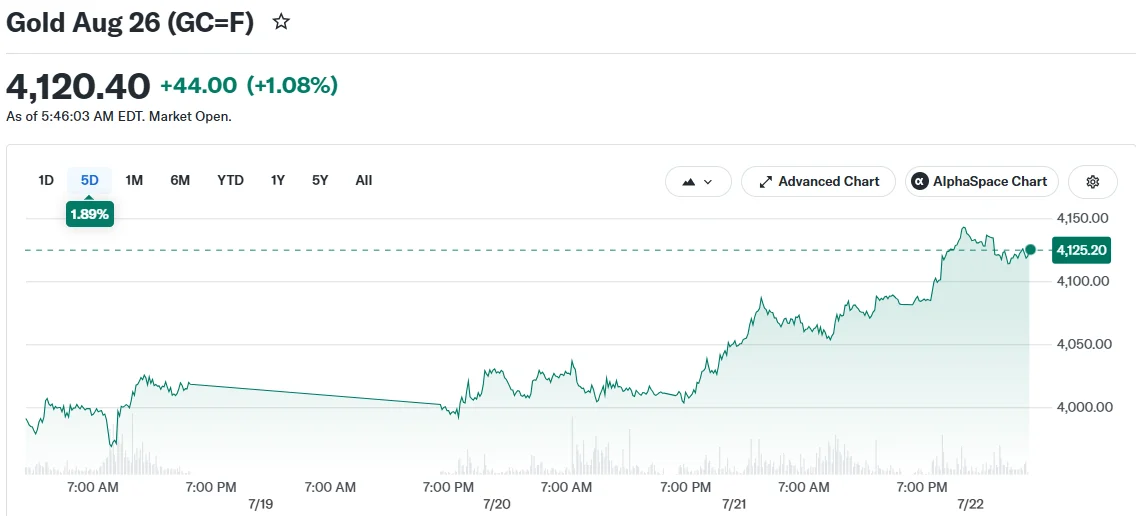
- Gold surged past $4,130 per ounce midweek, posting a 1.3% daily increase
- Escalating Middle East conflict, including US military action against Iran and Houthi naval blockades, is boosting safe-haven demand
- Crude oil prices crossed the $90 threshold, intensifying inflation concerns before the upcoming Federal Reserve policy meeting
- Market consensus anticipates the Fed will maintain current interest rates while potentially signaling an extended high-rate environment
- Other precious metals rallied alongside gold, with silver posting gains exceeding 4% in the previous trading session
The precious metal is currently trading north of $4,130 per ounce as intensifying Middle East hostilities prompt investors to seek refuge in traditional safe-haven assets, despite sustained strength in the US dollar and elevated Treasury yields.
Regional Turmoil Fuels Energy Market Anxiety and Inflation Worries
Gold futures advanced 1.5% to reach $4,137 during Wednesday’s session. This followed a substantial 2% surge in the prior trading day, marking the strongest weekly performance for the yellow metal in more than 90 days.
Ongoing hostilities near critical maritime chokepoints, particularly the Strait of Hormuz and Red Sea corridors, continue to rattle energy markets. In a significant development, three Saudi Arabian oil tankers reversed course in the Red Sea following Houthi forces’ declaration of a naval blockade.
The resulting disruption pushed oil prices beyond the $90 per barrel threshold. This development maintains upward pressure on inflation metrics and creates additional complexity for Federal Reserve policymakers.
President Donald Trump issued warnings about potential strikes targeting Iranian nuclear infrastructure. Iran’s government responded by cautioning that such military action would trigger broader regional escalation.

While Trump indicated the United States remains willing to engage in diplomatic dialogue with Tehran, American military forces executed their eleventh straight night of strikes in the region.
Central Bank Policy Outlook Creates Additional Market Volatility
The Federal Reserve’s upcoming policy meeting next week is drawing significant market attention. While no interest rate adjustment is broadly anticipated, investors are scrutinizing communications for indications that elevated rates may persist if energy-linked inflation pressures continue.
Elevated interest rates typically create headwinds for gold, as the non-yielding asset becomes less attractive relative to interest-bearing instruments. However, gold’s current resilience suggests safe-haven demand is sufficiently robust to counterbalance this traditional pressure.
According to Tony Sycamore, market analyst at IG, gold’s ability to maintain strength despite dollar appreciation and rising yields indicates investors are reinforcing its safe-haven status. He noted that improved retail positioning dynamics may be providing additional support.
Sycamore identified preliminary signs of base formation near the late-June floor of $3,942. A breakthrough above the early-July peak of $4,202 would create potential for advancement toward the 200-day moving average positioned around $4,494.
IG maintains a cautiously optimistic outlook provided gold sustains trading above the late-June support level.
Broader Precious Metals Complex Shows Strength
Silver advanced 1.5% to $59.71 per ounce during Wednesday’s trading, building on the previous session’s impressive 4% rally. Platinum climbed 2.3% to reach $1,666.59.
From a technical perspective, gold confronts resistance in the vicinity of $4,140, with additional overhead pressure at the $4,200 level. These price points represent the next critical challenges for bullish momentum.
Downside support is positioned around $4,020, with year-to-date lows near $3,950 establishing a secondary floor.
The yellow metal has accumulated approximately 2.5% gains this week as geopolitical uncertainty remains the predominant price catalyst.
Get 3 Free Stock Ebooks
Discover top-performing stocks in AI, Crypto, and Technology with expert analysis.
- Top 10 AI Stocks - Leading AI companies
- Top 10 Crypto Stocks - Blockchain leaders
- Top 10 Tech Stocks - Tech giants



