



Key Takeaways
- Precious metal declined 0.5% to settle at $4,395.78 amid climbing Treasury yields and energy prices
- Middle East tensions lifted crude oil after Iran threatened aggressive military stance
- Traders now assign 65% probability to Federal Reserve maintaining current rates in September
- Central bank purchases totaled 244 tonnes during Q1 2026, marking strongest quarter since Q4 2024
- ANZ projects bullion will climb to $5,200 per ounce before year-end
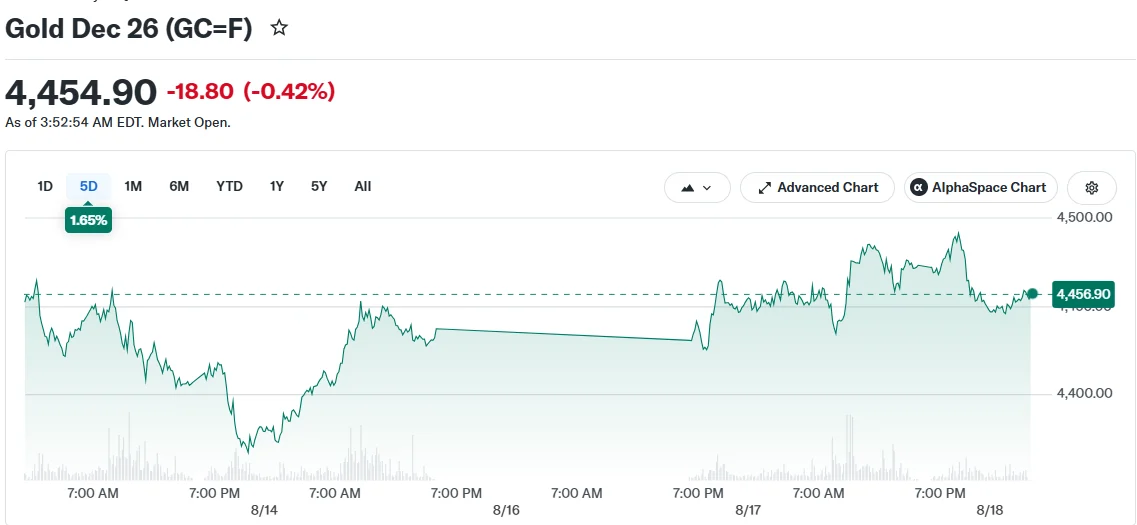
The precious metal experienced downward pressure on Tuesday as a pair of persistent market forces resurfaced: advancing U.S. government bond yields and strengthening crude oil valuations. These factors combined to drive bullion lower by 0.5% to $4,395.78 per ounce during morning trading sessions.
Futures contracts for the yellow metal similarly declined 0.5% to reach $4,451.07. Silver experienced a steeper 0.8% decline to $65.24 per ounce, while platinum decreased 0.7% to settle at $1,760.90.
The U.S. Dollar Index registered a modest 0.1% gain to 99.67, contributing additional downward pressure on commodities priced in dollars.
Bond Yields Increase Opportunity Cost for Non-Yielding Assets
The standard 10-year U.S. Treasury yield continued its upward trajectory on Tuesday. As yields advance, the alternative cost of maintaining positions in gold, an asset that generates no interest income, becomes increasingly significant.
This relationship has consistently limited the precious metal’s upward momentum over recent trading weeks. Market participants frequently shift capital toward interest-bearing instruments when fixed-income returns become more attractive.

Crude Oil Rally Intensifies Inflation Concerns
Oil prices gained ground following Iran’s announcement that it would implement a “fully offensive” military strategy should diplomatic negotiations with the United States collapse. The U.S. administration simultaneously rejected extending an existing temporary ceasefire agreement.
These developments maintained elevated anxiety across energy trading platforms. Advancing oil valuations typically amplify inflation projections, which subsequently increases the likelihood that the Federal Reserve maintains elevated borrowing costs for an extended period.
While the precious metal traditionally serves as protection against rising prices, elevated interest rates generally diminish its attractiveness since it produces no regular income stream.
Market participants have dramatically reduced expectations for a September Fed rate increase following the previous month’s surprising employment losses, moderating consumer price data, and weakening retail spending figures. Current pricing mechanisms suggest approximately 65% odds that the central bank maintains its present rate structure next month.
Market watchers are anticipating Wednesday’s publication of notes from the Fed’s July policy meeting. Federal Reserve Chair Kevin Warsh’s upcoming commentary at Jackson Hole also remains under close scrutiny for indications regarding future monetary policy direction.
Institutional Accumulation Continues Providing Price Floor
Notwithstanding Tuesday’s retreat, the precious metal has still advanced over 10% throughout the current month. The wider rebound has been underpinned by robust institutional purchasing activity, particularly from Chinese monetary authorities.
Worldwide central bank acquisitions totaled 244 tonnes during the opening quarter of 2026, representing the strongest three-month accumulation since the final quarter of 2024. Chinese authorities alone added 8 tonnes during April, marking their largest single-month purchase since December 2024.
The metal successfully recaptured its 100-day moving average for the first time since April during the previous week, although it has subsequently drifted back toward that technical threshold.
Critical resistance exists within the $4,440 to $4,450 zone, with the 200-day moving average positioned around $4,503 serving as the subsequent significant obstacle. A sustained breakthrough above both technical levels would establish momentum toward the $5,000 milestone.
ANZ projects the precious metal will advance to $5,200 per ounce before year-end, attributing the forecast to central bank portfolio diversification demand fueled by worsening geopolitical relationships.
Get 3 Free Stock Ebooks
Discover top-performing stocks in AI, Crypto, and Technology with expert analysis.
- Top 10 AI Stocks - Leading AI companies
- Top 10 Crypto Stocks - Blockchain leaders
- Top 10 Tech Stocks - Tech giants



