



TLDR
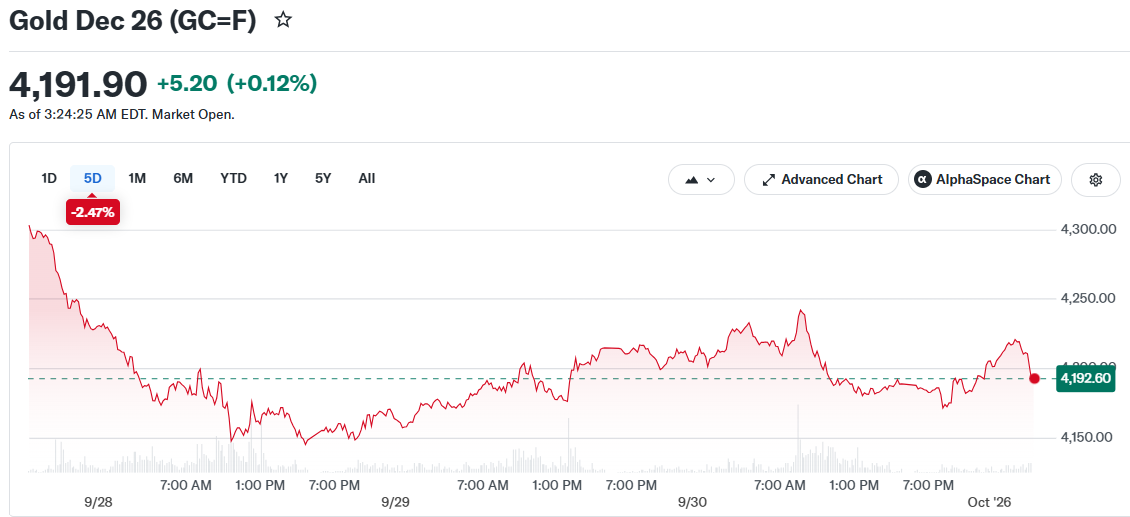
- Spot gold advanced 0.7% to $4,184.68 per ounce following a 6% decline in September, marking its steepest monthly loss since June
- Core PCE inflation, the Federal Reserve’s favored metric, increased 0.2% in August, missing analyst forecasts
- Market-implied probability of an October rate increase dropped to approximately 34%, down from nearly 70% earlier this week
- Robust consumer expenditure sustained Treasury yields at multi-decade peaks, limiting gold’s rally potential
- Market participants now await Friday’s employment data for additional insight into monetary policy direction
Gold prices staged a recovery on Thursday following a challenging September performance. The precious metal advanced as fresh inflation figures provided encouragement to market participants.
As of 01:44 ET, spot gold prices increased 0.7% to reach $4,184.68 per ounce. December gold futures similarly advanced 0.7%, trading at $4,214.
Other precious metals followed suit, with silver surging 1.4% to $61.27. Platinum added 0.5%, reaching $1,725.77.
PCE Data Reshapes Interest Rate Outlook
The Federal Reserve closely monitors the personal consumption expenditures price index as its primary inflation benchmark. The core reading, which excludes volatile food and energy components, increased a modest 0.2% in August.
This figure fell short of market expectations. Additionally, the prior month’s data underwent a downward revision.

The more subdued inflation print significantly altered trader sentiment regarding Federal Reserve policy trajectory. Market-based expectations for an October rate increase experienced a notable decline.
At the week’s outset, derivatives markets priced in nearly a 70% likelihood of additional tightening. Following the inflation release, that probability contracted to roughly 34%.
Diminished rate hike expectations generally favor gold valuations. As a non-yielding asset, the yellow metal becomes relatively less appealing when interest-bearing alternatives offer higher returns.
Consumer Resilience Supports Elevated Yields
Despite the encouraging inflation data, gold continues to confront headwinds. August consumer spending in the United States accelerated at its quickest rate in more than twelve months.
This expenditure strength indicates economic resilience in the face of restrictive monetary policy. Consequently, Treasury yields maintained their position near levels unseen in decades.
Elevated bond yields present a persistent challenge for gold valuations. They amplify the opportunity cost associated with holding non-income-producing assets.
The U.S. Dollar Index maintained strength as well, edging up 0.2% to 101.66. Dollar appreciation generally pressures gold prices by making the metal costlier for international purchasers.
September proved punishing for gold, with prices declining 6%. This represented the metal’s poorest monthly showing since June.
The selloff materialized after the Federal Reserve implemented its first rate increase since 2023. Policymakers additionally signaled openness to further monetary tightening.
Government bond yields climbed globally throughout September. Market participants expressed mounting apprehension regarding escalating sovereign debt levels and fiscal imbalances.
These concerns inflated the term premium—the additional compensation investors require for accepting the duration risk inherent in longer-maturity bonds.
The broad-based yield advance created a challenging environment for gold prices throughout the previous month.
Attention now shifts to Friday’s employment situation report from the United States. This release could provide crucial indications regarding the Federal Reserve’s policy intentions.
Labor market data will likely influence gold price expectations in the near term. Markets remain highly responsive to indicators of economic momentum or deceleration.
For the moment, gold has achieved some equilibrium following its September decline. However, persistently elevated yields continue to constrain the precious metal’s performance.
Get 3 Free Stock Ebooks
Discover top-performing stocks in AI, Crypto, and Technology with expert analysis.
- Top 10 AI Stocks - Leading AI companies
- Top 10 Crypto Stocks - Blockchain leaders
- Top 10 Tech Stocks - Tech giants



