



Key Takeaways
- On Thursday, the 10-year US Treasury yield surged to 5.342%, marking its highest point since the beginning of 2002.
- During Q3’s bond market turbulence, the yield exceeded its previous 2007 record.
- The 30-year Treasury yield climbed alongside, hovering around 5.64%.
- While August’s PCE inflation figures fell short of projections, core inflation continues to sit significantly above the Fed’s 2% objective.
- Market expectations for a Federal Reserve rate increase in October declined to approximately 37-38%, compared to more than 45% prior to the inflation release.
On Thursday, the benchmark US 10-year Treasury yield climbed to 5.342%, representing the steepest level observed since the opening months of 2002.
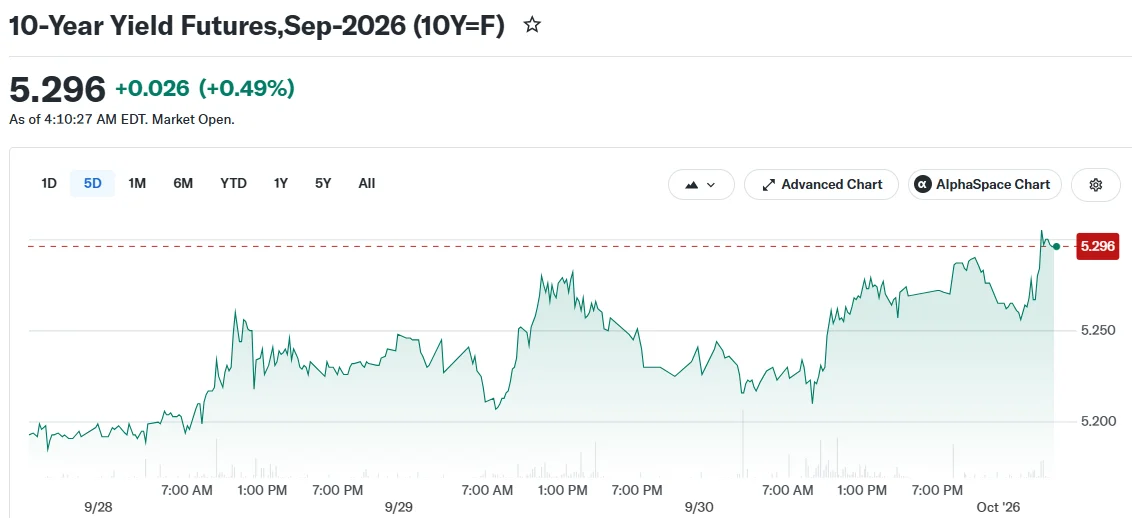
This surge occurred as selling pressure intensified across the bond market. The benchmark rate broke through its earlier 2007 ceiling, prompting market participants to assess whether this upward trajectory will continue.
Throughout the third quarter, this worldwide benchmark experienced its most substantial quarterly increase this century—a remarkable historical achievement.
The longer-dated 30-year Treasury yield followed suit on Thursday, trading in the vicinity of 5.64%, echoing levels not witnessed since 2002.
Forces Behind the Bond Market Decline
Multiple dynamics are contributing to the upward pressure on yields. Persistently high energy costs continue to fuel concerns that inflation could remain stubbornly elevated.

Despite signs of stabilizing oil supplies from the Middle East, negotiations between the US and Iran have stalled. Consequently, crude prices continue trading near levels typically associated with geopolitical conflict.
America’s mounting debt obligations represent another significant pressure point. Treasury buyback programs have underperformed relative to projections, intensifying strain on bond markets in recent trading sessions.
According to Patrick Munnelly, a market strategist at Tickmill Group, expanding budget shortfalls and substantial Treasury issuance volumes will likely maintain upward momentum on yields. He highlighted corporate borrowing linked to artificial intelligence infrastructure development as an additional contributing element.
Latest Inflation Figures Present Contradictory Picture
Fresh inflation statistics emerged this week. August’s PCE price index registered a 0.3% monthly gain, falling short of the anticipated 0.4% rise.
The core PCE measure increased by 0.2% during the same period, likewise undershooting analyst predictions.
On an annual basis, core PCE inflation advanced 3% during the twelve months concluding in August, representing a decline from the prior month’s 3.3% reading.
Despite this encouraging movement, inflation continues running considerably higher than the Federal Reserve’s 2% benchmark. Bill Adams, chief US economist at Fifth Third Commercial Bank, acknowledged the downward trajectory while emphasizing that current levels remain distant from the central bank’s objective.
Adams noted that the Fed’s upcoming decision will hinge significantly on September’s inflation statistics, which remain unreleased.
Meanwhile, additional economic indicators demonstrated resilience. Revised output calculations revealed the US economy expanded at a faster pace than initially estimated during Q2.
September’s private payroll additions also exceeded projections, based on ADP’s employment figures.
Market Expectations for Fed Policy Evolve
Current market pricing suggests approximately a 37% to 38% probability that the Federal Reserve will implement a rate increase in October, representing a notable decrease from the 45%-plus odds prevailing before the inflation data emerged.
Treasury yields experienced a temporary decline immediately following the inflation announcement. However, selling pressure reemerged as market participants digested conflicting signals emanating from the wider economic landscape.
The two-year Treasury yield, which serves as a sensitive indicator of near-term rate expectations, advanced to 4.893% by afternoon trading.
International bond markets demonstrated divergent movements. Germany’s 10-year bund yield retreated 5 basis points to settle at 3.563%. Meanwhile, the United Kingdom’s 10-year gilt yield edged marginally lower to 5.392%.
Market attention now turns to forthcoming US economic releases. Thursday brings weekly unemployment claims data, while Friday’s comprehensive September employment report could significantly influence expectations regarding the Federal Reserve’s policy trajectory.
Get 3 Free Stock Ebooks
Discover top-performing stocks in AI, Crypto, and Technology with expert analysis.
- Top 10 AI Stocks - Leading AI companies
- Top 10 Crypto Stocks - Blockchain leaders
- Top 10 Tech Stocks - Tech giants



