



Key Highlights
- Precious metal maintains position near three-month peak at approximately $4,660 per ounce following a weekly surge exceeding 7%
- Declining crude oil prices coupled with retreating US bond yields are diminishing inflationary pressures, bolstering bullion demand
- Diplomatic discussions between Iran and Oman focused on establishing a temporary shipping route through the Strait of Hormuz
- Markets anticipate Federal Reserve Chair Kevin Warsh’s Jackson Hole address on Friday for monetary policy insights
- Wednesday’s PCE inflation report will provide fresh perspective on economic conditions
The yellow metal experienced a modest pullback on Wednesday while maintaining proximity to its strongest level in three months, buoyed by retreating energy prices and softening government bond yields that have dampened inflation worries.
Spot gold hovered near $4,660 per ounce, with futures contracts advancing to $4,699. Silver climbed 0.7% to reach $69.05, while platinum posted a 0.3% gain.
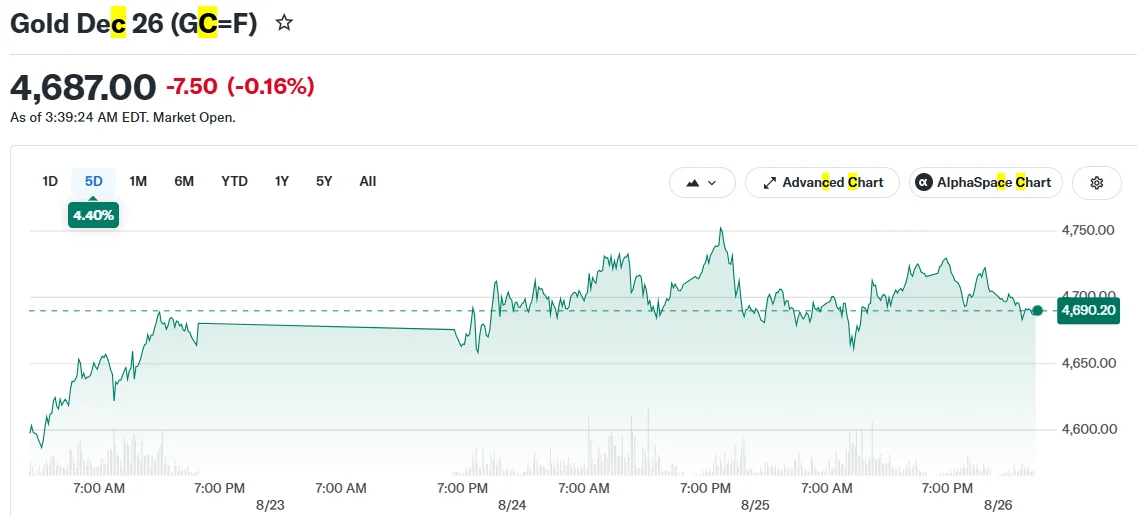
The precious metal has surged more than 7% during the past week, a rally partially fueled by the US Treasury Department’s decision to accelerate repurchases of longer-maturity government securities.
This policy shift has rekindled what market participants describe as the “currency debasement strategy,” where investors accumulate gold as a hedge against expanding government debt and potential dollar weakness. This trend previously contributed to bullion’s record-setting performance in 2025 and has regained prominence.
Crude Oil Decline Eases Central Bank Pressure
Oil prices retreated on Tuesday following diplomatic engagement between Iran and Oman regarding the establishment of a temporary cooperative maritime passageway designed to partially restore shipping operations through the Strait of Hormuz.

Declining energy costs carry significance for gold markets because fuel expenses represent a primary inflation driver. As oil becomes more affordable, inflationary pressures typically subside, diminishing the Federal Reserve’s justification for maintaining restrictive interest rate policies.
Elevated interest rates traditionally challenge gold’s appeal since the metal generates no yield. When borrowing costs rise, income-producing investments become comparatively more compelling.
Government bond yields declined approximately five to seven basis points throughout the maturity spectrum on Tuesday, providing additional tailwinds for bullion prices.
Federal Reserve Bank of Boston President Susan Collins indicated her preference for maintaining current interest rate levels, contingent upon inflation continuing its trajectory toward the central bank’s 2% objective.
Market Attention Shifts to Jackson Hole and PCE Release
Market participants are monitoring two critical developments that could influence gold’s trajectory in the immediate term.
The first involves Wednesday’s release of the US Personal Consumption Expenditures index. This metric serves as the Federal Reserve’s primary inflation benchmark and will deliver updated insight into pricing dynamics throughout the economy.
The second event centers on the Jackson Hole Economic Policy Symposium scheduled for Friday, where Federal Reserve Chair Kevin Warsh will present his inaugural major policy address since assuming the position.
Warsh has encountered scrutiny regarding perceived ambiguity surrounding his economic philosophy. Financial markets anticipate Friday’s presentation will provide enhanced clarity regarding the central bank’s stance on potential rate reductions.
ANZ analysts observed that Treasury Secretary Scott Bessent offered no additional guidance concerning debt management strategies, although reports indicate the Treasury Department may deploy cash holdings to repurchase earlier-issued, higher-coupon securities.
The US Dollar Index remained relatively unchanged at 99.01, holding steady following a marginal decline in the prior trading session.
Gold’s immediate trajectory will likely hinge on insights derived from the PCE inflation data and the substance of Warsh’s policy remarks regarding inflation trends and Federal Reserve intentions.
Get 3 Free Stock Ebooks
Discover top-performing stocks in AI, Crypto, and Technology with expert analysis.
- Top 10 AI Stocks - Leading AI companies
- Top 10 Crypto Stocks - Blockchain leaders
- Top 10 Tech Stocks - Tech giants



