



Key Highlights
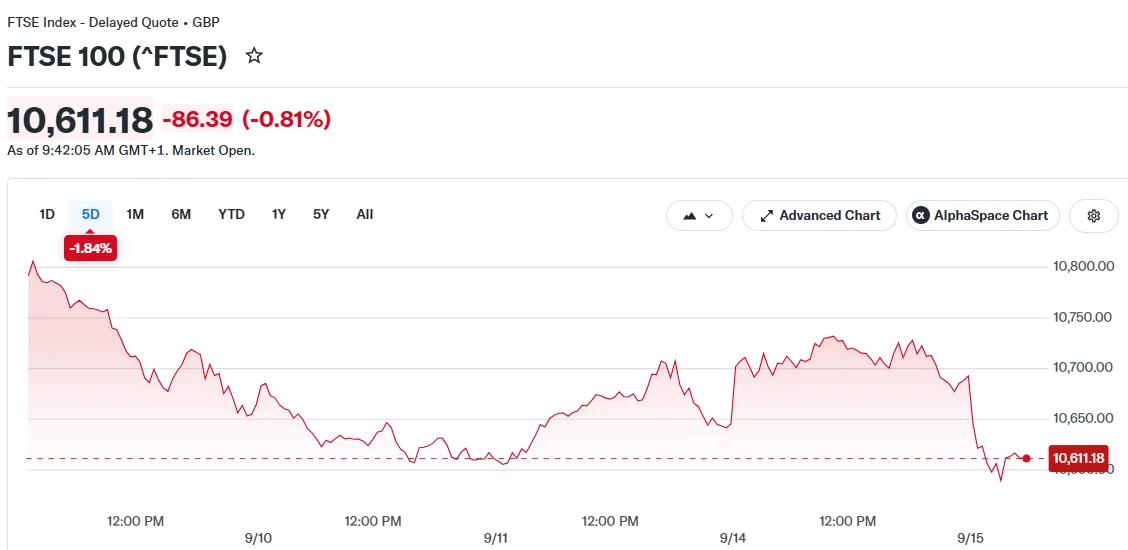
- British equities declined 0.60% Tuesday amid surging energy prices and mounting concerns about artificial intelligence regulation
- August witnessed a 26,000 decline in UK payrolled workers, continuing the downward trend from July’s revised 19,000 drop
- The jobless rate remained steady at 4.9% for the fourth consecutive month, staying under the anticipated 5% threshold
- Energy markets saw Brent crude climb to $107.42 per barrel following supply interruptions from a Saudi Arabian pipeline
- Market analysts anticipate the Bank of England will maintain its 3.75% benchmark rate given the softening employment figures
UK equity markets retreated Tuesday as escalating crude oil valuations and ongoing discussions surrounding artificial intelligence governance dampened investor confidence across European trading floors.
London’s benchmark index shed 0.60%, with continental peers also registering losses—the DAX declined 0.36% while the CAC 40 dropped 0.64%. The pound weakened 0.21% against the greenback, trading at $1.3472.
Market headwinds intensified as Brent crude advanced 1.67% to reach $107.42 per barrel. The rally stemmed from infrastructure issues affecting Saudi Arabia’s East-West pipeline, with ING analysts projecting elevated prices could persist for multiple weeks.
West Texas Intermediate also gained 1.7%, reaching $103.09. Maritime traffic data from Kpler, reported by Reuters, showed vessel passages through the Strait of Hormuz plummeted to four on Monday from the previous ten.
British Employment Landscape Shows Further Deterioration
Labor market statistics revealed UK payrolled worker numbers contracted by 26,000 during August. Combined with July’s downwardly adjusted 19,000 decline, PAYE employment now sits 0.5% beneath year-ago levels.

The figures significantly underperformed Capital Economics’ projection of a 5,000 increase, representing a notable disappointment.
Private enterprise bore the brunt of workforce reductions, shedding 34,000 positions in August for a 0.8% annual decline. The retail and hospitality sectors experienced the steepest contractions, exceeding 3% on a year-over-year basis.
Available job openings continued their downward trajectory, declining to 702,000 during the three months ending in August from 706,000 previously. This represents the weakest reading outside pandemic periods in more than ten years.
Compensation growth including performance-related payments moderated to 3.9% in July from June’s 4.2%. Base salary increases remained unchanged at 3.5%, matching economist expectations.
Capital Economics analysts suggested the softening employment environment reinforces expectations that inflationary pressures from elevated energy expenses will stay contained. The research firm indicated a meaningful probability exists that the Bank of England maintains its 3.75% policy rate both this week and potentially throughout the year.
ING forecasts the Monetary Policy Committee will deliver a 6-3 vote favoring no change.
Artificial Intelligence Governance Controversy Heightens Market Anxiety
Beyond macroeconomic releases, public disagreements over AI advancement protocols contributed to investor apprehension.
Dario Amodei, chief executive of Anthropic, advocated for enhanced oversight mechanisms on sophisticated AI systems, proposing mandatory independent evaluations by external parties. He cautioned that such technologies risk breaking free from human oversight and triggering devastating consequences.
Sam Altman of OpenAI alongside Elon Musk endorsed measured development strategies. President Donald Trump countered such restraint, arguing it could undermine America’s competitive position relative to Chinese artificial intelligence enterprises.
In corporate developments, Trustpilot disclosed first-half revenues climbing 23% to $151.4 million. Kier Group announced full-year revenues of £4.39 billion, representing a 7.5% increase, while entering 2027 with a record £11.9 billion order backlog.
Precious metals futures declined, with gold dropping 0.52% to $4,328.87. ING cautioned that bullion remains “vulnerable” heading into Wednesday’s Federal Reserve policy announcement.
Get 3 Free Stock Ebooks
Discover top-performing stocks in AI, Crypto, and Technology with expert analysis.
- Top 10 AI Stocks - Leading AI companies
- Top 10 Crypto Stocks - Blockchain leaders
- Top 10 Tech Stocks - Tech giants



