



TLDR
- Major European stock indices tumbled to their weakest levels in several months on Tuesday
- Brent crude oil climbed above $113 per barrel following strikes on Saudi Arabia’s pipeline network
- Traders anticipate a 90% likelihood of the Federal Reserve implementing a 25 basis point rate increase on Wednesday
- Top executives from OpenAI and Anthropic urged a temporary halt in sophisticated AI system development
- Trustpilot shares plunged more than 18% following a first-half 2026 net loss
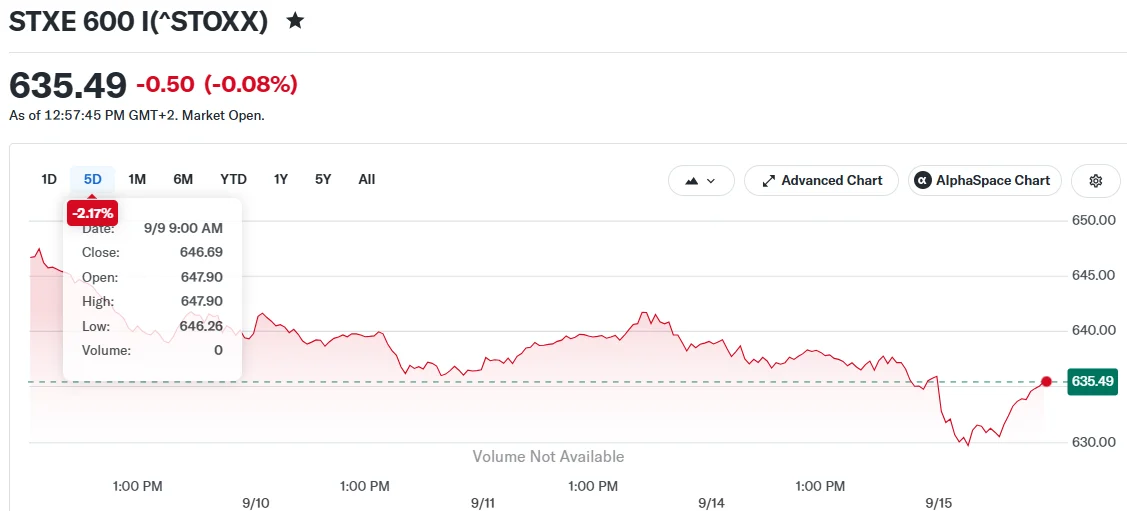
European equity markets experienced significant declines on Tuesday, with benchmark indices falling to levels not seen in several months. A combination of geopolitical instability, climbing energy prices, and anticipation of Federal Reserve monetary tightening dampened market confidence.
The continent-wide STOXX 600 index retreated 0.35%, reaching its weakest position in more than three months. France’s CAC 40 index shed 0.4%, touching nearly four-month lows, while Britain’s FTSE 100 and Germany’s DAX indices posted similar losses.
Crude Prices Climb Following Saudi Infrastructure Strikes
Rising energy expenses represented a significant headwind for European trading. Brent crude advanced 1.2% to settle above the $113 per barrel threshold, extending a rally spanning several weeks.
Saudi officials attributed the assault on the kingdom’s East-West pipeline infrastructure to Iranian-backed factions operating from Iraq. Authorities cautioned that the incident could impact as much as 4% of worldwide petroleum supply.
Meanwhile, Yemen’s Houthi rebel forces conducted additional attacks targeting Saudi territory and maritime routes in the Red Sea on Monday. Diplomatic negotiations scheduled in Oman were unexpectedly canceled, diminishing prospects for regional de-escalation.

Monday’s trading session witnessed similar weakness across European bourses. The CAC 40 declined 0.76% while the DAX slipped 0.30%, partially driven by Arctic territorial concerns as twelve European Union member states advocated for enhanced European military positioning in response to Russian activities.
Federal Reserve Policy Announcement Creates Market Uncertainty
The Federal Reserve commenced its two-day monetary policy gathering on Tuesday, with financial markets assigning a 90% probability to a 25 basis point interest rate elevation on Wednesday. This would mark the Fed’s initial rate adjustment since the middle of 2023.
The European Central Bank implemented a quarter-point rate increase to 2.50% during the previous week. The coordinated monetary tightening by leading central banks has maintained elevated government bond yields.
The U.S. 10-year Treasury yield remained near 4.98%, approaching thresholds last observed in 2007. Germany’s benchmark 10-year Bund yield stayed close to 3.51%.
Market observers noted the critical issue isn’t whether the Fed will raise rates, but rather what guidance Chair Jerome Powell provides regarding subsequent policy actions. An elevated U.S. inflation report released last Friday intensified speculation that additional monetary tightening may be necessary.
Technology shares throughout Frankfurt and Amsterdam faced selling pressure following a joint statement from OpenAI and Anthropic leadership advocating for a temporary pause in cutting-edge AI system development. The appeal emphasized the necessity for internationally coordinated risk-management frameworks.
ASML shares rebounded modestly, climbing 1.6%, while BE Semiconductor advanced approximately 1.2% after sustaining sharper declines in the previous session.
Trustpilot shares collapsed by more than 18% after reporting a net loss for the first half of 2026. The company absorbed a $6 million charge stemming from antitrust penalties and U.S. tax-related provisions.
Puig Brands declined 3.5% following the announcement of a €1.2 billion transaction to acquire the outstanding 50% ownership stake in skincare company ISDIN.
Investors now await Wednesday’s Federal Reserve policy statement for clearer guidance on market trajectory.
Get 3 Free Stock Ebooks
Discover top-performing stocks in AI, Crypto, and Technology with expert analysis.
- Top 10 AI Stocks - Leading AI companies
- Top 10 Crypto Stocks - Blockchain leaders
- Top 10 Tech Stocks - Tech giants



