


Key Highlights
- The greenback maintained its position around the 99.00 mark as market participants awaited crucial PCE inflation figures and the Jackson Hole economic symposium
- Australia’s currency surged to three-month highs following stronger-than-anticipated July inflation data showing a 3.5% annual increase
- The loonie came under renewed pressure following the breakdown of U.S.-Canada trade negotiations and the implementation of reciprocal tariffs
- Japan’s currency stabilized around the 159.00 level amid growing speculation of a potential Bank of Japan interest rate adjustment in September
- Precious metals retreated from quarterly peaks near $4,700 while Brent crude declined more than 2% as geopolitical tensions in the Middle East showed signs of easing
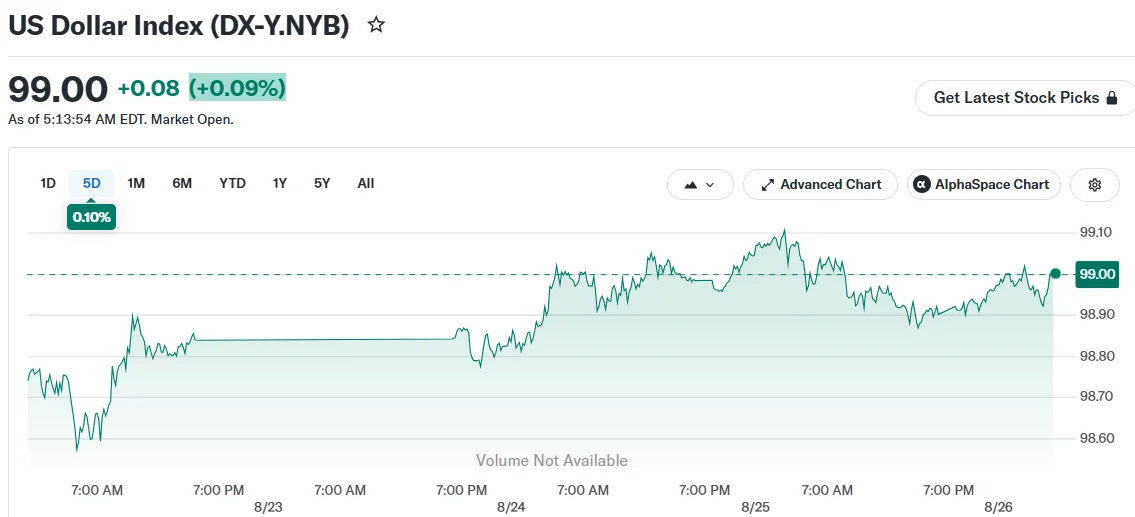
The greenback remained range-bound during Wednesday’s trading session as market participants positioned themselves ahead of the Personal Consumption Expenditures price index release, widely regarded as the Federal Reserve’s favored inflation gauge. The U.S. Dollar Index maintained its position around 99.00, not far from the three-month trough recorded last week.
Consensus forecasts point to a 0.2% monthly increase in the core PCE measure, consistent with recent annual trends. Currency strategists at ING noted that an on-target reading would likely maintain the dollar’s current trajectory, with minimal upside potential.
The upcoming Jackson Hole economic symposium scheduled for this weekend has also captured trader attention. The gathering of central bankers and policymakers may provide additional clarity regarding the Federal Reserve’s future monetary policy trajectory.
While the U.S. Treasury’s enhanced debt repurchase initiative has provided some relief for long-term bond yields, market observers note it fails to address fundamental concerns surrounding expanding government obligations and mounting debt servicing expenses.
Aussie Dollar Strengthens on Hotter-Than-Expected Inflation
The Australian currency emerged as a top performer during the trading day. The AUD/USD exchange rate advanced 0.3% to reach $0.718, marking its strongest level since the beginning of June.

Australian monthly consumer price inflation accelerated 1.0% in July, surpassing the anticipated 0.8% increase. While the year-over-year rate moderated to 3.5% from 3.8%, it nonetheless exceeded analyst projections of 3.2%.
The trimmed mean indicator, a metric closely monitored by the Reserve Bank of Australia, posted a 0.5% monthly gain. Core inflation on an annual basis remained unchanged at 3.6%. Market pricing now reflects increased probability of a fourth RBA rate increase before year-end.
Canadian and Japanese Currencies Under Scrutiny
The Canadian currency continued to face headwinds. The USD/CAD exchange rate climbed 0.2% to reach C$1.39 following the collapse of bilateral trade discussions earlier this week.
The United States implemented 50% duties on approximately $20 billion worth of Canadian exports. Ottawa retaliated with corresponding tariffs ranging from 15% to 50% on roughly $20 billion of American goods, scheduled to commence September 8.
Currency analysts at Danske Bank noted that these tit-for-tat trade measures introduce additional volatility for enterprises operating across the border and may create upward pressure on consumer prices while disrupting established supply networks.
The yen held firm around the 159.00 threshold. A recent Reuters survey revealed that a majority of economists now anticipate the Bank of Japan will accelerate its timeline for monetary tightening, potentially implementing a rate adjustment as soon as September.
Gold retreated below the $4,630 level after reaching a quarterly high approaching $4,700 in Tuesday’s session. Brent crude tumbled over 2% to approximately $87 per barrel following Iran’s decision to restart diplomatic discussions with Oman regarding Strait of Hormuz navigation, alleviating some supply disruption concerns.
Nvidia is scheduled to release quarterly earnings following Wednesday’s market close, adding another potentially significant catalyst to an already eventful trading day.
Get 3 Free Stock Ebooks
Discover top-performing stocks in AI, Crypto, and Technology with expert analysis.
- Top 10 AI Stocks - Leading AI companies
- Top 10 Crypto Stocks - Blockchain leaders
- Top 10 Tech Stocks - Tech giants



