


Key Takeaways
- Federal Reserve Chair Kevin Warsh indicated additional interest rate increases could be necessary unless inflation returns to the 2% target
- Market pricing now reflects a 58% probability of a Fed rate increase in September, climbing from 40% seven days earlier
- The dollar index slipped marginally to 99.53 while maintaining proximity to its highest reading since August 17
- Japan’s yen breached the 160 mark against the dollar temporarily before stabilizing around 159.57
- Crude oil rallied 2.5% to reach $90.21 per barrel following American military action against Iran’s Larak Island
The US dollar retreated modestly on Monday while maintaining its position near a two-week peak following Federal Reserve Chair Kevin Warsh’s hawkish remarks delivered at Jackson Hole last Friday.
Warsh indicated the central bank will need to “have work to do” should policymakers lack conviction that inflation is returning to the 2% objective. His statement represented the most explicit indication to date that additional rate increases remain a possibility.
Financial markets reacted swiftly to the comments. The likelihood of a September interest rate increase surged to 58%, climbing from approximately 40% recorded just seven days prior. Meanwhile, yields on 2-year US Treasury securities maintained levels close to a one-month peak.
The dollar index declined 0.11% to settle at 99.53 during Monday’s trading session. The benchmark had reached 99.73 on Friday, marking its strongest position since August 17.
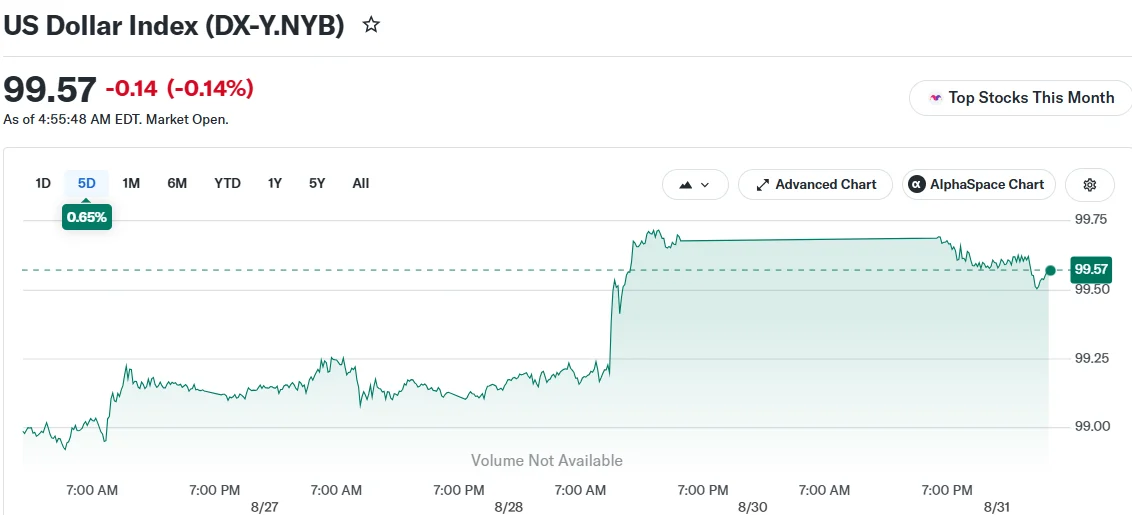
Notwithstanding Monday’s modest decline, the index remains positioned for its second consecutive monthly decrease. Earlier this month, announcements regarding US Treasury bond-buyback initiatives rekindled trading strategies that favor short positions against the greenback.

Japanese Yen Fluctuates Around Critical 160 Threshold
The Japanese yen attracted significant attention after temporarily weakening beyond the 160 per dollar mark on Friday. Market participants monitor this threshold closely as it may prompt intervention from Japanese authorities.
By Monday’s session, the yen had strengthened modestly to 159.57 against the dollar. US Treasury Secretary Scott Bessent characterized yen fluctuations as “pretty well contained” while expressing confidence that the Bank of Japan would respond appropriately.
Market analysts suggest any official intervention may prove temporary. The yen faces downward pressure from substantial interest rate differentials between the United States and Japan, negative real interest rates domestically, and the Bank of Japan’s cautious approach to policy normalization.
The euro appreciated 0.11% to $1.1597 while the British pound advanced to $1.3543. Both European currencies were positioned for their second consecutive monthly advance versus the dollar.
Crude Oil Surges on Middle East Military Action
Oil prices experienced significant gains on Monday following US military operations targeting Iran’s Larak Island on Sunday. The action marked the first publicly acknowledged American strike against Iranian territory since late July.
Brent crude futures advanced 2.5% to $90.21 per barrel. President Trump claimed via social media that Iran’s Kharg Island was being “blown to smithereens,” although no confirmation of an assault on that facility emerged.
G20 Gathering and Employment Data Ahead
Market participants are directing attention toward a G20 finance ministers gathering in Washington scheduled for Monday and Tuesday. Investors will scrutinize discussions for indications of multilateral coordination regarding Iran and potential measures addressing concerns over expanding US government debt.
Friday’s August nonfarm payrolls release represents the subsequent critical economic data point. That employment report, combined with next week’s consumer price inflation figures, could significantly influence market expectations approaching the September Federal Reserve policy meeting.
China’s yuan strengthened to 6.72 per dollar following data indicating manufacturing activity expanded in August, despite remaining within contractionary territory overall.
Get 3 Free Stock Ebooks
Discover top-performing stocks in AI, Crypto, and Technology with expert analysis.
- Top 10 AI Stocks - Leading AI companies
- Top 10 Crypto Stocks - Blockchain leaders
- Top 10 Tech Stocks - Tech giants



