



TLDR
- Crude benchmarks surged Tuesday with Brent reaching $91.87 and WTI touching $87.15 amid intensifying U.S.-Iran military confrontation
- American military operations targeted Iranian installations on Larak Island; Tehran responded by firing missiles at U.S. bases in Jordan
- Daily vessel movements through the Strait of Hormuz plunged to only 5 ships, drastically below the recent 14-vessel average
- Three projectiles struck a commercial tanker departing the strategic waterway on Tuesday
- America’s Strategic Petroleum Reserve has declined to 286.6 million barrels, approaching a four-decade low
Crude markets experienced significant upward momentum Tuesday as military confrontations between Washington and Tehran rekindled concerns over potential supply chain interruptions. Brent crude futures advanced to $91.87 per barrel, with U.S. West Texas Intermediate reaching $87.15.
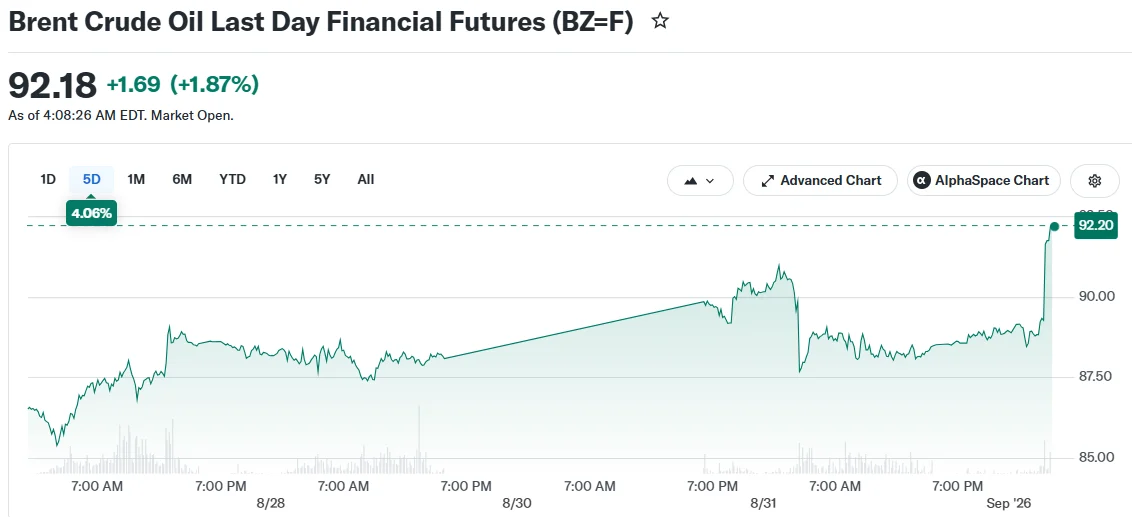
These benchmark contracts had previously closed approximately 3% higher in the prior trading session, extending gains fueled by escalating Middle Eastern tensions.
Military Operations Resume Following Temporary Cease
The current surge in hostilities commenced when American forces executed strikes against Iranian military installations on Larak Island, breaking several weeks of comparative tranquility. Tehran’s response included launching ballistic missiles targeting U.S. military installations in Jordan.
President Trump vowed forceful retaliation, escalating market anxieties that direct military engagement might expand and jeopardize critical energy facilities throughout the Persian Gulf.
“These bring the potential for Iranian retaliation back into the equation,” said Tim Waterer, chief market analyst at KCM. “Both of those risks are being reflected in the firmer tone in crude prices.”
Prior to the outbreak of hostilities in late February, the Strait of Hormuz facilitated the passage of roughly one-fifth of worldwide oil supplies. Iran closed the critical passage following coordinated U.S. and Israeli military operations against the nation on February 28.

Diplomatic initiatives spearheaded by Qatar and Oman aimed at reopening the strategic waterway have yet to achieve success.
Shipping Volumes Experience Dramatic Decline
Maritime tracking information from Kpler revealed merely five commercial vessels navigated the Strait of Hormuz on Monday, significantly beneath the recent 10-day average of approximately 14 ships. Notably, none of these five vessels were petroleum tankers.
The following day, the United Kingdom Maritime Trade Operations agency documented an incident where a tanker sustained hits from three projectiles during its departure from the strait. Authorities confirmed no injuries or ecological contamination resulted from the attack.
Market analysts from ANZ observed that current petroleum flows through Hormuz have decreased to roughly 6 million barrels daily, substantially below pre-crisis volumes.
Though crude movements through the passage had demonstrated modest improvement in previous weeks, the renewed military actions threaten to reverse these gains.
Emergency Reserves Approaching Critical Levels
America’s Strategic Petroleum Reserve decreased by approximately 3.1 million barrels during the past week, bringing total holdings to 286.6 million barrels—near its lowest inventory level in over four decades. Trump indicated that petroleum from a recently negotiated Venezuelan agreement would assist in replenishing reserves, although delivery schedules remain uncertain.
OPEC+ members authorized an incremental production expansion of roughly 188,000 barrels daily effective September, finalizing their planned output restoration. Meanwhile, Russia prolonged its diesel export prohibition through September 30, intensifying constraints on processed fuel availability.
Industry analysts surveyed by Reuters during August anticipate crude prices will maintain levels exceeding $80 per barrel throughout the remainder of 2026 as transportation disruptions persist.
Get 3 Free Stock Ebooks
Discover top-performing stocks in AI, Crypto, and Technology with expert analysis.
- Top 10 AI Stocks - Leading AI companies
- Top 10 Crypto Stocks - Blockchain leaders
- Top 10 Tech Stocks - Tech giants



