


TLDR
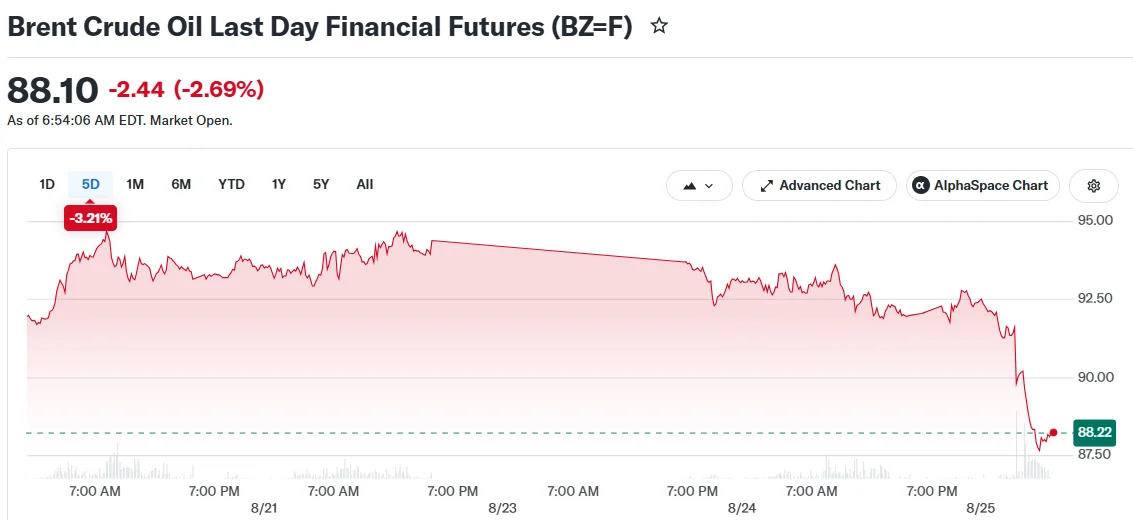
- Brent crude declined approximately 2% to roughly $90 per barrel; WTI touched a one-week low around $83
- Washington unveiled sanctions targeting 60 Iran-associated entities without establishing enforcement deadlines
- Market participants interpreted the sanctions as milder than anticipated, diminishing oil’s geopolitical risk premium
- Maritime traffic through the Strait of Hormuz continues to face major constraints, with just two vessels transiting Monday
- Pakistani officials report “significant progress” in diplomatic negotiations between Iran and the United States
Crude oil benchmarks tumbled to their lowest levels in a week on Tuesday as the most recent U.S. sanctions package targeting Iran proved far less threatening to markets than energy traders had anticipated.
Brent crude futures slipped approximately 2% to settle at $90.38 per barrel. Meanwhile, U.S. West Texas Intermediate crude descended to around $83.25, marking its weakest position in seven days.
The decline followed Washington’s Monday announcement of sanctions against 60 individuals and entities with connections to Iran. However, the Treasury Department stopped short of implementing immediate penalties, and Treasury Secretary Scott Bessent declined to provide a concrete timetable for enforcement.
Commodity analysts at ING characterized the market’s response to the sanctions as viewing them “marginal rather than market-moving.” ANZ’s research team shared a similar assessment, noting that markets appeared “unimpressed” by what officials had characterized as an unprecedented economic isolation campaign against Tehran.
Ole Hansen, Saxo Bank’s head of commodity strategy, noted that Washington’s pivot from potential military intervention toward economic coercion had calmed nerves in energy markets. He emphasized that the actual announcement fell short of the more aggressive measures many market participants had feared.

Economic Pressure Eases Immediate Supply Fears
The Trump administration characterizes the sanctions framework as a strategy to sever Tehran’s revenue streams and compel Iran to return to diplomatic negotiations. Washington has cautioned international partners to terminate commercial relationships with Iran or face potential secondary sanctions.
Conspicuously missing from the sanctions roster was China, currently Iran’s predominant crude oil purchaser. ING analysts highlighted lingering questions about whether Washington would risk damaging its delicate trade relationship with Beijing by penalizing Chinese companies.
Iranian officials have declared their readiness to respond and have historically threatened to obstruct petroleum shipments throughout the Middle East. U.S. Defense Secretary Pete Hegseth also affirmed that military options have not been ruled out.
Strait of Hormuz Risk Remains
Despite the muted market response, tangible supply disruption risks persist. Maritime data shows only two tankers successfully transited the Strait of Hormuz on Monday, representing the lowest single-day figure since the beginning of May. The critical waterway typically facilitates approximately one-fifth of worldwide oil consumption.
Additionally, an oil tanker sustained damage from an unidentified projectile off the coast of Oman on Tuesday, as reported by the United Kingdom Maritime Trade Operations agency.
Tim Waterer, chief market analyst at KCM, emphasized that Iran retains the capability to interfere with shipping routes, maintaining an underlying risk premium embedded in crude prices.
In separate developments, Russia’s Novoshakhtinsk oil refinery located in the Rostov region suffered damage overnight from a Ukrainian drone strike, forcing the facility to halt operations following the assault.
On the diplomatic landscape, Pakistan’s Interior Minister Mohsin Naqvi announced Tuesday that discussions with Iranian representatives had “concluded on a highly positive note” and indicated meaningful advancement toward reestablishing a ceasefire agreement between Iran and the United States.
An earlier ceasefire agreement signed in June disintegrated following attacks on tankers in the Strait of Hormuz.
Get 3 Free Stock Ebooks
Discover top-performing stocks in AI, Crypto, and Technology with expert analysis.
- Top 10 AI Stocks - Leading AI companies
- Top 10 Crypto Stocks - Blockchain leaders
- Top 10 Tech Stocks - Tech giants



