


Key Points
- Brent crude breached the $100 per barrel mark Thursday, reaching this level for the first time since late May
- Yemen-based Houthi forces announced strikes targeting Saudi oil vessels navigating the Red Sea
- American forces conducted their twelfth consecutive evening of military operations against Iranian positions
- Tehran announced complete restrictions on the Strait of Hormuz for vessels lacking proper authorization
- Energy sector equities including ExxonMobil and Chevron gained ground, while broader S&P 500 index futures declined more than 1%
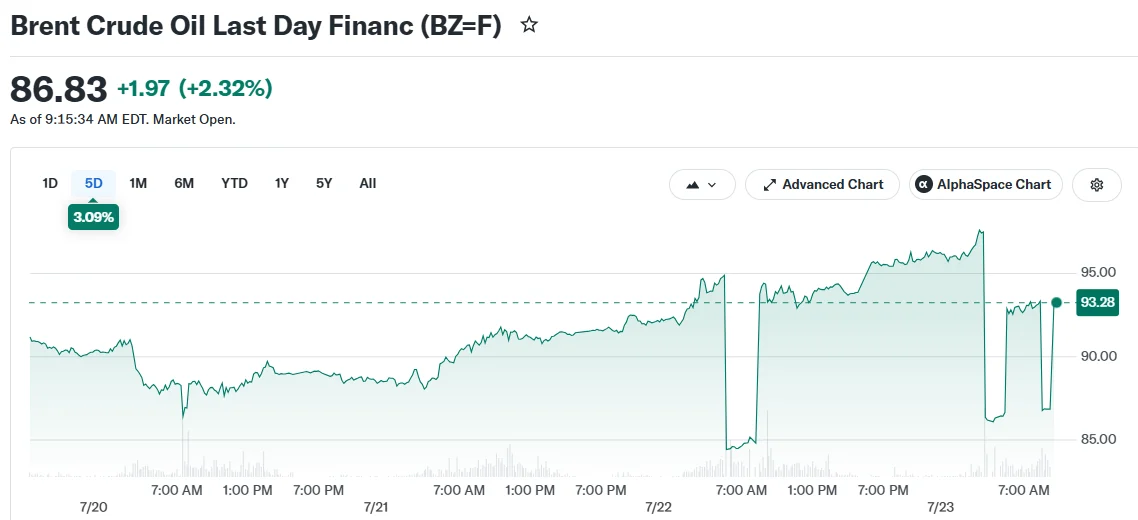
Energy markets experienced a dramatic rally Thursday as crude oil prices climbed beyond the $100 per barrel threshold, driven by intensifying Middle Eastern conflicts and mounting concerns over critical maritime passage security.
Brent crude benchmark futures climbed to $100.06 per barrel Thursday morning, marking the first breach of this psychological barrier since May 26. Meanwhile, West Texas Intermediate contracts surged approximately 5%, reaching the $91 per barrel range.
The dramatic price movement followed announcements from Houthi rebel forces operating in Yemen, who took credit for launching attacks against two Saudi Arabian oil tankers transiting the Red Sea. According to Houthi statements, these vessels had breached a naval embargo the militant group had instituted days earlier.
While Saudi officials have yet to verify any vessel damage, the incidents amplified anxieties regarding potential supply interruptions along one of the planet’s most critical petroleum transportation corridors.
Days prior, the Houthi organization had issued warnings that they would prevent Saudi-affiliated ships from traversing the Bab el-Mandeb Strait, a critical maritime bottleneck linking the Red Sea with the Gulf of Aden. Multiple Saudi petroleum tankers heading toward Indian and Chinese ports had already altered their routes in response to these threats.

Persian Gulf Waterway Faces Restrictions
U.S. armed forces executed their twelfth consecutive overnight military operation targeting Iranian facilities. Iran’s Revolutionary Guard reported that one vessel among three tankers caught fire in proximity to a mined navigation channel located south of the Strait of Hormuz.
Following these developments, Iranian authorities announced a complete closure of the Strait of Hormuz, stipulating that petroleum carriers must obtain advance clearance from Iranian officials before attempting passage through the waterway.
Combined, these two maritime chokepoints—the Strait of Hormuz and the Bab el-Mandeb—facilitate a substantial portion of worldwide seaborne petroleum transportation. Any prolonged obstruction could necessitate tanker diversions around Africa’s southern coast, significantly extending transit duration and escalating shipping expenses.
President Trump issued a statement via social media platforms, cautioning both Iranian leadership and Houthi forces that continued assault on commercial shipping would result in “major military punishment.”
Just one day prior, American officials had criticized Iran for demonstrating insufficient commitment to diplomatic negotiations.
Energy Equities Advance While General Markets Decline
Higher crude prices provided a boost to American petroleum company valuations. ExxonMobil shares advanced approximately 1.5% during pre-market hours, while Chevron stock increased roughly 1.9%.
However, wider market indices moved in the opposite direction. S&P 500 futures contracts retreated over 1% prior to regular trading commencement.
Recent U.S. federal energy statistics introduced an unexpected element to supply calculations. The Energy Information Administration disclosed an unanticipated increase in domestic crude stockpiles of 2 million barrels during the week concluded July 17, elevating aggregate commercial petroleum reserves to 411.7 million barrels.
Both gasoline and distillate reserves similarly expanded. Notwithstanding the inventory accumulation, market participants remained primarily focused on potential supply disruption risks stemming from regional hostilities rather than near-term stockpile figures.
Market observers cautioned that persistent uncertainty could continue pressuring financial markets should the regional conflict persist without diplomatic resolution.
Get 3 Free Stock Ebooks
Discover top-performing stocks in AI, Crypto, and Technology with expert analysis.
- Top 10 AI Stocks - Leading AI companies
- Top 10 Crypto Stocks - Blockchain leaders
- Top 10 Tech Stocks - Tech giants



