


Key Highlights
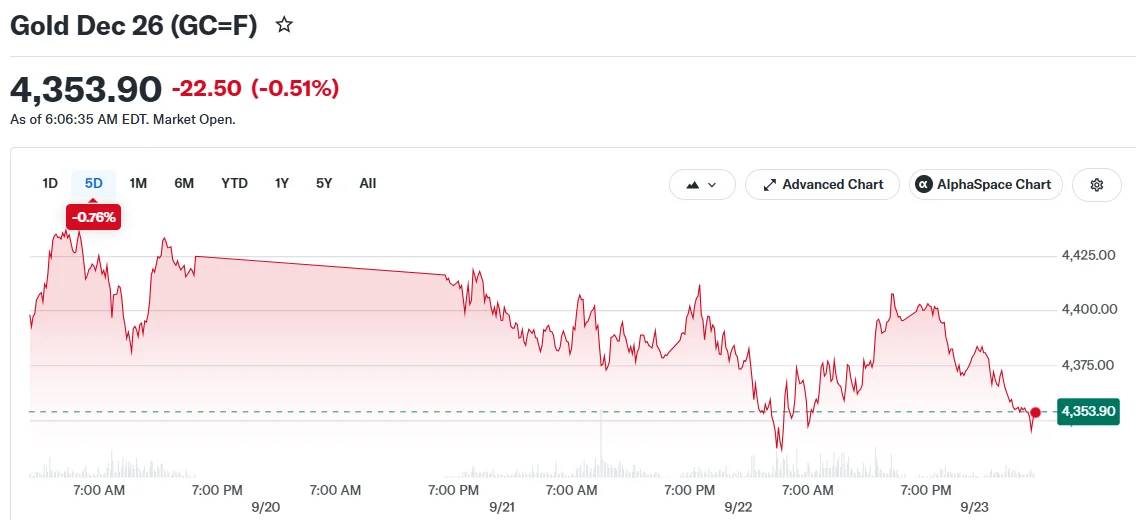
- Bullion prices retreated approximately 0.9% to settle near $4,318 per ounce amid dollar appreciation.
- The U.S. dollar index surged to levels not witnessed since late July, diminishing gold’s appeal to international purchasers.
- Last week’s Federal Reserve decision delivered a 25 basis point rate increase to 3.75%-4.00%, with markets anticipating additional monetary tightening ahead.
- Declining crude oil prices offer modest inflation relief, though petroleum costs remain significantly elevated year-to-date.
- Robust appetite from China and continued central bank accumulation provide a floor under prices.
Precious metal markets experienced downward pressure on Wednesday as the strengthening U.S. currency and projections for an extended period of elevated interest rates diminished appetite for the non-interest-bearing asset.
Spot gold declined roughly 0.9% to reach $4,318 per ounce, while futures contracts for U.S. gold decreased by approximately 0.5%. The dollar index advanced to approximately 100.71, marking its most robust position since July 30.
Elevated Rates Challenge Bullion Markets
The Federal Reserve implemented a 25 basis point increase to its benchmark rate last week, establishing a new range of 3.75%-4.00%—the first such adjustment in over three years. Central bank officials also signaled the possibility of an additional rate adjustment prior to the conclusion of 2026.
Elevated interest rate environments typically create headwinds for gold, as the precious metal generates no yield. This dynamic enables investors to capture superior returns through bonds and alternative income-producing investments.
Federal Reserve representatives have maintained their emphasis on inflation concerns. Susan Collins, President of the Boston Federal Reserve, stated that a moderately more restrictive policy rate may prove necessary to guide inflation sustainably back toward the central bank’s 2% objective.

The appreciating dollar compounds these challenges. Since gold trades in dollar denominations, a strengthening U.S. currency elevates costs for international buyers transacting in euros, yen, and other foreign currencies.
Retreating Petroleum Prices Provide Limited Support
Crude oil valuations have softened as optimism builds regarding enhanced Middle Eastern supply conditions. Iranian officials have suggested potential reopening of the Strait of Hormuz under specific circumstances, while Saudi Arabia has resumed operations on its East-West pipeline infrastructure.
Brent crude has slipped beneath the $100 per barrel threshold, alleviating concerns that energy costs will perpetuate inflationary pressures. Nevertheless, petroleum prices remain considerably elevated compared to early-year benchmarks.
Declining energy expenditures may eventually diminish pressure on monetary authorities to continue rate escalation. This development creates a partial offset to the strengthening dollar and prevailing expectations for continued monetary policy tightening affecting gold.
Chinese Market Activity Bolsters Precious Metal
Physical purchasing and investment flows continue delivering underlying support. ANZ research indicates Chinese gold imports approximated 1,000 tonnes throughout the initial eight months of 2026, while Chinese gold exchange-traded funds accumulated roughly 44 tonnes during August alone.
The People’s Bank of China reportedly intensified its gold acquisition program to approximately 20 tonnes in August. Central bank purchasing has emerged as a significant long-term demand catalyst for bullion markets.
Gold has nonetheless encountered difficulty as market participants concentrate on real yields and currency dynamics. Reuters coverage on Tuesday noted that bullion had retreated more than 22% from its January peak of $5,594.82 per ounce as ascending rates diminished its comparative attractiveness.
For the immediate term, primary market drivers remain the dollar trajectory, Treasury yield movements, and anticipations surrounding forthcoming Federal Reserve policy decisions.
Get 3 Free Stock Ebooks
Discover top-performing stocks in AI, Crypto, and Technology with expert analysis.
- Top 10 AI Stocks - Leading AI companies
- Top 10 Crypto Stocks - Blockchain leaders
- Top 10 Tech Stocks - Tech giants



