


Key Highlights
- Zakura introduces Zakura Common, an open-source cryptographic library that accelerates Zcash private transaction generation from over 3 seconds to less than 200 milliseconds
- Performance improvements include 14x faster mobile proof generation and 5x faster desktop processing
- Wallet providers can implement the library immediately without waiting for network upgrades or hard forks
- Following the announcement, ZEC climbed roughly 5%, though gains moderated during Monday’s broader market correction
- The new cryptography stack is already integrated into Zakura v1.3.0, with Vizor Wallet being an early adopter
A significant performance upgrade has arrived for Zcash through the introduction of Zakura Common, an open-source cryptographic toolkit developed to dramatically accelerate private transaction processing on the network.
Before this development, users initiating shielded transactions — which conceal sender identity, recipient information, and transaction amounts — experienced delays exceeding three seconds as wallets completed necessary cryptographic computations. The Zakura Common library reduces this latency to below 200 milliseconds in optimal conditions.
The cryptographic library originates from Zakura, the development team responsible for launching a Zcash full node client in July 2025. Among the co-founders is Sean Bowe, a distinguished zero-knowledge cryptography specialist who has contributed to Zcash’s proving mechanisms since before the network’s initial deployment.
Performance metrics show mobile proof generation accelerating by more than 1400%. Desktop systems experienced five-fold speed enhancements. Sinsemilla hashing operations, integral to Zcash’s Orchard protocol implementation, achieved a 21-times performance boost. The zk-SNARK verification process, fundamental to Zcash’s privacy architecture, now operates four to eight times more efficiently.
“Shielded wallets that use Zakura Common, and full nodes like Zakura itself, all benefit,” Bowe said in a post on X.
Implementation Impact on Wallets and End Users
This performance enhancement requires no modifications to Zcash’s underlying protocol architecture. Wallet development teams can incorporate the open-source library immediately, circumventing the need for network-wide consensus upgrades or protocol forks.

The latest Zakura release, version 1.3.0, incorporates the enhanced cryptographic stack. Vizor Wallet has emerged as one of the initial third-party applications to implement the technology. Additional benefits include accelerated wallet synchronization processes and improved full node efficiency with reduced block orphaning rates.
Developers have verified the software’s compatibility with the proposed 25-second block intervals planned for NU7, Zcash’s forthcoming major protocol enhancement.
Market Performance and ZEC Price Movement
Market analyst seth_fin shared observations on X noting ZEC was experiencing a “nice breakout after ETF news” and projected the token was “on its way to $1000,” highlighting growing market enthusiasm surrounding the asset.
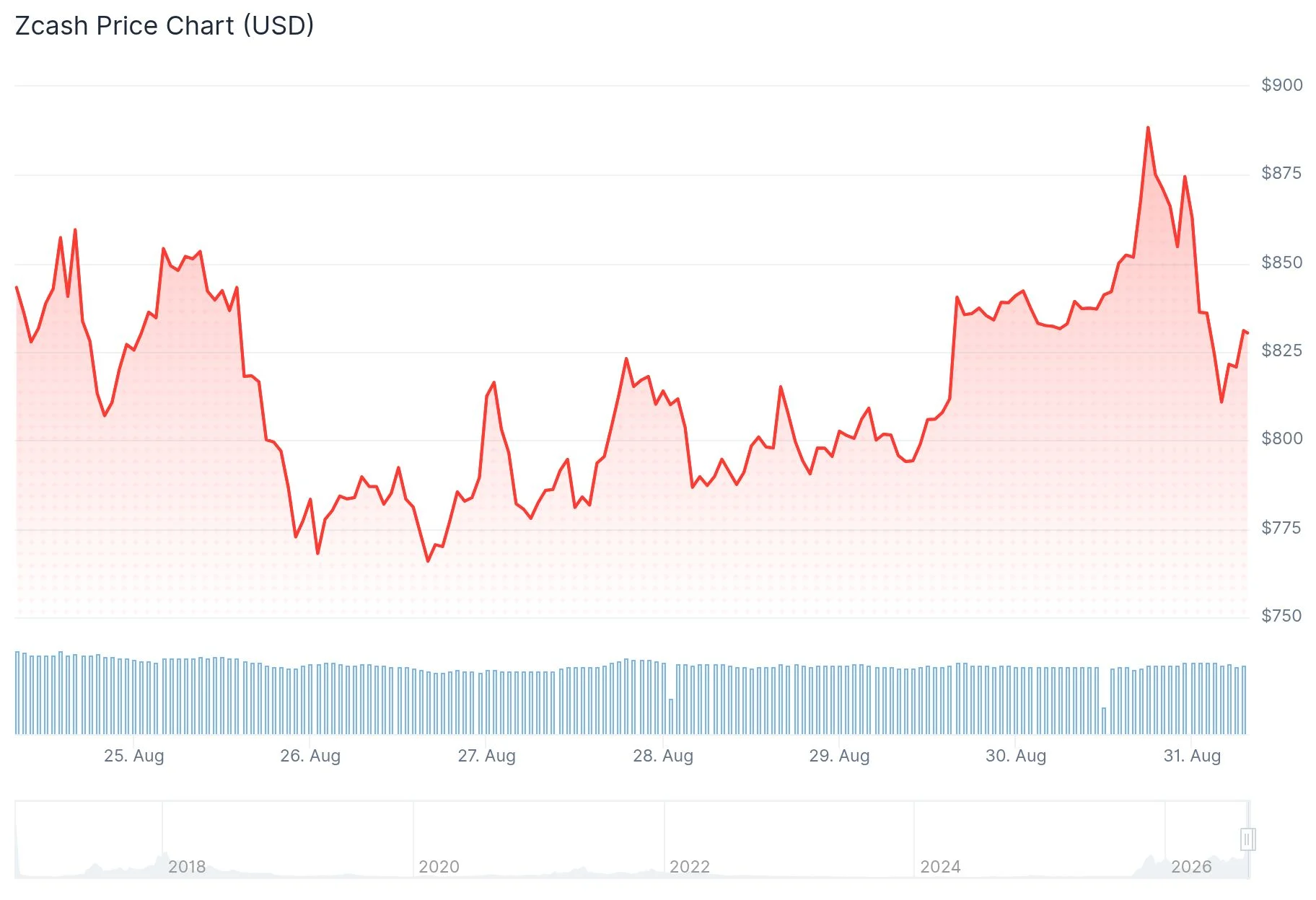
Following the Zakura Common announcement, ZEC appreciated approximately 5% to approach $839. The token experienced modest retracement during Monday’s trading session, correlating with broader cryptocurrency market weakness.
The Zakura Common launch represents one component of Project Tachyon, an ambitious initiative targeting scalability improvements to enable Zcash to process more than 50,000 private transactions per second — performance levels rivaling established payment card networks. This broader scaling project has also migrated to the enhanced cryptography infrastructure.
ZEC was trading around $839 during reporting, reflecting approximately 5% daily gains before Monday’s market-wide pullback began.
Get 3 Free Stock Ebooks
Discover top-performing stocks in AI, Crypto, and Technology with expert analysis.
- Top 10 AI Stocks - Leading AI companies
- Top 10 Crypto Stocks - Blockchain leaders
- Top 10 Tech Stocks - Tech giants



