
An emergency fund has one job: to be there when something goes wrong.
It may need to cover a broken transmission, an urgent flight, a medical bill or a month without income. The money shouldn’t depend on a rising market, and accessing it shouldn’t require solving a technical problem under pressure.
Stablecoins appear to meet some of those requirements. Assets such as USDC and USDT are designed to maintain a value close to the US dollar. They can be transferred at any time, held outside a bank and moved across borders without waiting for traditional banking hours.
That raises an increasingly common question: could stablecoins replace some or all of a conventional emergency fund?
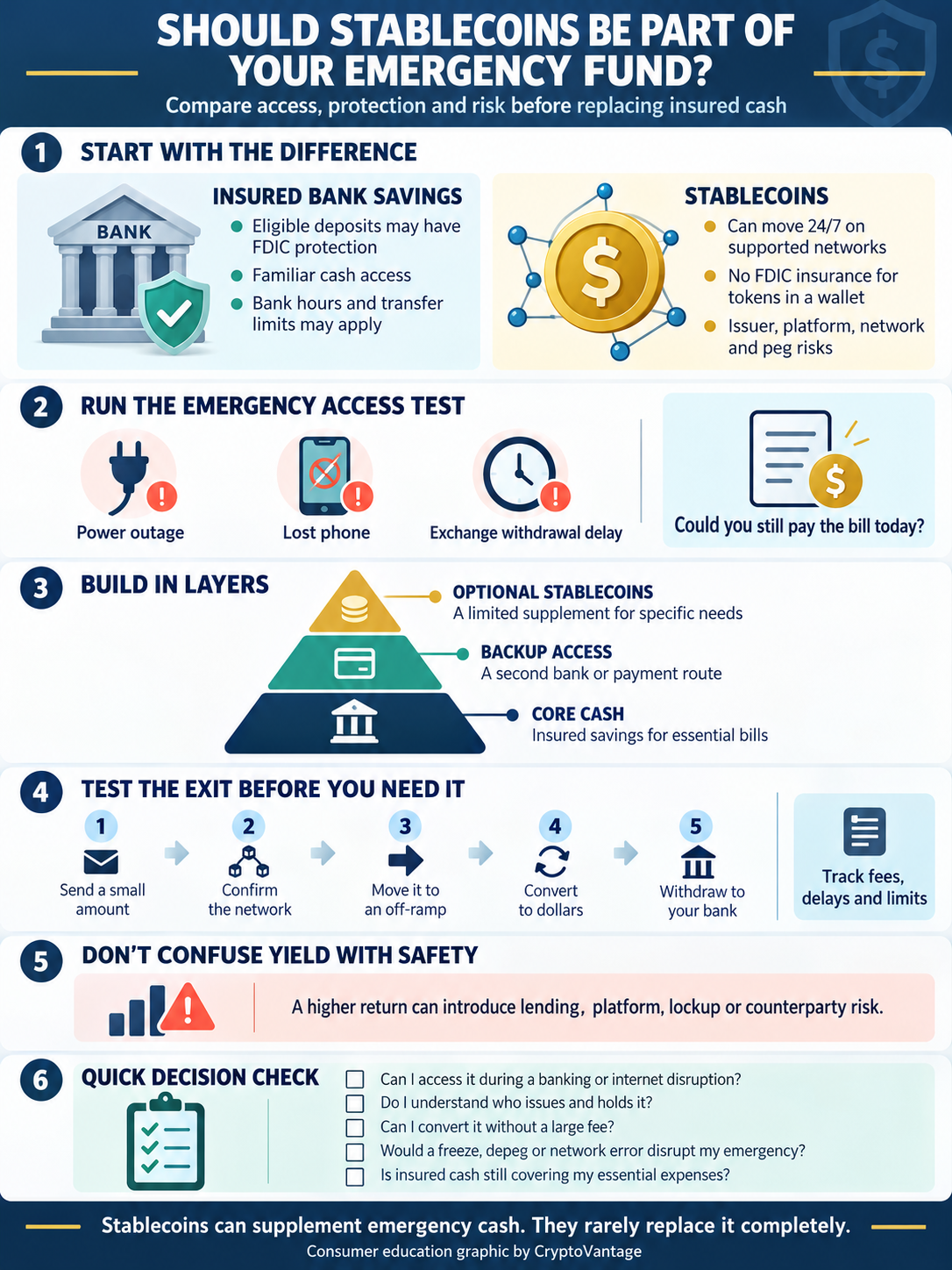
CryptoVantage examined that question by comparing stablecoins with checking accounts, savings accounts and money market deposit accounts. The answer isn’t a simple yes or no. Stablecoins can improve access in certain situations, but they introduce risks that insured bank deposits are specifically designed to avoid.
What an Emergency Fund Actually Needs
Investment accounts are judged by growth. Emergency funds should be judged by reliability.

A practical emergency reserve needs several qualities:
- Stable purchasing power
- Fast access
- Predictable conversion into spendable money
- Low transaction costs
- Protection from institutional failure
- Simple records
- Limited technical risk
- Availability when banks or markets are closed
Yield is useful, but it is secondary. Earning an extra percentage point doesn’t help if the account is frozen, the asset loses its peg or a transfer is sent through the wrong blockchain.
This is also why Bitcoin, Ether and other volatile cryptocurrencies generally don’t work as the core of an emergency fund. An unexpected expense may arrive during a market decline, forcing the owner to sell at an unfavorable time.
A stablecoin tries to solve that volatility problem. It doesn’t eliminate the other risks.
Stablecoins Are Designed to Track Another Asset
A stablecoin is a blockchain-based token designed to maintain a relatively stable value. Dollar-denominated products normally aim to trade around $1.
USDC is issued by Circle, while USDT is issued by Tether. Both exist on multiple blockchain networks and are widely supported by cryptocurrency exchanges and wallets.
Unlike Bitcoin, a fiat-backed stablecoin is issued by a company that holds reserve assets intended to support redemption. Circle publishes information about the assets backing USDC, while Tether publishes reserve reports and circulation data for USDT.
Readers unfamiliar with the structure can review how stablecoins work before deciding whether one belongs anywhere near household savings.
The important word is “designed.” A stablecoin’s target is $1, but that doesn’t mean its market price is contractually guaranteed to remain there at every moment or on every platform.
A Stablecoin Is Not an Insured Bank Deposit
This is the most important distinction.
Money held in an eligible checking, savings or money market deposit account at an FDIC-insured bank may receive deposit-insurance protection up to the applicable legal limits. That protection applies if the insured bank fails.
The FDIC explicitly states that crypto assets are not insured deposits. Its protection doesn’t cover the failure of a crypto exchange, wallet provider, custodian or stablecoin issuer.
That remains true even if a cryptocurrency company works with an insured bank. The fact that some of the company’s dollars are deposited at a bank doesn’t automatically give every token holder direct FDIC protection.
A customer should distinguish among:
- Dollars held directly in an insured bank account
- A cash balance held through a financial application
- USDC or USDT held on an exchange
- Stablecoins stored in a self-custody wallet
- Stablecoins deposited into a lending or yield product
Those arrangements may look similar inside an application. Legally and operationally, they are not the same.
For the portion of an emergency fund intended to cover rent, food and essential bills, deposit insurance is a substantial advantage.
Stablecoins Can Move Outside Banking Hours
Stablecoins have a genuine accessibility benefit: blockchain networks don’t close for weekends or holidays.
A self-custody wallet can send supported stablecoins at almost any time. Someone working internationally may transfer funds without waiting for the receiving bank’s business day to begin.
That can be useful when:
- A family member in another country needs money
- Local bank transfers are unavailable during a holiday
- The owner needs to move value between financial platforms
- Traditional international transfers would take several days
- A merchant or service provider directly accepts the stablecoin
Yet moving a token isn’t the same as paying an emergency expense.
A landlord, mechanic or hospital may require dollars through a card, check, ACH transfer or bank account. If the recipient doesn’t accept USDC or USDT, the owner must sell or redeem the stablecoin and withdraw the proceeds.
Coinbase states that selling cryptocurrency into a Coinbase cash balance is generally instant, subject to any account holds. The time required to move that cash elsewhere depends on the withdrawal method and the estimate shown before confirmation.
The blockchain may operate continuously, but the banking leg of the transaction can still introduce a delay.
The Network Matters
USDC is not confined to one blockchain. Circle supports it across multiple networks, with separate smart-contract addresses for each implementation.
This flexibility can reduce costs and improve transfer speed. It also gives users another decision to get right.
An exchange might support USDC deposits over Ethereum, Base and Solana while another platform supports only two of those networks. Selecting an unsupported network can delay access and may require a manual recovery process. In some cases, recovery may not be possible.
Network fees also vary. Moving USDC on Ethereum may cost more than transferring it through a lower-cost network, particularly during congestion. The cheapest route is not useful, however, if the destination doesn’t support it.
An emergency transfer checklist should confirm:
- The asset
- The sending network
- The receiving network
- The destination address
- Any memo or additional identifier
- The network fee
- The expected arrival time
For a large transfer, sending a small test amount first may reduce the risk of an irreversible mistake. That adds another transaction and fee, but emergencies are not a good time to discover that two platforms use incompatible deposit routes.
Issuers Can Freeze Certain Addresses
Stablecoins offer more control than a bank balance when held in a self-custody wallet, but they are not censorship-resistant in the same way as Bitcoin.
Circle’s published policies explain that it can block particular addresses from sending or receiving USDC in limited circumstances. Its risk disclosures also describe the ability to freeze associated assets under certain conditions.
Stablecoin issuers use these controls to respond to legal orders, sanctions, thefts and suspected illegal activity. For most ordinary users, an issuer-level freeze is unlikely. Still, it is a capability that should be acknowledged when evaluating the asset.
An exchange or custodial application can impose a separate account restriction. That means a holder may face two layers of control:
- The stablecoin issuer’s controls over the token
- The platform’s controls over the customer account
Self-custody removes the exchange-account layer, but it doesn’t remove the issuer’s smart-contract authority.
Pegs Can Come Under Pressure
A dollar-denominated stablecoin is expected to remain near $1. Market stress can test that expectation.
The token may trade below its target if users question reserve quality, redemption access or the financial health of an issuer or banking partner. Thin liquidity on a particular exchange can also produce a temporary price difference that doesn’t appear everywhere else.
Even a small deviation matters when the money is needed immediately.
If $10,000 in stablecoins can only be sold for $9,700 during a period of market stress, the 3% difference becomes a real emergency-fund loss. The holder may expect the peg to recover, but waiting defeats the purpose of keeping readily available reserves.
This doesn’t mean every stablecoin is destined to fail. It means a stable value depends on reserves, redemption mechanisms, market liquidity and continued confidence.
A conventional dollar in an insured bank account doesn’t need to maintain a market peg to itself.
Yield Adds Another Layer of Risk
Some platforms offer rewards or yield on stablecoin balances. This can make a stablecoin emergency fund look more attractive than a conventional savings account.
The source of the yield matters.
A platform might lend stablecoins to borrowers, deploy them through decentralized finance protocols or compensate users as part of a promotion. Each method adds risks beyond simply holding the token.
Possible risks include:
- Borrower default
- Platform insolvency
- Smart-contract failure
- Liquidity shortages
- Withdrawal delays
- Changing reward rates
- Loss of promotional benefits
- Additional token incentives declining in value
The collapses of BlockFi, Celsius and Voyager demonstrated why a balance labeled as a crypto “savings” product should not be assumed to carry the protections of a bank savings account.
A stablecoin held in a self-custody wallet creates issuer, software and user-security risks. Depositing it into a yield platform adds the platform and its strategy to the chain.
CryptoVantage’s review found that the more an emergency reserve is optimized for return, the less it may behave like an emergency reserve.
Bank Accounts Have Their Own Access Limits
Traditional bank accounts aren’t perfect.
An ACH transfer can take time. A bank may investigate unusual activity, delay a large deposit or temporarily restrict an account after detecting suspected fraud. ATM withdrawal limits can also prevent immediate access to a large amount of cash.
Online savings accounts may require money to be transferred into a linked checking account before it can be spent. That matters when comparing advertised interest rates.
Still, an established bank account usually integrates directly with the payment systems used for rent, utilities, credit cards and ordinary retail purchases.
Banks also provide familiar recovery systems. A forgotten password normally doesn’t destroy the underlying funds. A customer can verify their identity and regain account access.
A self-custody wallet works differently. Losing the recovery phrase and the device may make the stablecoins permanently inaccessible. Sending them to the wrong address may be irreversible.
Accessibility includes the ability to recover after an ordinary human mistake.
Comparing a Stablecoin With a Savings Account
Imagine someone has a $12,000 emergency fund, equal to four months of essential expenses.
If all $12,000 sits in an insured savings account, the owner receives straightforward dollar access, deposit protection and simple statements. The tradeoff may be waiting for a transfer into checking before spending it.
If the entire amount is converted to USDC and stored in a self-custody wallet, it becomes portable across supported blockchain networks. But the owner now depends on Circle’s reserves and redemption system, wallet security, a compatible off-ramp and correct network selection.
Holding the USDC on Coinbase simplifies conversion but adds exchange-account risk. Moving it into a yield product introduces another provider or smart contract.
The stablecoin option has more moving parts. Each one may work as intended, but an emergency fund is supposed to reduce the number of things that must work simultaneously.
That doesn’t prevent someone from maintaining a smaller stablecoin balance for cross-border transfers or crypto-native expenses. It does argue against treating stablecoins as a perfect substitute for insured cash.
A Layered Emergency Fund May Be More Practical
The most sensible structure may not require choosing only one asset.
A layered emergency reserve could separate money according to when and how it might be needed.
Layer One: Immediate Bills
Keep enough in an insured checking or savings account to cover urgent household expenses. This is the money for rent, groceries, insurance, medication and utilities.
It should be accessible without selling an investment or transferring funds through an exchange.
Layer Two: Secondary Cash Reserve
Additional emergency savings can remain in an insured high-yield savings account or money market deposit account. The owner can earn interest while retaining relatively straightforward access.
Before using any product described as a money market account, confirm whether it is a bank deposit account or a money market mutual fund. The names sound similar, but their protections differ.
Layer Three: Limited Stablecoin Liquidity
Someone who regularly makes international payments or operates within the crypto economy might hold a smaller USDC or USDT balance.
This portion should be an amount the owner can afford to access through a less predictable process. It shouldn’t be the only money available for tomorrow’s rent.
The correct percentage depends on the household. For many people, it may be zero. For a freelancer paid internationally, a stablecoin buffer may be more useful.
MoneyCheck has previously shown how even a relatively small crypto allocation can contribute a disproportionate amount of portfolio risk. Its coverage of Charles Schwab’s crypto-allocation framework reinforces the difference between the percentage of money allocated and the percentage of total risk that allocation creates.
Stablecoins Should Not Be Confused With Investments
An emergency fund should be separate from a long-term investment portfolio.
MoneyCheck’s guide to building a $1,000 cryptocurrency portfolio discusses asset allocation across Bitcoin, Ethereum and other cryptocurrencies. That type of portfolio has a different purpose from emergency savings.
Stablecoins may sit in the middle. They aren’t designed to appreciate like Bitcoin, but they still carry cryptocurrency-specific risks.
Someone could therefore maintain three clearly separated categories:
- Emergency cash
- Stablecoins for payments or transfers
- Long-term crypto investments
Keeping the categories separate makes it easier to avoid spending emergency money on a speculative opportunity or treating investment gains as guaranteed savings.
Questions to Ask Before Using Stablecoins for Emergencies
Before allocating any emergency reserves to a stablecoin, ask:
- Who issues the token?
- What assets back it?
- How frequently are reserve reports published?
- Which blockchain will be used?
- Where will the token be stored?
- Is the balance held directly or through a yield product?
- Can it be converted to dollars at any time?
- How long does the bank withdrawal normally take?
- What fees apply during conversion and withdrawal?
- Is there a second off-ramp if the primary exchange is unavailable?
- What happens if the wallet or phone is lost?
- Could the address or account be frozen?
- Is the emergency expense likely to accept the token directly?
- How much insured cash remains available?
If several answers are uncertain, the stablecoin probably isn’t ready to perform an emergency-fund role.
Test the Exit Before an Emergency
Anyone keeping emergency money in stablecoins should perform a small cash-out test before depending on the process.
That means sending a modest amount to the intended exchange, confirming that the deposit network works, selling the token and withdrawing dollars to the linked bank account.
Record:
- The blockchain used
- The network fee
- The exchange fee or spread
- The time required for confirmation
- The time required for the bank withdrawal
- Any minimum withdrawal amount
- Any security hold encountered
The test doesn’t guarantee that every future transaction will behave identically. It does reveal obvious problems while the situation is calm.
A second verified exchange or redemption route can also provide redundancy. Both accounts should be fully verified in advance. Creating a new exchange account during an emergency may trigger identity checks and funding delays.
Stablecoins Can Supplement Cash, but Should Rarely Replace It
Stablecoins solve real problems. They can move across borders, operate outside banking hours and provide dollar-denominated value inside blockchain applications.
Those benefits can justify holding a limited balance for international transfers, crypto-native payments or access to funds when a particular banking route is unavailable.
They don’t reproduce every feature of a conventional emergency fund.
Stablecoins lack direct FDIC insurance, depend on issuers and reserves, require correct blockchain handling and may still need to pass through an exchange before paying ordinary bills. Yield products add further risk rather than making the asset more cash-like.
The strongest emergency fund is usually boring. It is easy to reach, difficult to lose and available in the form the next bill requires.
Stablecoins may provide a useful additional layer. They shouldn’t be mistaken for the foundation unless the owner fully understands what could prevent the money from arriving when it is needed most.
About the Author
CryptoVantage is a cryptocurrency publication providing educational guides, news, analysis, and reviews covering Bitcoin, blockchain, exchanges, wallets, fintech, and digital assets. Its team of writers, researchers, and cryptocurrency specialists creates accessible content for both newcomers and experienced crypto users, helping readers better understand the rapidly evolving digital-asset industry.
Disclaimer: This is a Press Release provided by a third party who is responsible for the content. Please conduct your own research before taking any action based on the content.
Get 3 Free Stock Ebooks
Discover top-performing stocks in AI, Crypto, and Technology with expert analysis.
- Top 10 AI Stocks - Leading AI companies
- Top 10 Crypto Stocks - Blockchain leaders
- Top 10 Tech Stocks - Tech giants