



Key Takeaways
- XRP currently hovers near $1.40 with an approximate market capitalization of $87 billion
- Conservative projections suggest XRP could reach $4–$6 by 2031 through general crypto market expansion
- Optimistic scenarios place XRP between $10–$15 if it achieves widespread institutional settlement adoption
- Pessimistic forecasts estimate $0.70–$1.20 should financial institutions favor stablecoins or proprietary blockchain solutions
- Weighted probability analysis indicates a five-year price objective near $5.80
XRP remains a cryptocurrency that generates significant discussion among market participants. Supporters view it as a compelling opportunity for enterprise-level integration. Skeptics question its reliance on Ripple’s ecosystem and doubt whether banking institutions will adopt XRP for large-scale operations.
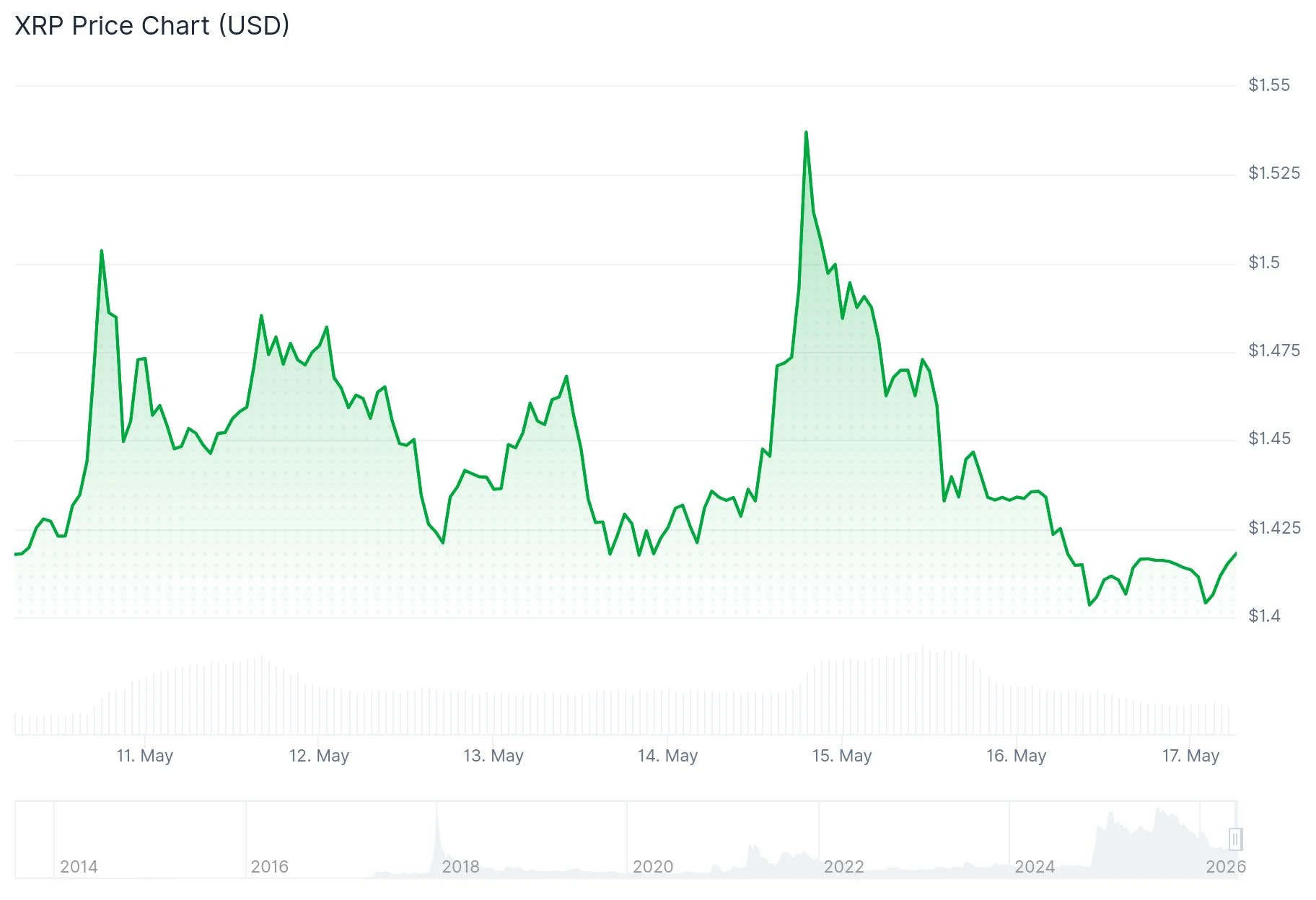
Currently, XRP is valued at approximately $1.40, commanding a market valuation approaching $87 billion with roughly 61.8 billion tokens in active circulation. The critical question facing investors is whether XRP can evolve into an essential component for cross-border payments, financial settlement systems, and institutional cryptocurrency holdings over the next five years.
Market researchers have outlined three distinct trajectories for where XRP might settle by the year 2031.
Conservative Projection: $4 to $6 Range
The most probable outcome positions XRP within the $4 to $6 bracket by 2031. Such a valuation would translate to a market capitalization ranging from approximately $250 billion to $375 billion.
This framework presumes XRP advances in tandem with overall cryptocurrency market expansion. Financial institutions would gain exposure through exchange-traded funds and compliant investment vehicles. The XRP Ledger would demonstrate consistent transaction growth. Regulatory frameworks would become clearer across major jurisdictions.

XRP would maintain a position beneath Bitcoin and presumably Ethereum under this projection. Nevertheless, it would represent substantial growth from current valuations.
Three critical elements must align for this outcome: favorable regulatory developments, genuine adoption metrics, and sustained investor appetite.
Optimistic and Pessimistic Projections
The optimistic forecast presents a more ambitious outlook. For XRP to achieve $10 to $15 valuations, market capitalization would need to surpass $600 billion, potentially approaching $900 billion.
This scenario demands XRP establish itself as a dominant settlement mechanism across payment networks, tokenized asset platforms, and international money transfer systems. Substantial ETF capital inflows combined with robust expansion of Ripple’s commercial ecosystem would be essential prerequisites.
The pessimistic projection presents a contrasting narrative. Should banking institutions prefer stablecoins, proprietary blockchain infrastructure, or government-issued digital currencies, XRP could remain confined to the $0.70 to $1.20 range.
Lackluster ETF participation or stagnant XRP Ledger transaction volumes would similarly constrain price appreciation.
Aggregating all three scenarios with appropriate probability weighting yields a target price approximating $5.80 by 2031.
Critical Factors for Monitoring
The primary catalyst remains enterprise adoption. Exchange-traded products and corporate treasury allocations could unlock substantially larger capital flows.
Regulatory clarity follows closely. XRP requires definitive legal frameworks in principal markets before significant institutional capital commits.
Practical implementation carries weight as well. Market participants will scrutinize whether XRP Ledger transaction volumes, asset tokenization activity, and settlement throughput demonstrate meaningful expansion.
Competitive pressure represents the principal downside risk. Ethereum, Solana, stablecoins, and private payment infrastructure all pursue the identical institutional market segment that XRP targets.
The probability-adjusted five-year valuation target stands at $5.80, calculated using existing circulating supply figures and reasonable market capitalization projections.
Get 3 Free Stock Ebooks
Discover top-performing stocks in AI, Crypto, and Technology with expert analysis.
- Top 10 AI Stocks - Leading AI companies
- Top 10 Crypto Stocks - Blockchain leaders
- Top 10 Tech Stocks - Tech giants



