


Key Highlights
- Geoffrey Kendrick of Standard Chartered believes his $100 UNI forecast for 2030 may be underestimating the token’s potential
- The decentralized exchange dominates Robinhood Chain with a 76.5% share of trading activity, capturing $1.81M of $2.28M in daily protocol fees
- Annual token burns have reached approximately $90M, eliminating roughly 4% of the circulating supply each year
- Over the last week, Robinhood Chain generated 60% of Uniswap’s entire protocol revenue
- A competing launchpad supported by SushiSwap is under development to contest Uniswap’s dominance on the network
When Geoffrey Kendrick of Standard Chartered projected a $100 valuation for UNI in June, he anticipated a 37-fold increase by 2030 fueled by decentralized finance expansion. Just six weeks into that prediction, the analyst is reconsidering his stance — not to lower expectations, but to suggest the target might actually be too modest.
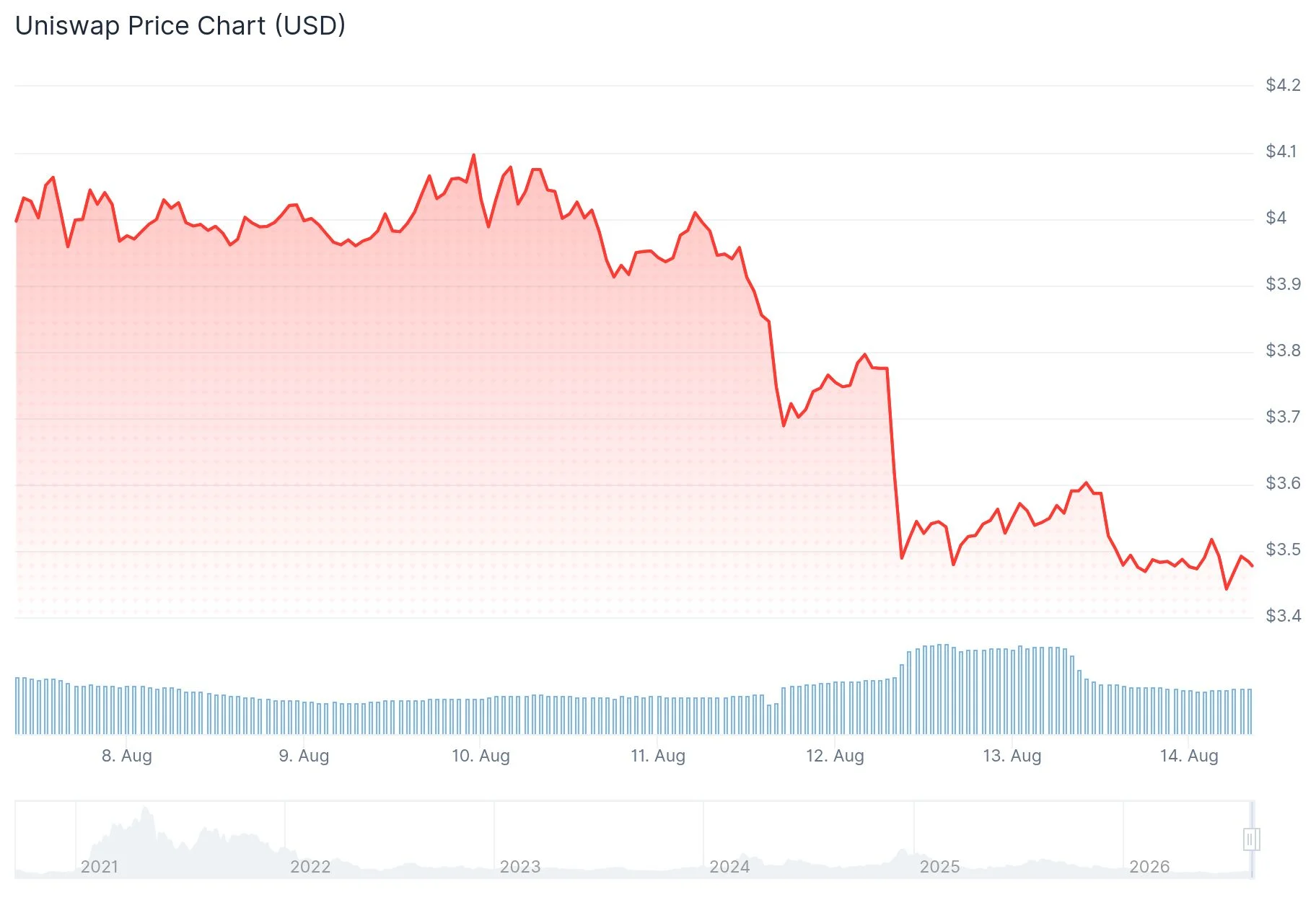
On Thursday, UNI exchanged hands around $3.48, experiencing a roughly 3% decline for the day. Blockchain analytics indicate that whale-level accumulation has reached its highest point in five years during this month.
Following its July 2 debut, Robinhood Chain saw Uniswap seize 76.5% of all on-chain trading within just 42 days, based on DefiLlama metrics. During peak activity, the protocol’s liquidity pools handled $409 million in daily trading volume.
This substantial volume translates directly into fee generation. Uniswap secured $1.81 million from the chain’s $2.28 million total daily fees — representing a 78.8% share while accounting for merely 16.3% of the chain’s total value locked.
The Significance of Token Burning
A fee distribution system implemented in December 2025 directs a portion of Uniswap’s protocol earnings toward purchasing and permanently removing UNI tokens from circulation. An additional mechanism specifically for Robinhood Chain activated on July 27, effectively doubling the burn velocity.

According to Kendrick’s calculations, the annualized burn rate currently sits at approximately $89–90 million. With UNI priced at $3.48, this translates to roughly 25.7 million tokens being eliminated annually — representing about 4% of the 624 million tokens currently in circulation.
The protocol initially distributed 1 billion tokens at launch. To date, approximately 109 million have been permanently burned.
Even if UNI reaches Kendrick’s end-2026 projection of $6.50, the burn mechanism would still eliminate around 2.2% of the total supply each year. Robinhood Chain alone accounted for $925,000 of Uniswap’s $1.55 million in aggregate protocol revenue during the previous seven-day period.
Emerging Competitive Challenges
Uniswap introduced Pools.trade, its proprietary token launchpad on Robinhood Chain, on August 5. The platform forgoes launchpad fees entirely, charging only a standard 0.25% fee for liquidity providers — significantly lower than the approximately 1% extracted by rival platforms.
A developer operating under the pseudonym 0xDeployer is constructing an alternative launchpad in collaboration with SushiSwap, alleging that Uniswap seeks to monopolize the entire chain infrastructure. A distinct token is being created to finance this initiative.
Currently, SushiSwap manages only 0.45% of trading volume on Robinhood Chain, while Uniswap commands 76.5%.
From July 27 through August 12, Uniswap’s average daily revenue climbed to $244,000 — representing a 2.4-fold increase compared to the preceding 17-day average of $99,800.
Get 3 Free Stock Ebooks
Discover top-performing stocks in AI, Crypto, and Technology with expert analysis.
- Top 10 AI Stocks - Leading AI companies
- Top 10 Crypto Stocks - Blockchain leaders
- Top 10 Tech Stocks - Tech giants



