



Key Highlights
- The platform handled $71.1 billion in trades across the last 30 days, exceeding the combined volume of its three nearest competitors
- Version 4 of the protocol accounts for approximately $38B in monthly activity, while v3 contributes around $32B
- Revenue from protocol fees totaled $28.2 million from January to July 2026
- The UNI token changed hands around $6.21, experiencing a roughly 2% decline in recent trading
- Supply reduction mechanisms via Firepit and TokenJar continue burning UNI, though the impact remains limited compared to 623 million tokens in circulation
The leading decentralized exchange has registered $71.1 billion in swap activity throughout the previous 30 days, positioning itself at the top of every DEX monitored by DeFiLlama. According to official statements, the platform’s throughput surpassed what the next three largest decentralized exchanges achieved together.
Looking at the seven-day window, the protocol facilitated over $21.3 billion worth of transactions. On any given day, swap volumes approached the $2 billion mark.
Its nearest rival, PancakeSwap, recorded $29.8 billion during the identical monthly timeframe. This creates a differential exceeding $41 billion between the two leading platforms.
The fourth iteration of Uniswap represents approximately $38 billion of the aggregate monthly figure. The third version delivers around $32 billion, while version 2 supplements this with more than $1.2 billion.
Multi-Chain Deployment Drives Activity
The protocol maintains operations on over 40 different blockchain networks. While Ethereum retains the dominant position in terms of total value locked, networks including Base, Arbitrum, BNB Chain, Polygon, and Robinhood Chain all add to the aggregate numbers.

Robinhood Chain registered approximately $1.35 billion in aggregate DEX activity within a 24-hour period as of September 13. The Uniswap protocol represented roughly $262 million of that single-day volume.
Market observer Yasuhiro highlighted that $UNI appears to be breaking through a prolonged descending trend line visible on daily timeframes while maintaining position above ascending support levels. His analysis identified a preferred buying range between $4.40 and $4.80, projecting potential price objectives at $10.80 and $15.70, maintaining optimism provided the pattern of higher lows continues.
Revenue Streams and Supply Reduction
The protocol collected $28.2 million in earnings from January through July 2026, sourced from $297.9 million in total trading fees, based on Token Terminal’s tracking data. Peak monthly earnings reached $5.3 million during June.
By the beginning of August, total accumulated earnings since fee implementation had climbed to $29.8 million. Governance Proposal 100 extended the fee structure to v4 liquidity pools spanning seven blockchain networks in July, boosting projected daily protocol earnings from approximately $114,000 to $325,000.
Fee proceeds are directed to TokenJar smart contracts. Community members can utilize Firepit to burn UNI tokens in exchange for claiming these fees, creating a direct connection between platform usage and supply contraction. An additional treasury burn of 100 million UNI has further decreased total supply.
Current circulating supply stands at approximately 623 million UNI tokens, supporting a market capitalization around $3.85 billion. The active burn rate remains modest when measured against this outstanding supply.
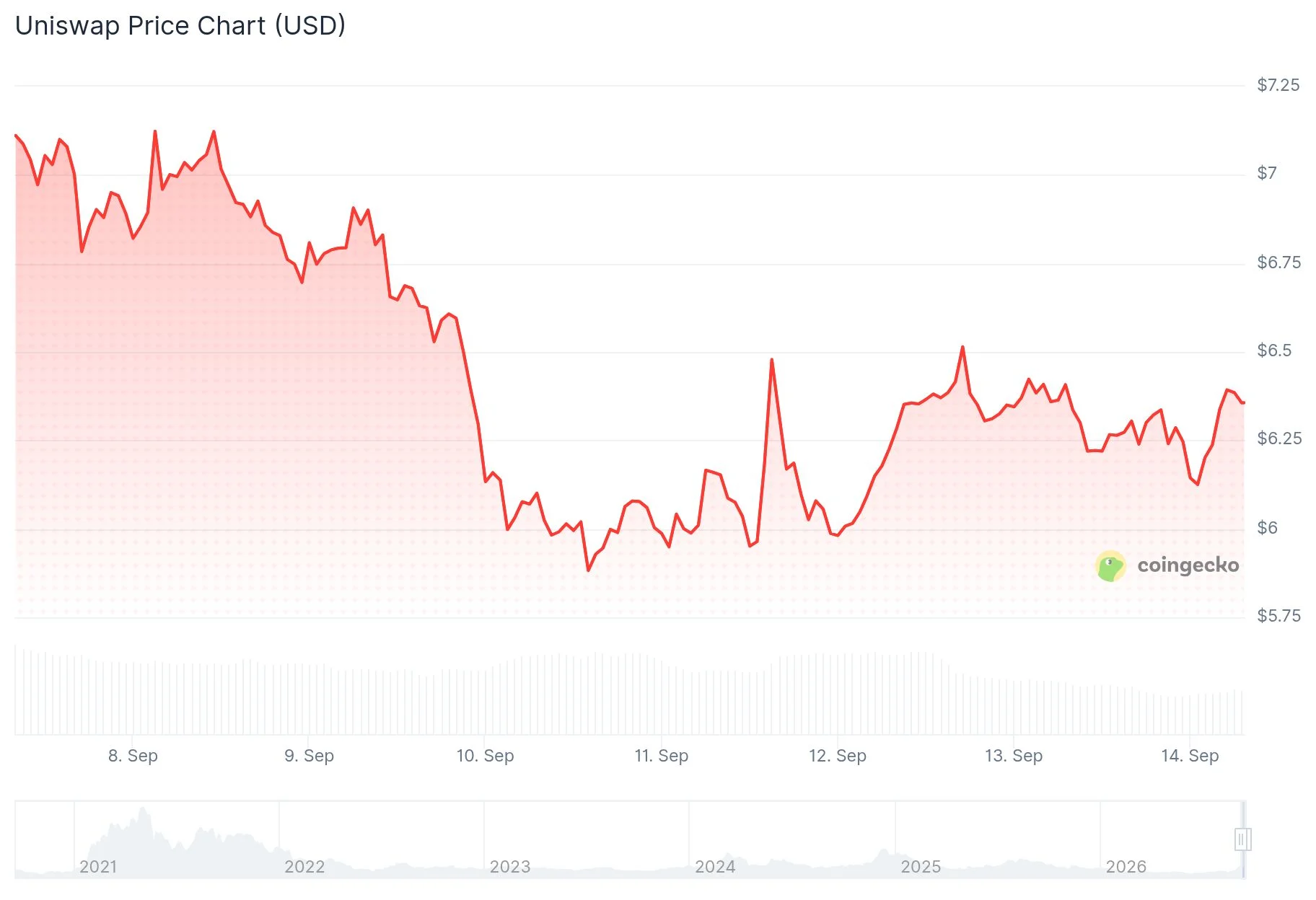
UNI exchanged hands near $6.21 on September 13, declining approximately 2% from the previous session’s close, fluctuating within a range of roughly $6.17 to $6.55 throughout trading hours.
Get 3 Free Stock Ebooks
Discover top-performing stocks in AI, Crypto, and Technology with expert analysis.
- Top 10 AI Stocks - Leading AI companies
- Top 10 Crypto Stocks - Blockchain leaders
- Top 10 Tech Stocks - Tech giants



