



TLDR
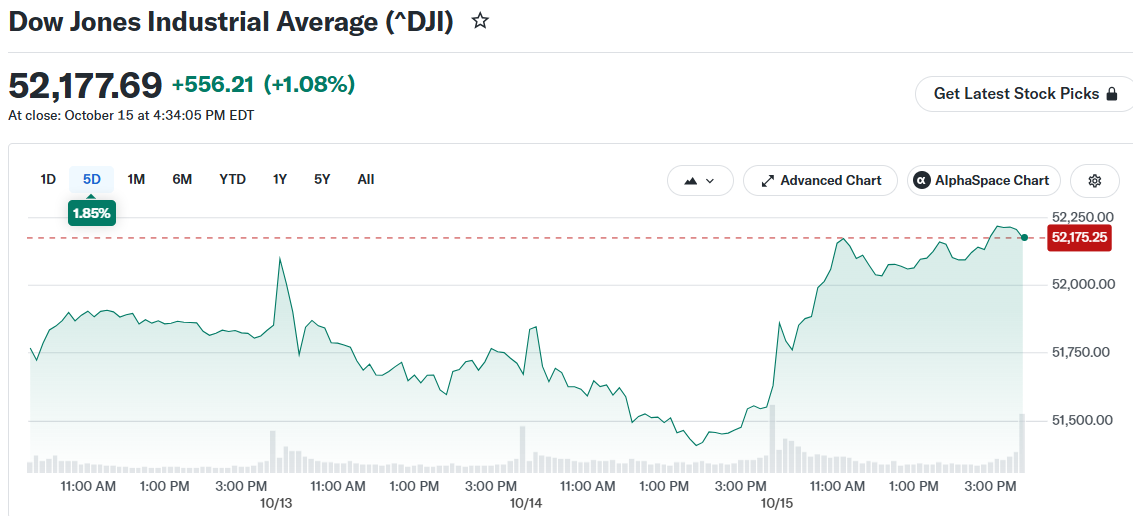
- The Dow gained 556.21 points, or 1.08%, to close at 52,177.69 as investors left AI stocks.
- Seagate, Western Digital and SK Hynix fell on fears of a memory chip glut.
- September producer prices rose 1.3%, the largest monthly gain since 2022.
- CoreWeave rose almost 6% a day after dropping more than 15%.
- Traders scaled back bets on an October Fed rate hike.
Wall Street’s Dow Jones Industrial Average finished higher on Thursday as investors moved money out of artificial intelligence stocks. Concerns about heavy tech spending pushed many buyers toward cheaper shares.
The Dow gained 556.21 points, or 1.08%, to close at 52,177.69. The S&P 500 rose 0.33% to 7,744.06.
The Nasdaq Composite edged up 0.08% to end at 26,713.03. It was down as much as 1.4% earlier in the session.
Chip Stocks Slide on Supply Fears
Seagate Technology and Western Digital fell again this week. SK Hynix also dropped, and it led a sell-off in South Korea’s Kospi index overnight.
Traders fear a glut of memory chips as South Korea faces tougher competition from China. Tesla CEO Elon Musk said on X that “China will be making a LOT of RAM in 2028.”
CNBC sources said Anthropic’s third-quarter revenue grew to $16.8 billion. Some traders worry that pace may not support the big gains in chipmaker shares.
Some AI names bounced back. CoreWeave shares rose almost 6% after dropping more than 15% the session before.

Investors had worried the company was borrowing too much to build out its AI business. Its corporate bond yields also jumped.
Micron Technology recovered from early losses to finish nearly 2% higher.
Alex Shahidi, co-chief investment officer at MAI Capital Management’s Evoke, pointed to Treasury yields near 5%, the highest since the early 2000s. “It’s not are you in or out of AI; it’s how concentrated you want to be,” he said.
Inflation Data Keeps Pressure On
Stocks outside tech did well. Walmart rose 1.5%, and Nike gained more than 5%.
The producer price index for September rose 1.3% from August and 6.3% from a year earlier. Both were the largest gains since 2022.
Consumer prices also came in hotter than expected on a yearly basis. The consumer price index rose 0.6% in September and 3.7% from a year ago.
The data raised fears the Federal Reserve could tighten policy faster before the year ends. Stocks fell on Wednesday after the consumer price report.
David Russell, global head of market strategy at TradeStation, said the latest report shows inflation is getting worse as energy prices stay high. “Election or no election, prices are rising and the Fed might be forced to act,” he said.
Markets steadied after a rocky week. Stock futures are edging higher, and Treasury yields are stable.
Brent crude is near $105 a barrel, and the 10-year Treasury yield is 5.102%. Investors have scaled back bets on an October rate hike after Fed Chairman Kevin Warsh declined to signal the central bank’s next move.
Get 3 Free Stock Ebooks
Discover top-performing stocks in AI, Crypto, and Technology with expert analysis.
- Top 10 AI Stocks - Leading AI companies
- Top 10 Crypto Stocks - Blockchain leaders
- Top 10 Tech Stocks - Tech giants



