


Key Takeaways
- Equity futures declined Tuesday amid escalating Iran tensions and increasing Federal Reserve rate hike expectations
- Crude oil prices approached $90 per barrel following renewed US-Iran military confrontations
- Probability of a September Fed rate increase jumped to 64.4% after Chair Kevin Warsh’s Jackson Hole remarks
- Treasury yields on the 10-year note surged to 4.75%, intensifying headwinds for equities
- Critical economic releases include Tuesday’s JOLTS data and Friday’s employment report
US equity markets began September under pressure as futures contracts slipped Tuesday morning. Investors grappled with a confluence of challenges including surging crude prices, elevated bond yields, and mounting expectations that the Federal Reserve will deliver another rate increase.
Futures tied to the Dow Jones Industrial Average retreated 0.7%, with S&P 500 contracts declining approximately 0.3%. Contracts linked to the Nasdaq-100 fell 0.1%. The weakness extended Monday’s losses across all three benchmark indices.
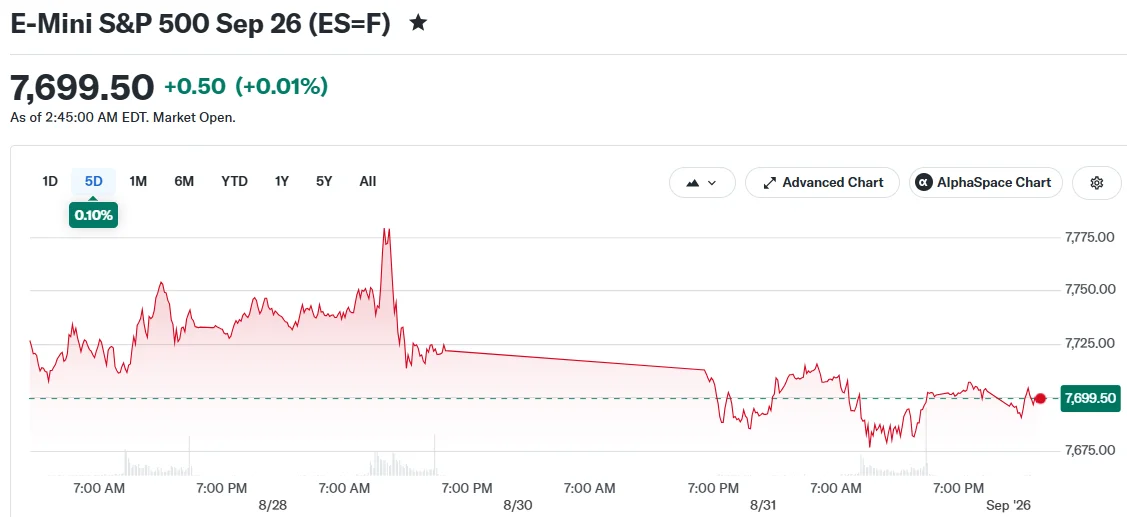
While September opened with selling pressure, equities concluded August with robust double-digit percentage gains for the year. Technology sector strength in August helped offset July’s steep declines.
Middle East Hostilities Drive Energy Prices Higher
Escalating conflict between Washington and Tehran has emerged as a primary catalyst for market volatility. The two nations reengaged in military operations over the weekend—their first confrontation in a month—triggering a sharp spike in energy prices.
Brent crude contracts are hovering around $90 per barrel. The strategically vital Strait of Hormuz continues to experience severe disruptions, with maritime traffic operating at minimal capacity compared to pre-conflict levels.

The United States tightened economic sanctions against Iran last week, further diminishing prospects for diplomatic resolution in the immediate future.
Rising oil prices amplify inflationary pressures throughout the economy. This development compounds challenges facing Federal Reserve policymakers as they navigate monetary policy decisions.
Market Prices In Higher Probability of September Rate Increase
Derivative markets now indicate a 64.4% likelihood that the Federal Reserve will implement a 25 basis point rate hike at its September policy meeting. This represents a substantial increase from the 42.7% probability registered just seven days earlier, based on CME FedWatch data.
The recalibration followed Federal Reserve Chair Kevin Warsh’s address at last Friday’s Jackson Hole economic symposium. While Warsh emphasized the central bank’s dedication to achieving its 2% inflation objective, he refrained from explicitly previewing a rate adjustment.
Yields on 10-year Treasury securities climbed to 4.75%, maintaining downward pressure on equity valuations. Higher yields increase capital costs for businesses and typically compress stock price multiples.
Several significant economic indicators will be released this week that could substantially influence market direction. Tuesday brings the Job Openings and Labor Turnover Survey, while Friday’s employment report will provide crucial labor market insights. Manufacturing metrics from S&P Global and the Institute for Supply Management are also scheduled for release.
Quarterly results from Dell and Palo Alto Networks will offer perspectives on enterprise technology expenditures and cloud infrastructure demand.
Historical seasonal patterns show September typically delivers the poorest performance for US equities, compounding the cautious sentiment already prevalent among market participants.
Get 3 Free Stock Ebooks
Discover top-performing stocks in AI, Crypto, and Technology with expert analysis.
- Top 10 AI Stocks - Leading AI companies
- Top 10 Crypto Stocks - Blockchain leaders
- Top 10 Tech Stocks - Tech giants



