


Key Takeaways
- A group of seven Senate Democrats claims the latest CLARITY Act revision lacks adequate safeguards for ethics, consumer rights, and anti-fraud measures
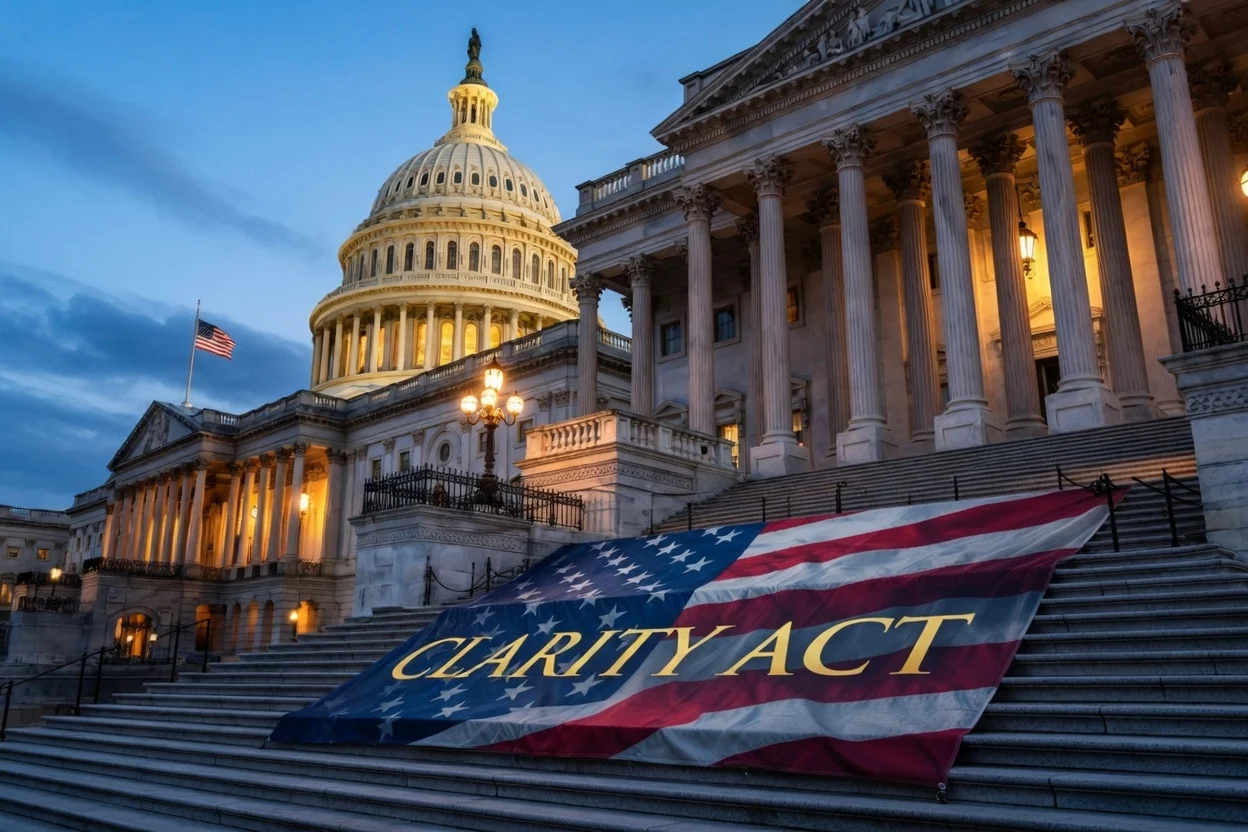
- Republicans unveiled the 616-page legislative text on Wednesday, featuring provisions that prohibit federal officials from creating or endorsing digital assets
- The prohibition on government officials would sunset on January 20, 2029 — coinciding with the conclusion of Trump’s presidency
- Financial disclosures show Trump generated more than $1.4 billion through cryptocurrency-related activities in 2025, intensifying Democratic scrutiny
- Passage requires 60 Senate votes, necessitating support from approximately 10 Democratic lawmakers
Congressional Republicans made public the complete Digital Asset Market Clarity Act text this Wednesday, yet prominent Democratic senators immediately signaled the legislation requires substantial revisions before earning their approval.
A coalition of Democratic senators—Angela Alsobrooks, Cory Booker, Catherine Cortez Masto, Ruben Gallego, John Hickenlooper, Mark Warner, and Raphael Warnock—issued a unified statement declaring the legislation inadequate across multiple critical dimensions.
Their statement highlighted deficiencies in ethical standards for government officials, protections for consumers, prevention of illegal financial activity, management of conflicts of interest, and maintenance of market integrity.
Breaking Down the Ethics Language
Embedded within the 616-page document is text prohibiting all federal government officials, their spouses, and staff members from launching or promoting digital assets. Crypto platforms would similarly face restrictions against listing tokens connected to government officials.
Senator Cynthia Lummis, among the bill’s primary proponents, verified that these ethical restrictions would extend to President Trump.
White House officials characterized the measure as representing “the most comprehensive and wide-ranging ethics provision in history.” Senator Bernie Moreno went further, dubbing it “the most powerful ethics language in U.S. history.”

Yet the restriction carries a time limit. The ban terminates on January 20, 2029 — precisely when Trump’s second presidential term concludes.
Democratic lawmakers additionally expressed alarm that the language seemingly excludes children of elected officials from its scope. Trump’s three adult sons serve as co-founders of World Liberty Financial, while two have established American Bitcoin, a Bitcoin mining operation.
Questions About Implementation and Timing
Authority to enforce these ethics requirements would rest with the U.S. Attorney General rather than state-level prosecutors. Several Democrats, Alsobrooks among them, have indicated this enforcement structure fails to meet their standards.
Trump’s mandatory financial reporting revealed cryptocurrency-related earnings exceeding $1.4 billion during 2025, ensuring ethics considerations remain central to legislative discussions.
Senate passage demands 60 affirmative votes, meaning Democratic support from roughly 10 members becomes essential.
According to reports, Senate Majority Leader John Thune intends to schedule a floor vote next week, irrespective of whether sufficient Democratic backing has materialized.
With the Senate’s summer recess commencing after August 7, legislators face a compressed timeframe for action.
The Democratic contingent emphasized ongoing negotiations remain active. “We have been working in good faith with our Republican colleagues for the past year and will continue doing so,” their collective statement read.
Kristin Smith from the Solana Policy Institute observed the legislation now incorporates comprehensive disclosure requirements, an illicit finance framework, and enhanced spot market oversight, positioning it as a genuine opportunity for cross-party collaboration.
Should the Senate approve the measure, it would proceed back to the House of Representatives before potentially arriving at Trump’s desk for signature.
Get 3 Free Stock Ebooks
Discover top-performing stocks in AI, Crypto, and Technology with expert analysis.
- Top 10 AI Stocks - Leading AI companies
- Top 10 Crypto Stocks - Blockchain leaders
- Top 10 Tech Stocks - Tech giants



