



Key Takeaways
- PUMP token has climbed approximately 50% from its recent low, reaching around $0.0020
- The project’s largest-ever investor and team token unlock was successfully absorbed by the market without causing a price drop
- Pump.fun introduced “BOOST mode,” a feature that redirects stranded liquidity toward buying and burning newly migrated tokens
- Declining Open Interest alongside rising prices indicates spot market demand is fueling the rally rather than leveraged trading
- Critical resistance zone exists between $0.00210 and $0.00215, requiring a decisive breakout to signal a sustained trend reversal
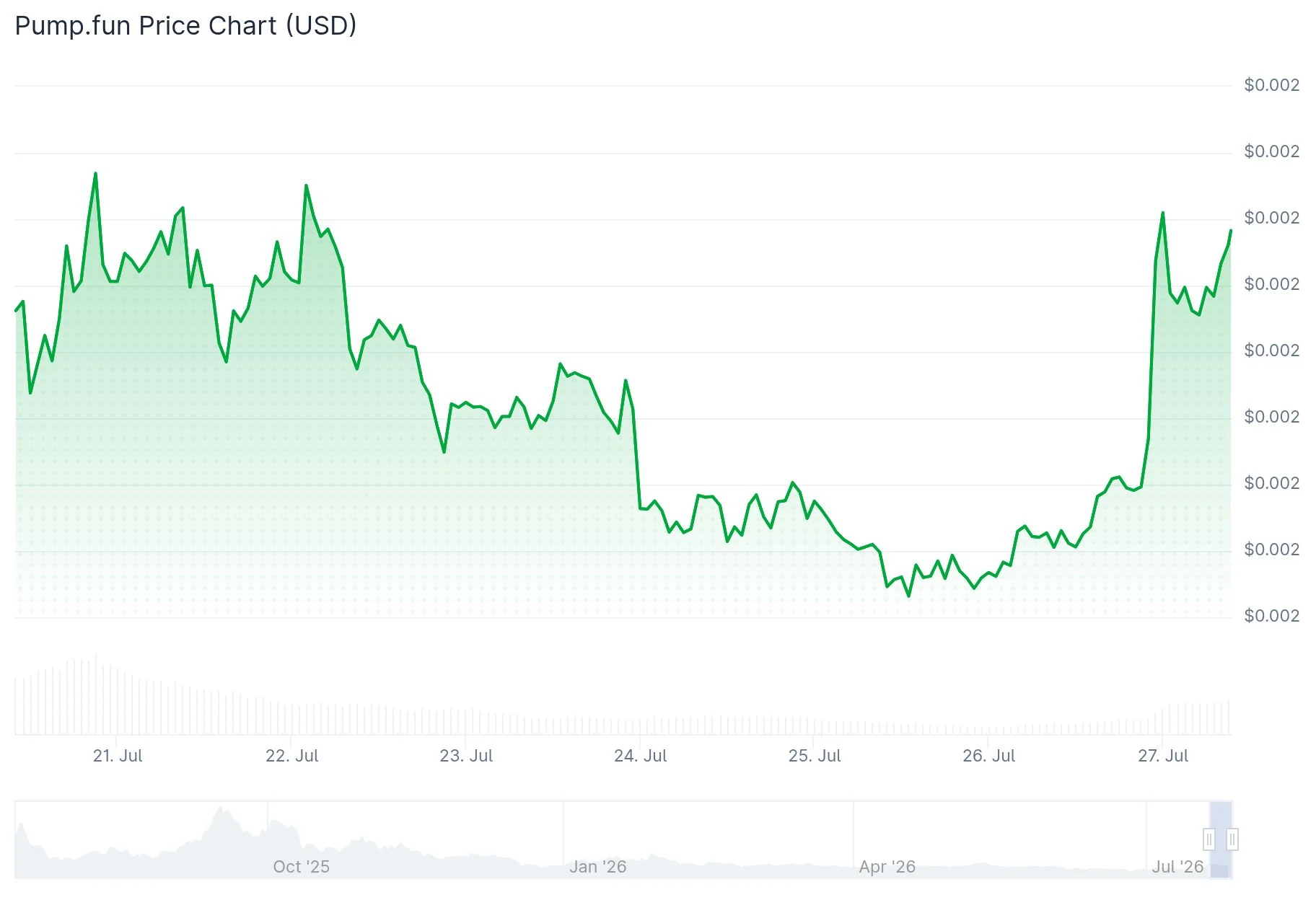
Pump.fun (PUMP) has experienced a dramatic surge of approximately 50% from its recent bottom near $0.0013, currently changing hands around the $0.0020 level. What makes this price action particularly noteworthy is that it occurred despite the project executing its most substantial token unlock event to date—an event that market participants widely anticipated would create selling pressure.
During mid-July, the protocol released 25% of its investor allocation (totaling 32.5 billion PUMP tokens) alongside 25% of team allocations (50 billion PUMP tokens). The balance of these allocations will vest gradually through a 36-month linear schedule. Historically, significant unlock events of this magnitude tend to create downward price momentum. However, PUMP bucked this trend entirely.
Rather than capitulating, market participants stepped in to absorb the influx of newly available tokens, driving the price toward an important long-term descending resistance trendline. This development has transformed the narrative from supply overhang concerns to questions about whether bullish momentum can be sustained.
Prominent crypto analyst Ansem (@blknoiz06) weighed in on the situation via X, highlighting that PUMP consistently generates $1 million in daily revenue even during weak on-chain market conditions. He characterized it as “one of the few stories in crypto where the issue is actually the narrative and sentiment instead of the actual fundamentals.” Ansem suggested that a resurgence in Solana ecosystem activity could propel PUMP to new all-time highs, noting that HYPE commands a 15x premium valuation despite comparable two-year revenue figures.
BOOST Mode Introduces Fresh Momentum
The Pump.fun team recently unveiled “BOOST mode,” an innovative mechanism designed to capture liquidity that becomes stranded during token migrations from bonding curves to automated market maker (AMM) pools. This feature redirects that otherwise-lost liquidity to execute buy and burn operations for the migrating token over approximately five minutes. According to project estimates, more than $100 million in liquidity is permanently lost each year through this process. BOOST aims to recapture a portion of that value, effectively adding roughly 20% additional liquidity for each newly migrated coin based on the team’s calculations.

Although BOOST primarily benefits newly launched tokens rather than directly impacting PUMP itself, the feature enhances the overall ecosystem economics that PUMP represents as the platform’s native asset. The timing of this announcement aligned with PUMP posting weekly gains exceeding 30%.
On July 20, PUMP experienced a single-day spike of 20–22%, accompanied by a more than 500% explosion in 24-hour trading volume, which reached approximately $131 million. Open Interest metrics simultaneously jumped from roughly 100 million to 163 million contracts during that initial breakout phase.
Technical Analysis Shows Mixed Signals
From a technical perspective, the Supertrend indicator has shifted to a bullish configuration, and price action is currently trading above the Guppy EMA cloud. Despite these positive signals, Open Interest has exhibited a downward trajectory even as prices continue climbing. This divergence strongly suggests that spot market buyers are responsible for the rally rather than an influx of new leveraged positions.
Blockchain whale monitoring accounts have identified several modest but significant PUMP accumulation transactions in recent trading sessions. Additionally, the protocol maintains an ongoing buyback and burn program that removes approximately 0.1% of circulating supply on a daily basis, creating a consistent deflationary pressure that complements the BOOST mechanism.
The primary resistance zone is located between $0.00210 and $0.00215. Immediate downside support exists in the $0.00185–$0.00190 range, while the recent swing low at $0.0013 represents the critical level that bulls must defend to maintain the bullish structure.
Get 3 Free Stock Ebooks
Discover top-performing stocks in AI, Crypto, and Technology with expert analysis.
- Top 10 AI Stocks - Leading AI companies
- Top 10 Crypto Stocks - Blockchain leaders
- Top 10 Tech Stocks - Tech giants



