


TLDR
- Oracle (ORCL) shares sank 6% after reports revealed OpenAI’s actual annualized revenue trails earlier estimates.
- OpenAI reportedly reached about $50 billion in annualized revenue, far under the $68 billion figure that made the rounds last month.
- The earlier number mixed in gross revenue from OpenAI’s partners, inflating the true growth picture.
- Oracle is also dealing with pipeline delays at its data centers, forcing it to truck in natural gas to keep builds on schedule.
- The stock has lost 31% of its value this year and sits 57% under its 52-week high of $313.
Oracle shares slid 6% on October 8, closing around $135, after fresh details about AI partner OpenAI’s finances rattled investors. The stock remains far off its 52-week peak of $313, hit back in October 2025.
CNBC reported that OpenAI’s annualized revenue landed near $50 billion at the end of September. That’s a steep drop from the $68 billion run rate that had been floating around just weeks before.
The Financial Times broke the story first, citing an investor presentation OpenAI used to defend its $852 billion valuation. The company is reportedly laying groundwork for a 2027 IPO.
How the Numbers Got Mixed Up
A person familiar with the matter told CNBC the original $68 billion figure folded in gross revenue from OpenAI’s partners. That made side-by-side comparisons with Anthropic look better, but it also overstated OpenAI’s core business.
Once the real number got out, AI stocks across the sector sold off. Oracle, tightly linked to OpenAI through its cloud infrastructure deals, took one of the bigger hits.

Climbing bond yields piled on extra pressure. Growth-dependent tech names like Oracle tend to suffer more when yields rise, since much of their valuation rests on future earnings.
Big swings aren’t new for Oracle. The stock has posted 36 moves of more than 5% in a single day over the past year alone.
Just 9 days before this drop, Oracle shares had jumped 4% on news of Oracle Fusion Claw, a new AI tool built for enterprise applications. The company also debuted compliance software for banks and financial firms around that time.
Natural Gas Trucks and Data Center Delays
Oracle’s troubles don’t stop at OpenAI. The company has had to truck in natural gas to its Salt Lake City and Texas data center sites after pipeline hookups fell behind schedule.
Oracle has gone as far as declaring force majeure on some of these delays, a sign the disruptions are serious enough to be legally notable. That points to real risk of cost overruns on its cloud buildout.
The company still holds a deep backlog of committed cloud customers, something that typically supports future revenue. But turning that backlog into actual paying usage takes time and money.
Oracle already carries a heavy debt load from its data center spending. Any slowdown in AI demand or further construction delays could squeeze margins harder than expected.
Year-to-date, Oracle stock is down 31%. Still, someone who invested $1,000 in Oracle five years ago would have roughly $1,434 today.
Average daily trading volume for Oracle runs around 31.5 million shares. The company’s market cap now stands at $437.7 billion, with a technical sentiment rating of “Hold.”
Chart Analysis
Oracle’s longer-term chart shows a bounce off April’s lows near $120, with the stock running past $200 before giving back much of that gain. A rising support trendline drawn from the April low still holds, sitting just below current levels near $135.
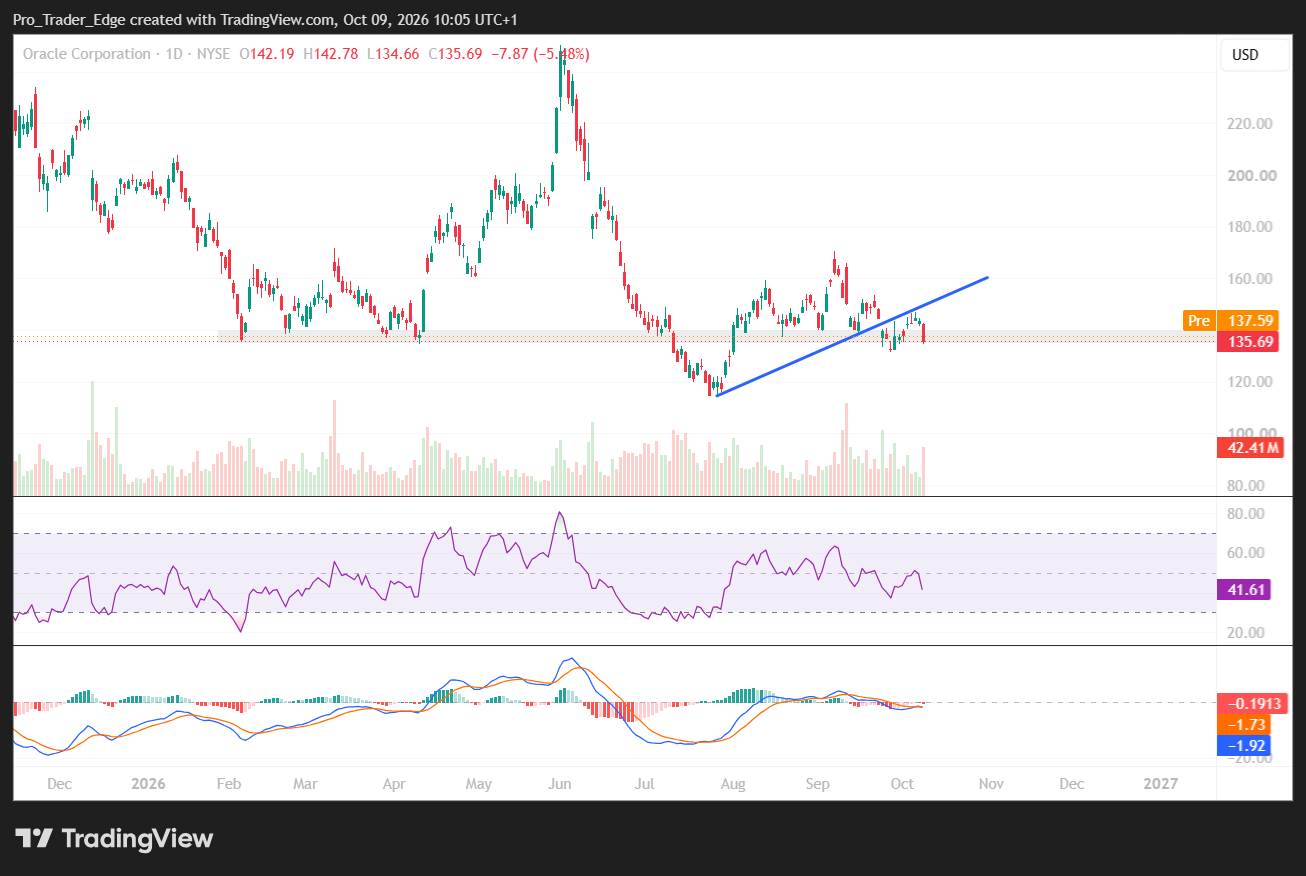
Shares are down 5% on the day at $135.69, with the $130 to $135 range acting as support from earlier price action this year. RSI at 41.61 and a negative MACD both signal weakening momentum, though price has yet to break the longer-term uptrend line.
Get 3 Free Stock Ebooks
Discover top-performing stocks in AI, Crypto, and Technology with expert analysis.
- Top 10 AI Stocks - Leading AI companies
- Top 10 Crypto Stocks - Blockchain leaders
- Top 10 Tech Stocks - Tech giants



