
TLDR
- Oil fell more than 3% Monday as hopes for U.S.-Iran diplomacy eased supply fears.
- January Brent traded near $110 a barrel and WTI near $100 after a nearly 15% October rally.
- Iranian and Qatari officials held a third day of talks on reopening the Strait of Hormuz.
- OPEC+ kept December output targets unchanged and will meet again Nov. 29.
- Goldman Sachs raised its Brent and WTI forecasts but expects supply risks to stay elevated.
Oil prices fell more than 3% on Monday as hopes for diplomacy in the U.S.-Israeli war with Iran eased worries about supply disruptions. The drop reversed some of last week’s gains.
January Brent futures fell 3.1% to $109.90 a barrel in early trading. U.S. West Texas Intermediate (WTI) crude dropped 3.5% to $100.47 a barrel.
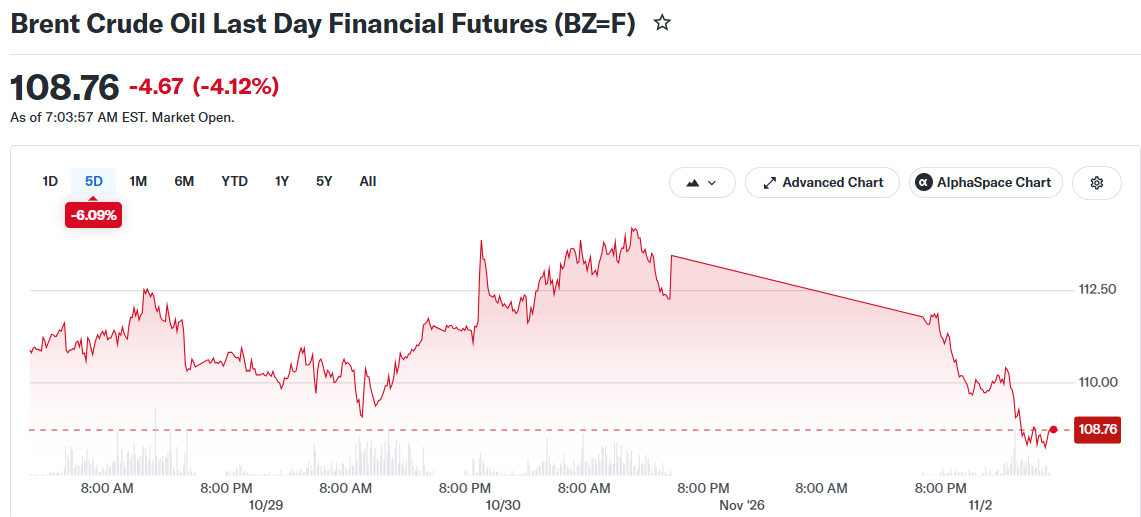
Both benchmarks rose nearly 15% in October on Middle East supply disruptions. Brent reached its highest level in six months.
Diplomacy in focus
President Donald Trump told Israeli Prime Minister Benjamin Netanyahu on Saturday that he preferred to give diplomacy more time, Axios reported. Netanyahu had pressed for U.S. strikes to restart soon after the midterm elections.
Iranian and Qatari officials held a third straight day of talks on Monday. Qatar is trying to mediate a proposal to reopen the Strait of Hormuz.
Iranian Foreign Minister Abbas Araghchi said Sunday that the talks had not produced an agreement. An Iranian delegation led by a deputy foreign minister went to Qatar, and no direct meeting with U.S. officials was planned.

Tehran has said it remains open to diplomacy while preparing to defend itself. Attacks on tankers and limits on Iranian oil exports have raised shipping and insurance costs.
The Wall Street Journal reported that the U.S. told several Gulf Arab countries to prepare for a possible short, intense campaign against Iran after Tuesday’s midterm elections. Trump has not made a final decision on renewed strikes.
OPEC+ and forecasts
Seven OPEC+ producers agreed Sunday to keep December output targets unchanged. The group, which includes Saudi Arabia and Russia, will meet again Nov. 29 to review January levels.
Exporters are sending more oil around the Strait of Hormuz. Loadings at Fujairah and Omani terminals are 36% above prewar levels, while Red Sea shipments are 8% higher, according to Kpler.
OPEC’s oil output was still more than 3 million barrels a day below prewar levels in September. That was despite an increase in production.
Goldman Sachs raised its December 2026 Brent forecast to $105 a barrel from $90. Its WTI forecast rose to $94 from $81.
The bank also lifted its 2027 average forecasts to $88 for Brent and $78 for WTI. They were $80 and $73 before.
Goldman expects supply risks to stay elevated and allowed for 1 million barrels per day of possible disruptions in 2027. It cited conflicts in the Middle East and Russia-Ukraine, plus possible problems in Kazakhstan and parts of Africa.
A Saudi-led coalition said Sunday it targeted resources the Houthis use for missile and drone programs. Saudi air defenses also destroyed a ballistic missile the Houthis fired toward southern Saudi Arabia.
In later trading, Brent was down about 3.96% at $108.94 a barrel. WTI was down about 4.08%.
Get 3 Free Stock Ebooks
Discover top-performing stocks in AI, Crypto, and Technology with expert analysis.
- Top 10 AI Stocks - Leading AI companies
- Top 10 Crypto Stocks - Blockchain leaders
- Top 10 Tech Stocks - Tech giants