


Quick Overview
- Micron achieved all-time high Q2 fiscal 2026 sales of $23.86 billion alongside a 74.4% gross margin
- SK Hynix delivered unprecedented Q1 2026 sales of KRW 52.57 trillion, fueled by artificial intelligence chip requirements
- Each company profits from surging requirements for high-bandwidth memory chips powering AI data centers
- Market analysts consider SK Hynix the purest HBM investment, whereas Micron provides diversified memory market access
- SK Hynix plans a U.S. ADR offering to reduce its discount relative to Micron’s valuation
Micron and SK Hynix are capitalizing on the artificial intelligence memory revolution, yet they present distinct investment opportunities within the same industry trend. Micron stands as America’s premier memory semiconductor manufacturer, delivering products spanning DRAM, NAND flash, and high-bandwidth memory technology (HBM). SK Hynix has established itself as the most transparent publicly traded investment vehicle for AI data center infrastructure through its dominance in HBM production.
These equities frequently exhibit correlated price movements, yet their underlying investment narratives differ substantially.
Micron’s Historic Performance
Micron’s second fiscal quarter of 2026 represented unprecedented performance metrics throughout the company’s existence. Sales reached $23.86 billion, gross profitability landed at 74.4%, and net earnings totaled $13.79 billion. Cash generated from operations measured $11.9 billion.
Artificial intelligence infrastructure, rather than consumer electronics, powers this expansion. Micron’s Cloud Memory segment generated $7.75 billion in quarterly sales, while its Core Data Center division contributed $5.69 billion. The company established new revenue benchmarks across DRAM chips, NAND storage, HBM products, and all operating divisions.

This diversification distinguishes Micron from competitors. The company’s success doesn’t depend on a single product category.
The downside involves memory market cyclicality. Micron continues aggressive capital investments to satisfy current demand, and eventual supply expansion could diminish pricing strength. Present market dynamics remain robust, though favorable memory cycles inevitably reverse.
SK Hynix’s HBM Leadership Position
SK Hynix announced unprecedented quarterly performance in Q1 2026, reporting sales of KRW 52.57 trillion alongside operating income of KRW 37.61 trillion. Management indicated that AI processor demand continues exceeding production capabilities, suggesting sustained pricing advantages.
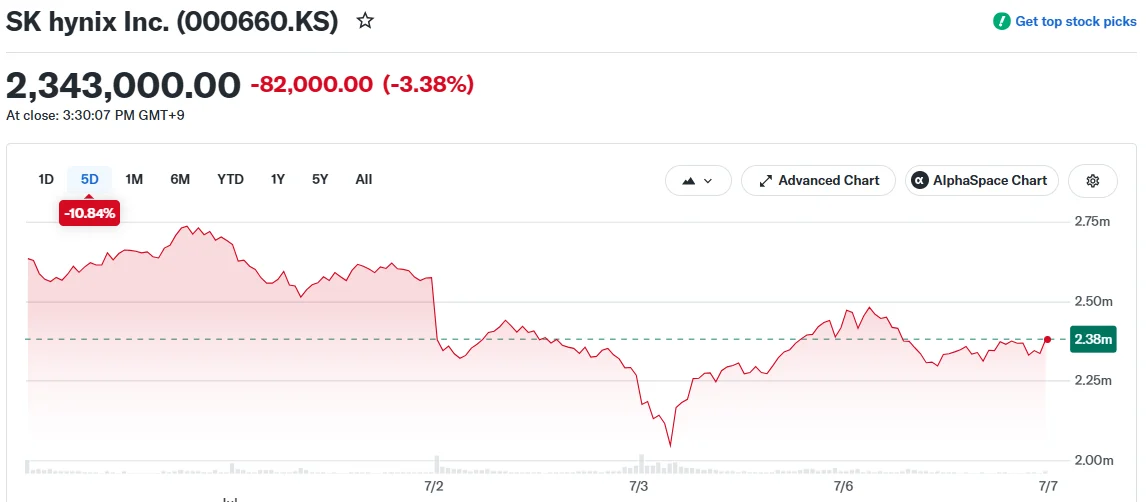
SK Hynix maintains stronger HBM concentration than any competitor. This positioning has attracted investors seeking targeted exposure to AI server expansion. During July 2026, the corporation advanced initiatives for American Depositary Receipt availability, designed to narrow its valuation discount versus Micron while accessing expanded investor populations.
The consequence involves heightened concentration risk. SK Hynix faces greater sensitivity to HBM price fluctuations and AI server demand volatility compared with diversified competitors. This creates a more aggressive yet potentially unstable investment proposition.
Investment Comparison
Micron delivers comprehensive memory market participation, featuring substantial cash generation and involvement throughout the complete AI memory ecosystem. SK Hynix provides concentrated positioning in HBM technology, the memory segment most intimately connected to AI processor capabilities.
Both corporations benefit from identical industry momentum. The distinction lies in exposure concentration levels.
Through July 2026, SK Hynix’s anticipated U.S. ADR introduction remains among the memory industry’s most scrutinized events, as management works to present its AI-memory investment case directly to American capital markets.
Get 3 Free Stock Ebooks
Discover top-performing stocks in AI, Crypto, and Technology with expert analysis.
- Top 10 AI Stocks - Leading AI companies
- Top 10 Crypto Stocks - Blockchain leaders
- Top 10 Tech Stocks - Tech giants



