


TLDR
- D.A. Davidson analyst Gil Luria raised his Micron price target to $3,000 from $2,100 on October 7.
- Micron stock sat near $1,088 at the time, meaning the new target implies the stock could almost triple.
- Luria’s call rests on a memory chip shortage he expects to last through 2027 and 2028.
- Micron’s fiscal fourth-quarter revenue hit $54.23 billion, up roughly 379% year-over-year, with adjusted earnings of $33.42 per share.
- Jim Cramer separately floated the idea that Micron could run from around $1,000 to $2,000 per share.
Wall Street keeps finding new reasons to like Micron (MU). The latest comes from D.A. Davidson analyst Gil Luria, who raised his price target to $3,000 from $2,100 on October 7. He kept his Buy rating intact.
Micron stock was trading near $1,088 at the time of the call. That gap between price and target means Luria sees room for the stock to almost triple from here.
His reasoning isn’t complicated. Luria believes a memory chip shortage will stretch through 2027 and into 2028, and that scarcity is what gives him confidence in his numbers.
The logic traces back to AI. More memory means better model performance and quicker inference. So the companies building out AI infrastructure want as much high-bandwidth memory and DRAM as they can lock down right now.
Luria named names when describing the buying frenzy. He pointed to Amazon, Microsoft, Google, Nvidia and Apple as the firms securing Micron’s capacity through long-term deals. His summary of the dynamic was blunt: “If you don’t buy it, they will.”
The Numbers Behind The Optimism
Micron’s recent results give the bulls plenty to work with. Fiscal fourth-quarter revenue reached $54.23 billion, up roughly 379% from the year before. Adjusted earnings per share came in at $33.42, versus just $3 a year earlier.

Gross margin expanded by 41 percentage points to 87%. Management guided first-quarter revenue toward $61.5 billion, a number that has pushed several analysts to lift their own targets in recent weeks.
Breaking it down further, DRAM made up 73% of total revenue and grew 343% year-over-year. NAND revenue grew 526% to $14.10 billion. Micron also says its HBM4 memory capacity is already sold out for 2026.
The company locked in $32 billion in new supply commitments during the quarter. Its backlog grew to $150 billion, up from $100 billion the quarter before. That’s an unusual level of forward visibility for a chipmaker.
Cramer Adds His Own Take
CNBC’s Jim Cramer discussed Micron this week as well, suggesting the stock could move from around $1,000 to $2,000 per share over time. He referenced Melius Research analyst Ben Reitzes, who has set a $2,200 target. Cramer’s view is that Micron has moved past its old cyclical identity and into something closer to a secular growth stock.
Funding that growth isn’t cheap. Micron has committed $200 billion in capital expenditure to expand capacity and keep up with its backlog. That spending also carries the usual overcapacity risk that has hit the memory industry before.
Despite the rally, Micron still trades at a forward P/E of around 7. For comparison, Nvidia trades at a forward P/E near 25. Rival SK hynix is even cheaper, at a forward P/E of 5.4.
Institutional interest has picked up too. 184 hedge funds reported holding Micron stock in the second quarter, up from 154 in the first quarter. Short interest as a percentage of float remains low.
Micron stock is up more than 200% year-to-date as of this week.
Chart Analysis
Micron (MU) stock dropped 4.79% to close at $1,035.84, pulling back after an all-time high near $1,255. The stock is now sitting right at a key support level around $1,035, which also lines up with a rising trend line from the July low near $700. RSI sits at 51.21, right in neutral territory, while MACD has crossed below its signal line, pointing to fading short-term momentum.
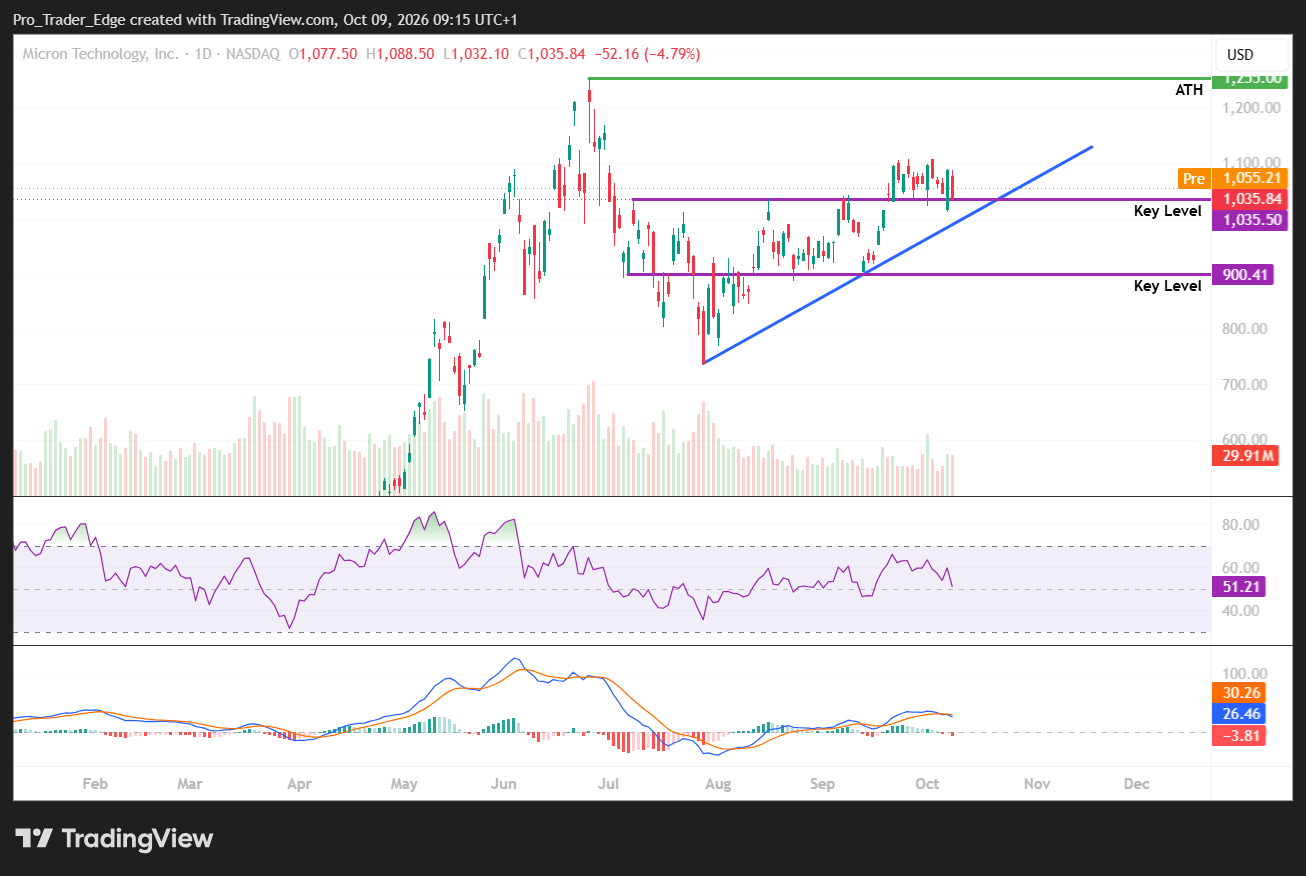
The broader structure still looks constructive as long as the $1,035 level holds, since a bounce here would keep the higher-low pattern intact. A clean break below that zone opens the door toward the next support near $900, while reclaiming the $1,100 area would signal the uptrend is resuming toward new highs.
What to watch: a break below $1,035 could open the door to $900; holding above it keeps the uptrend structure intact.
Get 3 Free Stock Ebooks
Discover top-performing stocks in AI, Crypto, and Technology with expert analysis.
- Top 10 AI Stocks - Leading AI companies
- Top 10 Crypto Stocks - Blockchain leaders
- Top 10 Tech Stocks - Tech giants



