



Key Takeaways
- A wallet associated with a16z accumulated $90.87M in HYPE tokens throughout approximately 30 days.
- Technical analysis reveals a cup-and-handle formation suggesting possible 55% upside to $71–$72 levels.
- HYPE climbed approximately 7% in one day while Bitcoin and Ethereum recorded declines.
- A strategic partnership with Coinbase and Circle enables Hyperliquid to receive up to 90% of USDC reserve earnings.
- Bitwise declared plans to allocate 10% of BHYP ETF management fees toward purchasing and holding HYPE.
Hyperliquid’s HYPE token has emerged as a standout performer in the cryptocurrency market throughout recent trading sessions. A convergence of on-chain activity, institutional participation, and a significant stablecoin partnership has elevated the token’s profile.
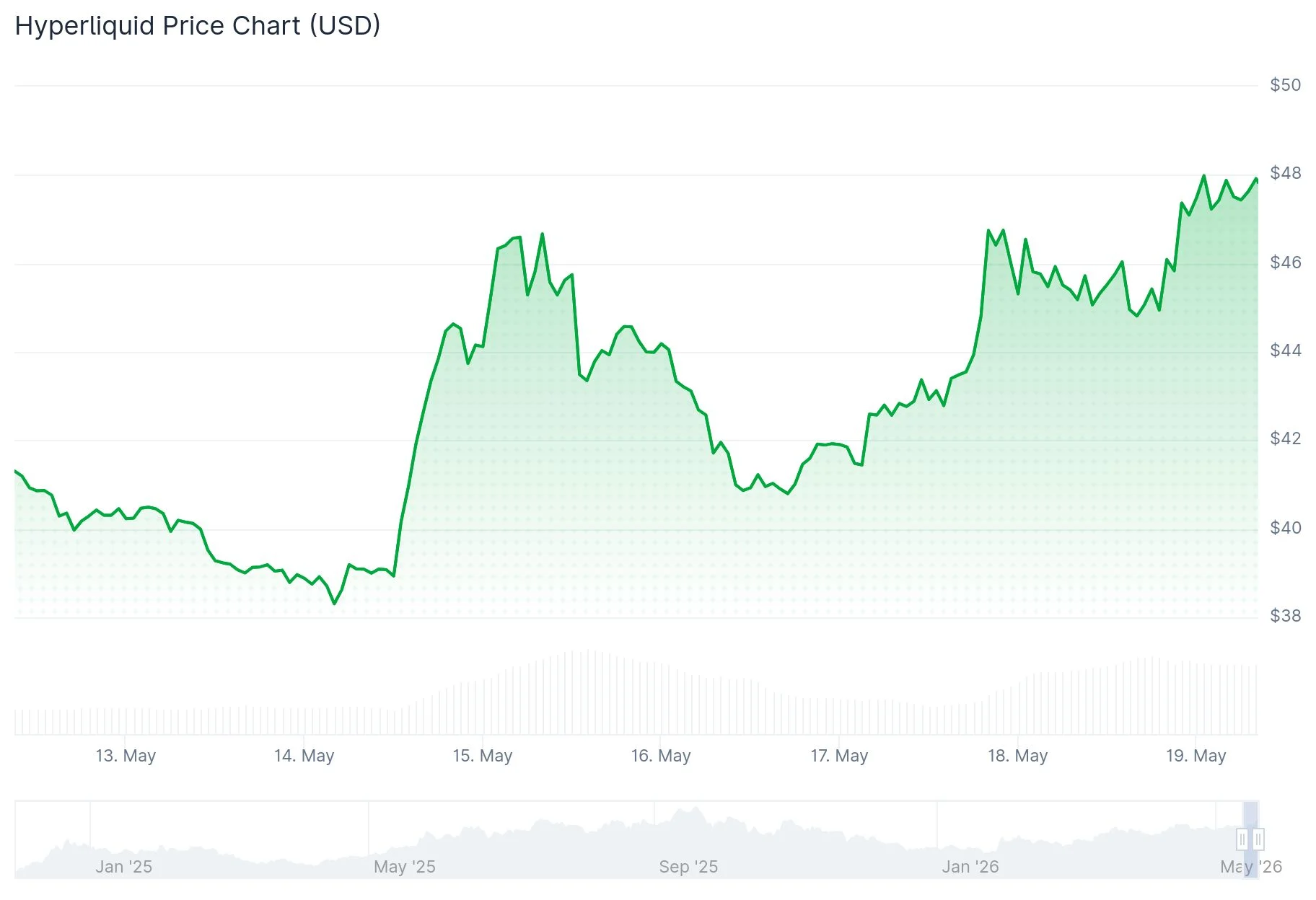
A cryptocurrency wallet with connections to Andreessen Horowitz acquired 372,000 HYPE tokens—approximately $16.91 million—within a three-hour window on Monday. This latest transaction elevated the wallet’s complete accumulation since mid-April to 2.11 million HYPE tokens, representing approximately $90.87 million in total value, based on information from Lookonchain and Arkham Intelligence.
During this accumulation phase, HYPE recorded gains of roughly 7% across a 24-hour period. Meanwhile, Bitcoin declined 1.22% and Ethereum dropped 2.22% during the identical timeframe. From a year-to-date perspective, HYPE has advanced 80%, contrasting sharply with BTC’s 12.5% decline and ETH’s 28.3% decrease.
Chart Analysis Suggests Potential Move to $71
HYPE’s three-day pricing chart displays a classic cup-and-handle formation. This technical structure typically indicates bullish continuation, characterized by a rounded bottom recovery followed by a brief consolidation before an upward breakout.
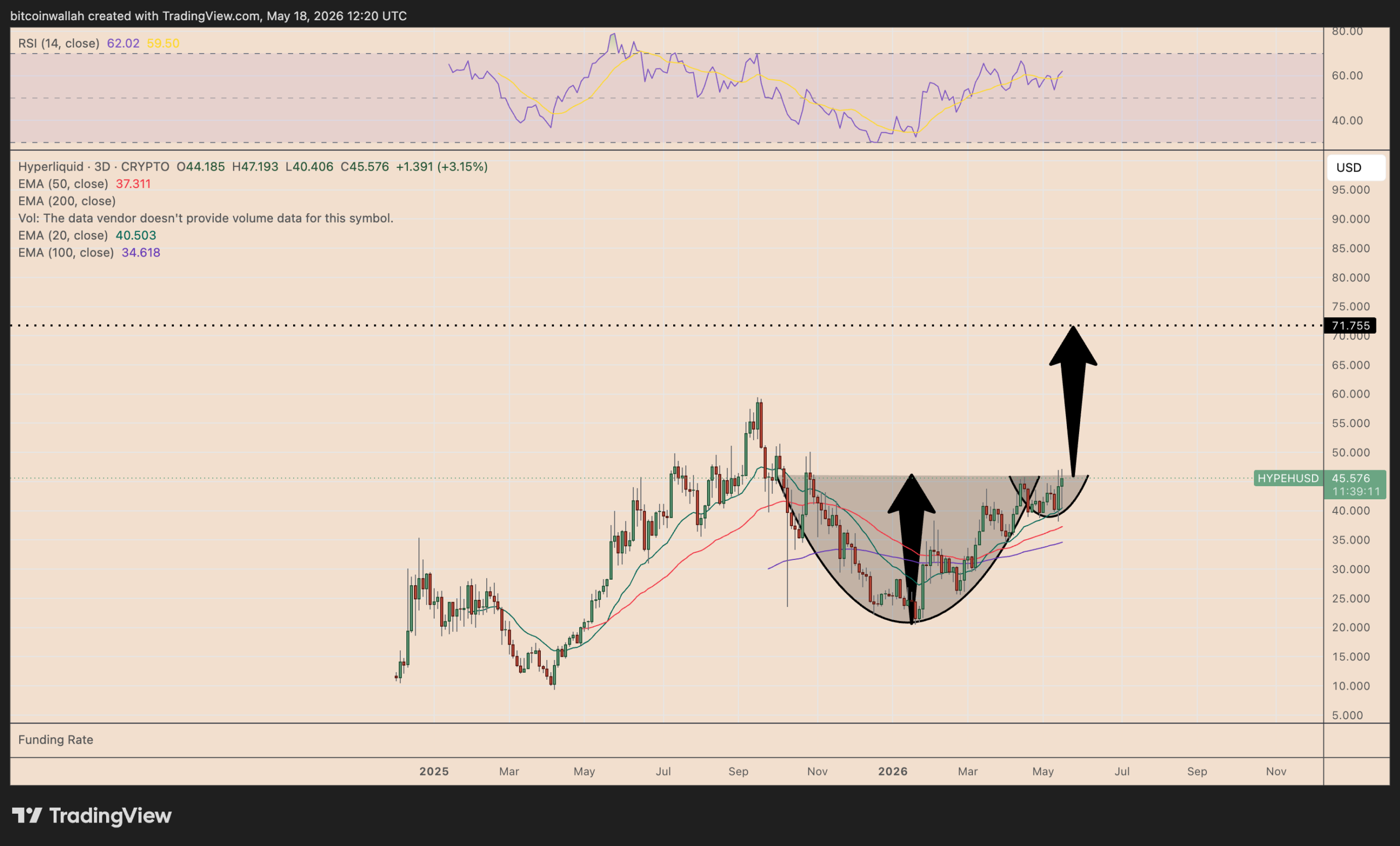
For HYPE specifically, the cup developed after prices tumbled from approximately $46 down to $21, subsequently recovering toward the $45–$47 zone. This level currently functions as the pattern’s critical neckline resistance. As of Monday’s trading, the token was experiencing mild consolidation with a slight downward bias, creating the characteristic “handle” component.

Should HYPE successfully breach the $45–$47 neckline resistance, the pattern’s measured move calculation—derived from the cup’s depth—projects a target in the $71–$72 territory. This would establish a fresh all-time high, representing approximately 55% appreciation from present levels.
Crypto trader Pentoshi noted that regulatory approval via the US CLARITY Act could enable hedge funds, proprietary trading desks, and institutional asset managers to access Hyperliquid, potentially multiplying platform revenue “5x–10x.”
Stablecoin Partnership May Generate $160M in Annual Revenue
Hyperliquid revealed last Thursday that Circle’s USDC stablecoin would become the designated “Aligned Quote Asset” across its trading platform. Under this arrangement, Coinbase serves as the treasury deployer for the majority of USDC on the network, while Circle manages minting operations and cross-chain connectivity.
The critical element: Hyperliquid will capture up to 90% of reserve income generated from USDC holdings on its platform—revenue that historically went to Circle and Coinbase. Ryan Watkins, co-founder of Syncracy Capital, characterized it as “Hyperliquid’s biggest announcement all year.”
With more than $5 billion in USDC currently on the platform, market analysts project the arrangement could funnel $135–$160 million per year into Hyperliquid’s ecosystem via yield distribution. Compass Point researchers estimate the partnership may strip $60–$80 million in combined annual EBITDA from Circle and Coinbase.
Coin Bureau reported on X that Bitwise intends to direct 10% of management fees collected from its BHYP ETF toward acquiring and maintaining HYPE holdings. Bitwise further emphasized that 99% of Hyperliquid’s blockchain-generated revenue funds HYPE token buybacks and burns—a mechanism that could generate sustained buying pressure.
A regulated US spot HYPE ETF launched during the previous week, establishing a compliant entry point for traditional institutional investors.
Compass Point analysts also cautioned that additional DeFi platforms, such as Polymarket and Jupiter, might now negotiate comparable revenue-sharing arrangements with stablecoin providers.
Get 3 Free Stock Ebooks
Discover top-performing stocks in AI, Crypto, and Technology with expert analysis.
- Top 10 AI Stocks - Leading AI companies
- Top 10 Crypto Stocks - Blockchain leaders
- Top 10 Tech Stocks - Tech giants



