



Key Takeaways
- Goldman Sachs reduced its fourth quarter 2026 Brent crude projection to $80 per barrel from a previous $90 estimate
- The investment bank’s 2027 Brent average target dropped to $75, down from $80
- A U.S.-Iran interim agreement will lift the blockade and restore Strait of Hormuz operations
- Persian Gulf export flows are now projected to return to normal levels by late July, advancing the timeline by one month
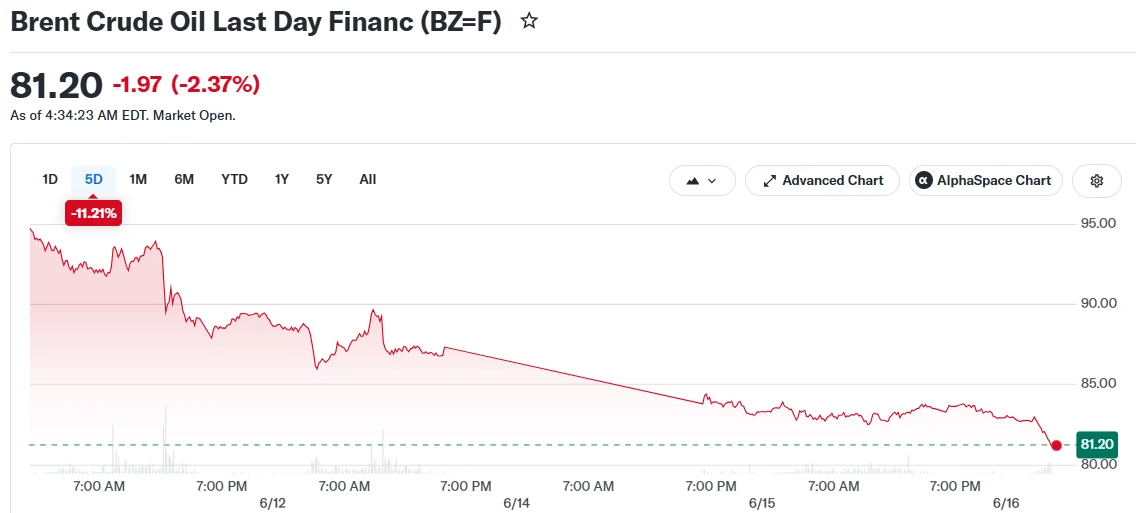
- Oil prices tumbled on the diplomatic breakthrough, with Brent sliding 3.4% to $87.33 and WTI declining 3.2% to $84.88
Following President Trump’s announcement of an interim diplomatic agreement to end the U.S. blockade and restore full access through the Strait of Hormuz, Goldman Sachs has significantly revised its crude oil price projections.
The financial institution now anticipates the critical waterway will return to complete operational capacity by the conclusion of July 2026, accelerating its previous timeline by approximately 30 days from an end-of-August projection.
Goldman’s revised forecasts show Brent crude at $80 per barrel for the fourth quarter of 2026, representing a $10 reduction from prior estimates. The firm’s 2027 annual average for Brent has been adjusted to $75, down $5 from earlier projections. WTI crude is now forecast at $75 for Q4 2026 and $70 throughout 2027.
According to the bank’s analysis, accelerating the supply normalization schedule by one month translates to a fair value reduction of approximately $10 per barrel in 2026 and $5 per barrel for 2027.
Crude markets responded swiftly to news of the diplomatic breakthrough. Brent crude settled 3.4% lower at $87.33 per barrel, while WTI crude dropped 3.2% to close at $84.88.

The Strategic Importance of Hormuz
The Strait of Hormuz represents a critical chokepoint for global oil transportation and liquefied natural gas shipments, handling approximately 20% of worldwide supply. Market participants quickly unwound risk premiums once the waterway’s reopening became credible.
Persian Gulf export volumes have already recovered to approximately 11 million barrels daily. Goldman’s analysis indicates that achieving pre-conflict shipping levels would require Hormuz throughput to increase by 12 million barrels per day, representing roughly 70% of historical flow rates.
During the height of tensions, market analysts feared potential disruptions ranging from 12 to 15 million barrels per day from Gulf producers. Current assessments have moderated those concerns to approximately 5 to 6 million barrels daily.
U.S. commercial crude stockpiles declined by 7.2 million barrels to 426.5 million barrels, positioning inventories nearly 5% beneath the five-year seasonal average. Distillate fuel supplies registered 13% below typical levels.
Production Increases and Consumption Concerns
Goldman attributes its more bearish long-term outlook to accelerating production growth from multiple sources including the United States, Brazil, Guyana, Venezuela, and the United Arab Emirates.
Demand fundamentals present additional headwinds, particularly China’s rapid adoption of electric vehicles, which continues to erode petroleum consumption growth. The bank’s models incorporate expectations that slightly over 10% of current demand weakness will prove structural rather than cyclical.
Despite projecting a substantial 3.2 million barrel-per-day supply surplus in 2027, Goldman anticipates prices will stabilize near long-term equilibrium values. Strategic petroleum reserve accumulation exceeding 1 million barrels daily is expected to absorb excess supply and prevent inventory overhangs.
The firm acknowledges upside risks remain significant. Should the Strait of Hormuz experience extended disruptions through 2027, Brent crude could surge beyond $130 per barrel in late 2026 and maintain a $105 average throughout the following year.
Conversely, a bearish scenario incorporating faster export restoration combined with deteriorating demand could push Brent below $60 per barrel in 2027.
Exxon chief executive Darren Woods cautioned that prolonged closure of the strait would ultimately exhaust alternative supply channels. Goldman has maintained a residual security premium within its base case forecasts, acknowledging continued geopolitical uncertainty.
The formal signing ceremony for the agreement is scheduled for Friday.
Get 3 Free Stock Ebooks
Discover top-performing stocks in AI, Crypto, and Technology with expert analysis.
- Top 10 AI Stocks - Leading AI companies
- Top 10 Crypto Stocks - Blockchain leaders
- Top 10 Tech Stocks - Tech giants



