


Key Takeaways
- Asian technology stocks experienced a downturn on Monday as traders locked in gains from semiconductor shares following the previous week’s surge
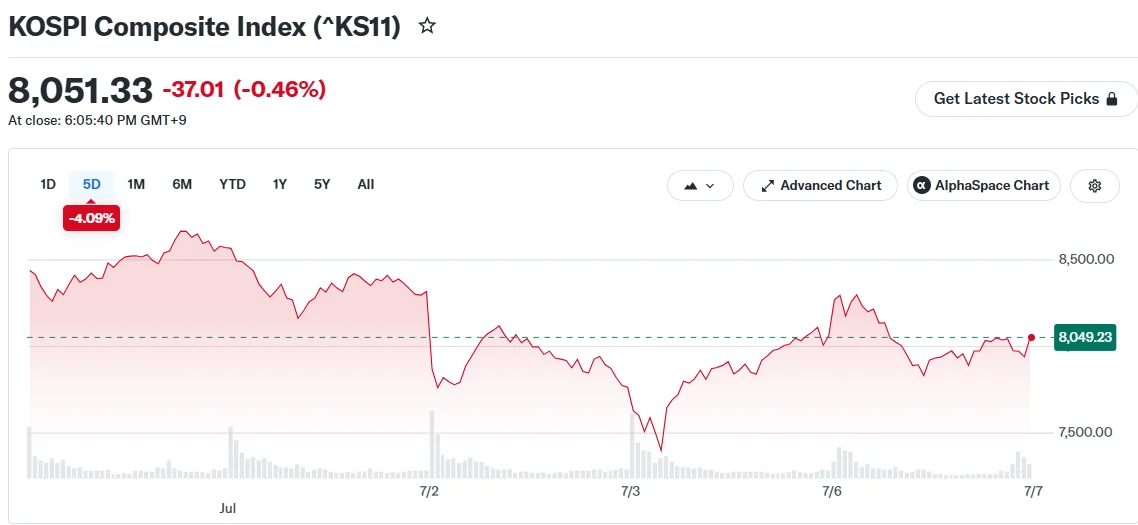
- Seoul’s KOSPI index declined 0.5%, with SK Hynix tumbling more than 4% and Samsung Electronics also retreating
- SK Hynix plans to debut $29 billion worth of American depositary receipts on the Nasdaq exchange
- Goldman Sachs keeps its positive stance on South Korean equities, projecting over 20% gains for the KOSPI within a year
- Declining crude oil prices and reduced geopolitical risks boosted trading sessions in Hong Kong, Indonesia, and India
Technology-focused equity markets across Asia experienced a pullback on Monday as market participants secured profits from semiconductor stocks following their robust recovery during the prior week. The decline was particularly pronounced in South Korean and Japanese markets, both heavily weighted toward chip manufacturers.
Seoul’s KOSPI benchmark concluded trading 0.5% lower, erasing gains from earlier in the session. Tokyo’s Nikkei 225 similarly retreated. Mainland China’s CSI 300 declined 0.6%, whereas Taiwan’s primary index showed minimal movement.
Semiconductor Sector Drives Losses
SK Hynix plummeted more than 4% in Seoul trading, while Samsung Electronics decreased approximately 1.5%. Battery manufacturer LG Energy Solution experienced a nearly 4% drop. MediaTek declined 1.4% in Taipei.
Overseas investors were net sellers of South Korean equities totaling 828.8 billion won during the session. The Korean won depreciated 0.3% versus the U.S. dollar.
Despite Monday’s setback, the KOSPI has surged approximately 86% year-to-date, positioning South Korea as Asia’s top-performing equity market for the first half of 2026. Artificial intelligence memory chip stocks have been the primary catalyst behind these impressive returns.

A notable exception was Hon Hai Precision Industry, commonly referred to as Foxconn. The stock advanced 0.6% following the announcement of record-breaking June and second-quarter revenue, propelled by robust AI server demand. Taiwan Semiconductor Manufacturing also posted modest gains.
SK Hynix is moving forward with plans to list 17.79 million new shares via American depositary receipts on the Nasdaq, representing a transaction worth approximately $29 billion. South Korean President Lee Jae Myung has urged government officials to accelerate implementation of significant chip and AI initiatives unveiled last week.
Bank of America characterized the recent AI stock correction as a repositioning of portfolios rather than a fundamental shift. The financial institution emphasized that artificial intelligence infrastructure spending continues unabated despite investors becoming more discriminating in their selections.
Goldman Sachs Maintains Optimistic Outlook on South Korea
Goldman Sachs reaffirmed its conviction that the KOSPI has more than 20% appreciation potential over the coming 12 months, establishing a price target of 12,000. The investment bank anticipates the rally will expand beyond AI chip manufacturers into energy, materials, and industrial sectors.
Goldman noted that international capital flows are already diversifying toward other AI-related industries and industrial companies. The firm also highlighted that retail investors maintain conservative exposure levels, with Korean households predominantly allocated to real estate and international equities rather than domestic stocks.
The bank projects extraordinary earnings expansion of 320% for 2026, followed by an additional 35% growth in 2027.
Mixed Performance Across Asian Markets
Beyond the chip sector, regional markets displayed stronger performance. Hong Kong’s Hang Seng climbed 0.9%. Indonesia advanced 0.8% while India’s Nifty 50 gained 0.7%.
Falling crude oil prices provided additional market support. OPEC+ approved another production boost for August, maintaining elevated supply forecasts and alleviating inflation worries.
Market participants are now focused on Federal Reserve meeting minutes scheduled for Wednesday release, alongside inflation reports from China, Taiwan, Thailand, and the Philippines. Taiwan’s June trade statistics will be closely monitored for evidence that AI-driven demand continues supporting export activity.
Get 3 Free Stock Ebooks
Discover top-performing stocks in AI, Crypto, and Technology with expert analysis.
- Top 10 AI Stocks - Leading AI companies
- Top 10 Crypto Stocks - Blockchain leaders
- Top 10 Tech Stocks - Tech giants



